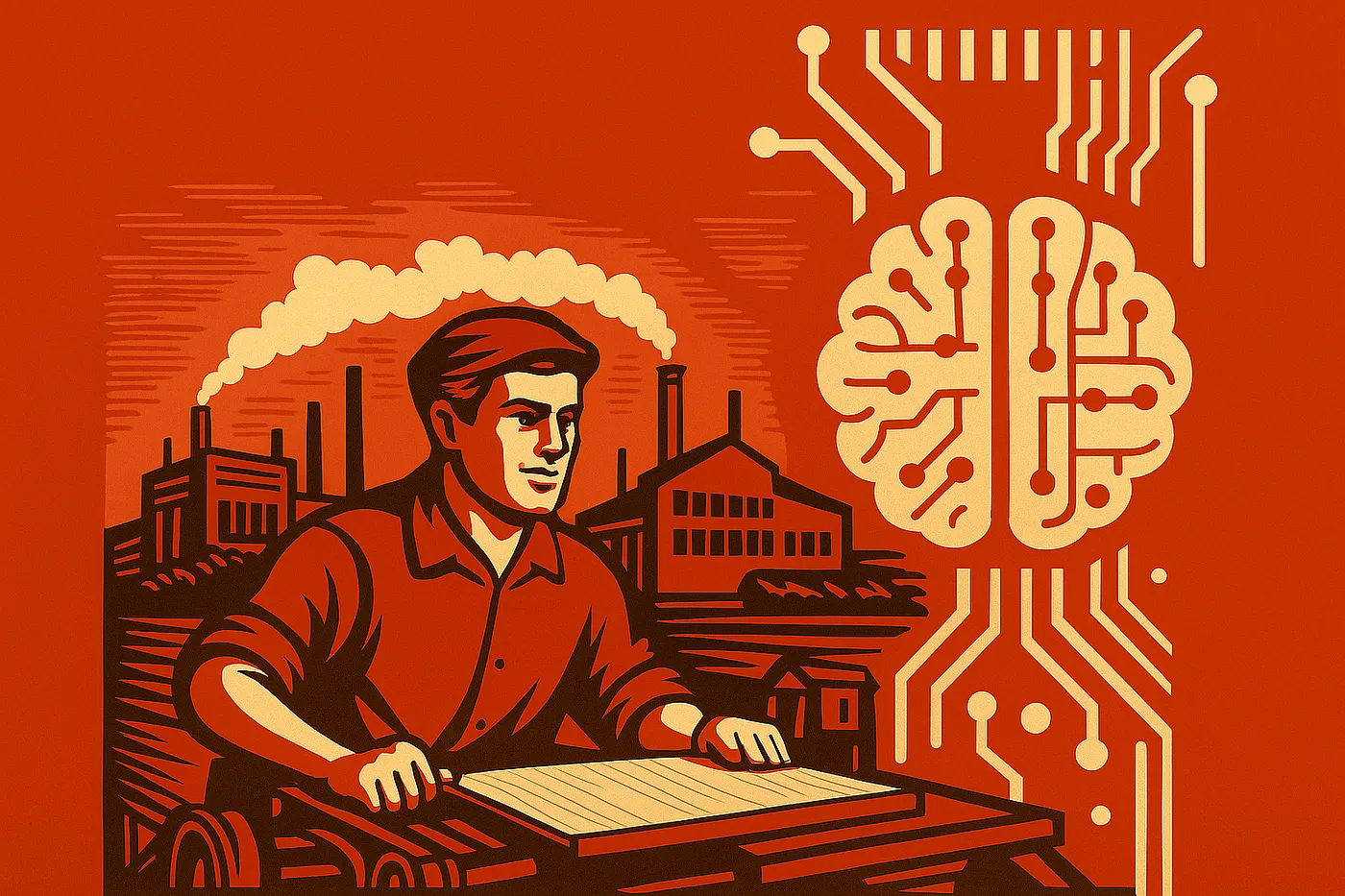
The Complete 75 Year Journey to Perfect Decisions
The Secret Behind Every Smart Decision
Every time your GPS finds the perfect route through traffic, every time Netflix suggests exactly what you want to watch, every time Amazon delivers your package precisely on time, you’re witnessing the culmination of 14 revolutionary breakthroughs that changed how humans make decisions forever.
But it all started on a factory floor in Soviet Russia with a simple question about plywood production.
This is the complete story of the Decision Detectives: brilliant minds who solved humanity’s greatest puzzle one breakthrough at a time. Their discoveries didn’t just change mathematics: they changed how we live, work, and think.
Get ready for the ultimate journey from a Soviet factory floor to quantum computers that can consider infinite possibilities simultaneously.
Breakthrough #1: The Soviet Genius Who Started Everything (1939)
Kantorovich’s Linear Programming Revolution
While the world prepared for war, a 27-year-old Soviet mathematician named Leonid Vitaliyevich Kantorovich received an ordinary consulting request that would change everything.
A local plywood factory asked a simple question: “How do we assign our machines to different jobs to maximize output?”
The Problem: Multiple machines, multiple tasks, varying efficiency rates. The number of possible combinations was astronomical. Factory foremen relied on gut instinct and endless trial-and-error.
Kantorovich’s Breakthrough: Working through the night with just pencil and paper, he discovered that complex resource allocation problems could be solved with simple linear equations. He called it “linear programming”, though computers didn’t exist yet.
His method was elegant:
- Define your goal (maximize production)
- List your constraints (machine capacity, materials, labor)
- Let mathematics find the optimal solution
The Hidden Impact: Kantorovich had discovered the mathematical DNA of modern decision intelligence. Every optimization system today, from Google’s search algorithms to Amazon’s logistics, uses principles he developed on that factory floor in 1939.
Breakthrough #2: The Crisis That Proved It Could Work (1948)
The Berlin Airlift: When the Sky Became a Dashboard
Picture this: Berlin, 1948. Stalin has cut off all roads, railways, and waterways to West Berlin. 2.5 million people are trapped, with maybe 30 days of food left. The only way in? Through the air.
The math was terrifying. Berlin needed 4,500 tons of supplies daily just to survive. Each plane could carry 10 tons maximum. That meant 450 flights per day, every day, using a single runway, in unpredictable weather, with Soviet fighters watching every move.
One mistake meant people would starve.
The Breakthrough: Lieutenant General William Tunner transformed the Berlin Airlift into history’s first real-time optimization system. The sky literally became a dashboard: residents looked up, counting planes and calculating survival odds. Controllers tracked dozens of aircraft simultaneously, optimizing routes, schedules, and cargo distribution in real-time.
The Miracle: By peak operation, planes landed every 90 seconds, 24/7. They delivered not just the minimum 4,500 tons, but regularly exceeded 8,000 tons daily. On Easter Sunday 1949, they delivered 12,941 tons in one day.
The Decision Detectives had proven that Kantorovich’s mathematical optimization could solve impossible real-world problems. The foundation for every smart system you use today was born from desperate necessity in war-torn skies.
Breakthrough #3: The Game Theorist Who Saw Both Sides (1944)
Von Neumann’s Duality: The Two-Sided Mathematics
While Kantorovich optimized resources, John von Neumann tackled an even trickier puzzle: How do you make optimal decisions when other smart people are trying to outmaneuver you?
The Insight: Von Neumann realized that every strategic decision has two perspectives: what you’re trying to maximize and what your opponent is trying to minimize.
The Revolutionary Discovery: Every optimization problem actually contains two connected problems:
- The primal problem: What you’re trying to achieve
- The dual problem: The hidden costs and trade-offs of your constraints
Real-World Magic: This “duality theory” transformed business strategy from guesswork into science. Suddenly, managers could mathematically determine which constraints were truly limiting growth and exactly how much it would be worth to overcome them.
Today’s Impact: Every pricing algorithm, every trading decision, every supply chain optimization uses von Neumann’s dual thinking to find hidden opportunities and bottlenecks.
Breakthrough #4: The Economist Who Found Perfect Balance (1951)
Koopmans’ Equilibrium Theory: The Economic Foundation
Tjalling Koopmans, a Dutch-American economist, solved a fundamental puzzle: In complex systems with millions of individual decision-makers, how do optimal outcomes emerge from seemingly chaotic interactions?
The Breakthrough: Koopmans developed “Activity Analysis”: proving that under the right conditions, free market mechanisms would naturally find the same optimal solutions that linear programming could calculate centrally.
The Revolutionary Insight: You didn’t need a central planner to achieve optimal resource allocation if you had the right price mechanisms and information flows.
The Foundation: Koopmans’ work provided the mathematical foundation for understanding how markets process information and coordinate decisions across millions of participants. His theories explained why price signals could guide individual decisions toward collectively optimal outcomes.
Modern Relevance: Every auction algorithm, every dynamic pricing system, every marketplace optimization relies on Koopmans’ equilibrium principles to balance supply and demand automatically.
Breakthrough #5: The Visionary Who Conquered Time (1957)
Bellman’s Dynamic Programming : Sequential Decision Intelligence
Most early optimization focused on single decisions at one moment. But Richard Bellman at RAND Corporation realized the biggest challenge: How do you make optimal choices when each decision affects all future options?
The Time Problem: Career planning, investment strategies, resource management: all involve sequences of decisions that unfold over time. Bellman called this “the curse of dimensionality”. As problems extend across time, possibilities grow exponentially.
Bellman’s Breakthrough: His “Principle of Optimality” was deceptively simple: work backwards from your goal, determining the optimal choice at each step. Instead of calculating every possible future, solve smaller sub-problems in the right order.
He called it “Dynamic Programming,” and it conquered time itself.
Your Daily Life: Every time GPS recalculates your route, every time your investment app rebalances your portfolio, every time a streaming service pre-loads videos, that’s Bellman’s time-conquering mathematics working invisibly.
Breakthrough #6: The Psychologist Who Embraced Reality (1956)
Herbert Simon’s Bounded Rationality : The Human Reality
While mathematicians developed perfect optimization theories, Herbert Simon asked a crucial question: Do human beings actually make decisions the way mathematical models suggest they should?
The Reality Check: Simon observed that real human decision-making looked nothing like the “rational actor” assumed by economic theory. People don’t calculate every possible option. They don’t have perfect information. They don’t even have unlimited time.
The Breakthrough: Simon introduced “bounded rationality”: the idea that human decision-making is constrained by cognitive limitations, time pressure, and incomplete information. Instead of optimizing perfectly, people “satisfice”. They search for solutions that are good enough.
The Bridge to Practical Systems: Simon’s work explained why pure optimization algorithms often failed in real-world applications. The most successful decision intelligence systems would be those that enhanced human judgment rather than replacing it.
Today’s Impact: Every user-friendly interface, every recommendation system, every AI assistant is designed around Simon’s insights about human limitations and decision-making shortcuts.
Breakthrough #7: The Mathematicians Who Conquered Uncertainty (1955)
Stochastic Programming: Decision-Making Under Uncertainty
All optimization theories so far assumed perfect information. But what happens when you need to make decisions under genuine uncertainty — when you don’t even know what you don’t know?
The Challenge: A farmer decides how much wheat to plant before knowing weather or market prices. A company chooses production capacity before knowing actual demand. Most real decisions involve betting on uncertain futures.
The Breakthrough: George Dantzig and colleagues developed stochastic programming: optimization methods that could handle decisions when key parameters were uncertain or random.
The Solution: Two-stage decision models:
- Here-and-now decisions: Choices you must make before uncertainty is resolved
- Wait-and-see decisions: Actions you can take after learning more information
Modern Applications: Risk management, financial planning, supply chain optimization, emergency preparedness — all use stochastic programming to create robust strategies that perform well across various possible futures.
Breakthrough #8: When Theory Met Practice (1971)
Decision Support Systems : The Computer Revolution
By the 1970s, decision mathematics was sophisticated but theoretical. The computational power to solve real problems didn’t exist. MIT researchers changed everything by creating Decision Support Systems — interactive computers that enhanced human judgment with mathematical analysis.
The Philosophy: Instead of replacing human decision-makers, these systems amplified human intelligence. Managers could explore “what-if” scenarios, examine trade-offs, and understand solution sensitivity.
The Game Changer: The invention of spreadsheet software (VisiCalc, then Lotus 1–2–3, then Excel) democratized optimization. Suddenly, anyone could build models, analyze scenarios, and optimize decisions without programming expertise.
The Revolution: Decision intelligence transformed from academic discipline into practical business tool used by millions daily. Spreadsheets became the gateway drug for optimization thinking.
Breakthrough #9: The Game Theorists Who Completed the Picture (1950–1994)
Nash, Selten, and Harsanyi: Beyond Zero-Sum Strategy
Von Neumann’s original game theory focused on zero-sum situations — one player’s gain balanced another’s loss. But John Nash realized most real-world strategic situations weren’t zero-sum.
Nash’s Breakthrough: The Nash Equilibrium: situations where no player could improve their outcome by unilaterally changing strategy. This revolutionized understanding of everything from business competition to international relations.
Selten’s Addition: Evolutionary game theory: how strategies evolve over time and why some become stable while others disappear.
Harsanyi’s Contribution: Games with incomplete information: strategic decision-making when you don’t know everything about your opponents.
The Completion: Together, their work created a comprehensive framework for strategic decision-making under realistic conditions, transforming game theory from mathematical curiosity into practical tool for business strategy and competitive analysis.
Breakthrough #10: The Algorithm That Proved It Could Be Done (1979)
Khachiyan’s Ellipsoid Algorithm: Theoretical Breakthrough
For forty years after Kantorovich’s discovery, linear programming remained somewhat mysterious. Everyone knew it worked in practice, but no one could prove it would always work efficiently in theory.
The Problem: Problems might require exponential time to solve, making large applications computationally impossible.
Khachiyan’s Breakthrough: The Soviet mathematician proved that linear programming problems could always be solved in polynomial time: meaning solution time grew predictably with problem size, not explosively.
The Significance: While Khachiyan’s ellipsoid algorithm was rarely used in practice, his theoretical breakthrough was crucial. It proved that optimization was computationally feasible even for very large problems.
The Guarantee: This gave decision intelligence the theoretical foundation it needed to tackle complex real-world applications with confidence.
Breakthrough #11: The Algorithm That Actually Delivered (1984)
Karmarkar’s Projective Scaling: The Practical Revolution
While Khachiyan proved efficiency was theoretically possible, Narendra Karmarkar at Bell Labs delivered it practically. His projective scaling algorithm could solve linear programming problems 50–100 times faster than previous methods.
The Commercial Revolution: Karmarkar’s algorithm made it economically feasible to optimize systems that were previously impossible: airline scheduling with millions of variables, telecommunications network routing, financial portfolio optimization, global supply chain management.
The Transformation: This breakthrough transformed decision intelligence from academic exercise into commercial necessity. Companies that could solve larger optimization problems faster gained decisive competitive advantages.
The Foundation: Karmarkar’s work became the launching pad for the optimization revolution that would follow.
Breakthrough #12: The Methods That Scale Infinitely (1990s)
Interior Point Methods: Modern Optimization Evolution
Building on Karmarkar’s insights, researchers developed interior point methods that could solve optimization problems of unprecedented size and complexity — millions of variables and constraints simultaneously.
The Capability: These algorithms made real-time optimization possible for the first time. Problems that once took hours could be solved in seconds.
Real-World Applications:
- GPS navigation systems calculating optimal routes in real-time
- Internet routing protocols optimizing data transmission
- Financial trading systems processing millions of transactions
- Supply chain systems coordinating global logistics
The Infrastructure: Interior point methods became the invisible infrastructure powering modern life. Every optimized system you interact with likely uses these algorithms under the hood.
Breakthrough #13: When Machines Learned to Decide (2000s)
Machine Learning Meets Decision Intelligence: The Convergence
The most dramatic breakthrough came when machine learning merged with optimization theory. For the first time, systems could both learn from data AND optimize decisions simultaneously.
The Revolution: Algorithms began discovering optimal strategies through trial and error, combining human insight with computational power at unprecedented scale.
Reinforcement Learning: Systems could now learn optimal decision rules that human experts never imagined, improving performance through experience.
Real-World Magic:
- Algorithmic trading systems processing millions of transactions per second
- Recommendation engines predicting preferences with supernatural accuracy
- Autonomous vehicles optimizing routes while learning from experience
- Smart grids balancing energy supply and demand in real-time
The New Reality: Every major tech platform now uses automated decision intelligence operating at the speed of computation rather than human thought.
Breakthrough #14: The Quantum Future (2020s)
Quantum Decision Theory: The Final Frontier
The ultimate frontier involves quantum computers that can theoretically consider all possible solutions simultaneously, exploring possibilities that classical computers could never handle.
The Promise: While classical computers examine solutions sequentially, quantum systems could explore astronomical numbers of possibilities in parallel, finding optimal choices for problems with virtually unlimited variables.
The Potential Applications:
- Drug discovery optimizing molecular interactions
- Climate modeling with unprecedented complexity
- Financial risk management across global markets
- Artificial intelligence systems that learn and optimize simultaneously
The Reality: Still largely experimental, but early results suggest quantum optimization could solve problems that would take classical computers longer than the age of the universe.
The Future: Quantum decision intelligence represents the next evolutionary leap: from optimizing known possibilities to exploring infinite potential futures.
The Revolution Is Complete (And Just Beginning)
What the 14 Breakthroughs Achieved
In 75 years, these brilliant minds transformed human decision-making from intuitive guesswork into mathematical science. Each breakthrough built upon the last:
- Berlin Airlift proved optimization could solve impossible logistics
- Kantorovich discovered the mathematical foundation
- Von Neumann added strategic thinking with duality
- Koopmans showed how markets naturally optimize
- Bellman conquered time-based decisions
- Simon brought human psychology into the equation
- Stochastic Programming handled uncertainty
- Decision Support Systems made it practical
- Nash, Selten, Harsanyi completed strategic theory
- Khachiyan proved theoretical feasibility
- Karmarkar delivered practical speed
- Interior Point Methods enabled global scale
- Machine Learning convergence created intelligent optimization
- Quantum Theory promises infinite possibilities
Your Optimized Life
Every smart system you use daily carries forward these 14 breakthroughs. From war-torn Berlin to quantum frontiers, the goal remained the same: helping people make better choices to create better lives.
The Hidden Victory: The Decision Detectives solved the mystery of optimal choice. They automated the art of decision-making. They gave humanity mathematical superpowers for navigating complexity.
The Future? Even more optimized, even more intelligent, even more perfectly suited to human flourishing.
The revolution is complete. The optimization continues. And every decision gets a little bit smarter.
What optimal choice will you make next?
Ready to experience the future of decision-making today? Othor AI transforms complex data into actionable insights in just 30 seconds — no coding, no waiting, no complexity.