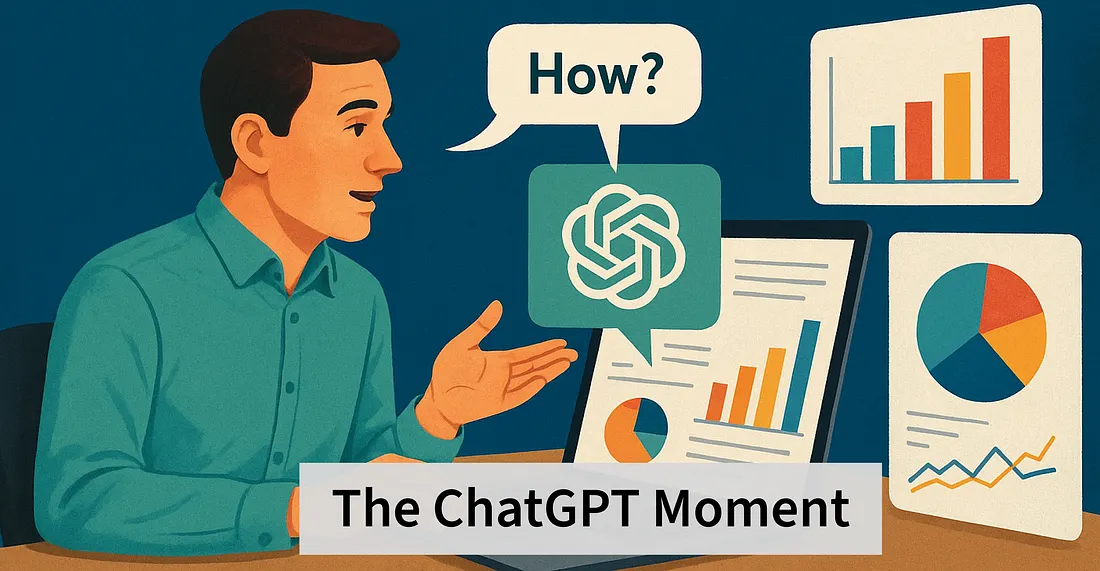
How the breakthrough in conversational artificial intelligence is revolutionizing how we interact with data, making complex analytics as simple as asking a question, and ushering in the era of truly democratized business intelligence
The Journey to Conversational Intelligence
Our “Data Detectives” journey began with Herman Hollerith’s punch cards saving the 1890 U.S. Census, continued through Alan Turing’s pattern recognition breaking the Enigma code, witnessed American Airlines’ SABRE system creating real-time business intelligence, discovered Walmart’s Pop-Tarts phenomenon revealing hidden supply chain patterns, and saw Netflix’s million-dollar algorithm revolutionize personalization. We explored how Moneyball challenged century-old assumptions with analytics, watched Target’s pregnancy predictions cross ethical boundaries, witnessed Cambridge Analytica weaponize data against democracy, and saw COVID-19 dashboards democratize data literacy worldwide. Each breakthrough built toward a single goal: making data insights accessible to everyone. Now, that goal has been achieved.
The Breakthrough That Changed Everything
On November 30, 2022, OpenAI released ChatGPT to the public. Within five days, it had reached one million users. Within two months, it had 100 million active users, making it the fastest-growing consumer application in history. But ChatGPT’s impact extended far beyond consumer adoption — it fundamentally transformed how humans interact with information and established natural language as the new interface for data analysis.
For decades, business intelligence required specialized skills. Analysts learned SQL to query databases, mastered complex dashboard interfaces, and translated business questions into technical specifications. Data insights remained locked behind technical barriers that limited access to a small group of trained professionals.
ChatGPT shattered this paradigm. Suddenly, asking questions of data became as simple as having a conversation. No coding required. No dashboard navigation needed. Just plain English questions receiving sophisticated analytical insights in return.
This wasn’t merely a technological advancement — it was the democratization of data analysis itself, fulfilling a promise that had been decades in the making.
The Evolution Toward Conversational Analytics
The path to conversational business intelligence began long before ChatGPT’s release. Search engines had trained users to expect instant answers to questions. Voice assistants like Siri and Alexa had established natural language as a legitimate interface for technology. COVID-19 dashboards had created mass data literacy and appetite for real-time insights.
But previous attempts at natural language analytics had been frustratingly limited. Early systems could handle simple queries like “What were sales last quarter?” but struggled with nuanced requests like “Why did our customer acquisition cost increase in the Northeast, and what factors might be contributing to this trend?”
ChatGPT’s breakthrough came from its ability to understand context, handle ambiguity, and engage in multi-turn conversations about data. Users could ask follow-up questions, request clarifications, and explore analytical threads naturally — just as they would with a human analyst.
The implications became clear immediately: if anyone could ask sophisticated questions in plain English and receive expert-level analytical insights, then business intelligence was no longer limited by technical literacy. The bottleneck had been removed.
The Democratization Revolution
ChatGPT’s release triggered an immediate transformation in how organizations approach data analysis. Within months, businesses across every industry began integrating conversational AI into their analytics workflows, creating unprecedented access to data insights.
Executive Decision-Making: C-level executives, traditionally dependent on analysts to prepare reports and presentations, could now directly interrogate company data. Questions like “What’s driving our churn rate increase?” or “Which markets show the strongest growth potential?” became instantly answerable without waiting for analyst availability or report scheduling.
Sales Team Empowerment: Sales representatives gained real-time access to customer insights, market trends, and performance analytics. Instead of requesting reports from marketing teams, they could instantly ask, “Which prospects in my pipeline are most likely to close this quarter?” and receive data-driven answers.
Operational Intelligence: Frontline managers could analyze operational data in real-time, asking questions like “Why is productivity lower on Tuesdays?” or “What maintenance patterns predict equipment failure?” without needing technical training or analyst support.
Customer Service Analytics: Support teams could instantly access customer behavior patterns, satisfaction trends, and resolution effectiveness data through simple conversational queries, improving service quality and response times.
The Technical Revolution Behind the Scenes
While users experienced ChatGPT as simple conversation, the technical achievement behind conversational analytics represented decades of advancement in artificial intelligence, natural language processing, and data integration.
Large Language Models (LLMs) like GPT had learned to understand context, intent, and nuance in human language. They could translate business questions into technical queries, execute complex analytical operations, and present results in accessible formats.
Integration platforms began connecting conversational AI to enterprise data systems, allowing natural language queries to access real-time information from databases, APIs, and cloud platforms. The technical complexity of data access became invisible to users.
Advanced prompt engineering enabled conversational systems to understand business context, industry terminology, and organizational specifics. AI could learn company-specific metrics, understand departmental priorities, and provide insights relevant to particular roles and responsibilities.
Real-time processing capabilities meant that conversational analytics could provide instant responses to complex questions, making data exploration as fluid as human conversation.
From Business Intelligence to Business Conversation
Perhaps most significantly, ChatGPT transformed business intelligence from a formal, structured process into an ongoing conversation with data. Traditional BI followed predictable patterns: request → analysis → report → presentation → decision. Conversational analytics enabled fluid, exploratory dialogue with data that more closely resembled human thinking processes.
Users could follow analytical threads naturally, asking “Why?” and “What if?” questions that led to deeper insights. They could test hypotheses, explore scenarios, and iterate on ideas without formal project structures or technical overhead.
The conversation paradigm also enabled collaborative analytics. Teams could share conversational sessions, building on each other’s questions and insights. Data exploration became a social activity rather than an individual technical task.
Quality control evolved as well. While early adopters worried about AI accuracy, sophisticated systems began providing confidence levels, citing data sources, and explaining analytical reasoning. Users learned to verify important insights while relying on AI for initial exploration and hypothesis generation.
The Future of Data Interaction
As we conclude our journey through the evolution of business intelligence — from Hollerith’s punch cards to ChatGPT’s conversational analytics — we can see a clear trajectory toward increasingly accessible, democratic, and human-centered data interaction.
Each breakthrough in our “Data Detectives” series solved a fundamental challenge: Hollerith automated manual counting, Turing revealed hidden patterns, Walmart created predictive insights, Netflix personalized recommendations, Moneyball questioned conventional metrics, Target raised ethical questions, Cambridge Analytica demanded regulatory response, and COVID dashboards democratized data literacy.
ChatGPT represents the culmination of this evolution: business intelligence that requires no technical training, no specialized interfaces, and no formal analytical processes. Just questions and answers, as natural as human conversation.
The Lessons for Modern Business
Accessibility drives adoption: The most powerful technology becomes truly valuable only when it’s accessible to everyone who needs it, not just technical specialists.
Conversation is the universal interface: Natural language interaction removes barriers between human thinking and data insights, enabling more intuitive and productive analytics.
Democratization multiplies impact: When analytical capabilities expand from dozens of specialists to thousands of users, the organizational impact grows exponentially.
Human + AI collaboration defines the future: The most effective analytical workflows combine human curiosity and business judgment with AI’s processing power and analytical speed.
The Continuing Evolution
The ChatGPT moment teaches us that the ultimate goal of business intelligence isn’t more sophisticated dashboards or complex algorithms — it’s making data insights as accessible as human conversation. When anyone can ask any question of any dataset and receive expert-level analytical insights instantly, the boundary between human thinking and data analysis disappears.
Today, as conversational AI capabilities continue advancing toward multimodal interaction, real-time learning, and autonomous analysis, we’re entering an era where business intelligence becomes indistinguishable from business conversation. The future belongs to organizations that embrace this conversational paradigm and empower every employee to become their own data detective.
From Herman Hollerith’s mechanical tabulator to ChatGPT’s conversational intelligence, the story of business intelligence has been a journey toward democratization, accessibility, and human empowerment. The data detectives of tomorrow won’t need technical training or specialized tools — they’ll just need curiosity and the ability to ask good questions.
The revolution is complete. The conversation has just begun.
About This Series
“Data Detectives” has explored the fascinating evolution of business intelligence through history’s most captivating moments. Each post connected groundbreaking historical achievements to modern BI capabilities, showing how today’s conversational analytics evolved from yesterday’s innovations.
From punch cards to AI conversations, the journey reveals a consistent theme: the most transformative breakthroughs are those that make powerful capabilities accessible to more people. As we enter the age of conversational business intelligence, that democratization is finally complete.
Business Intelligence Conversational AI Data Democracy Future of Analytics