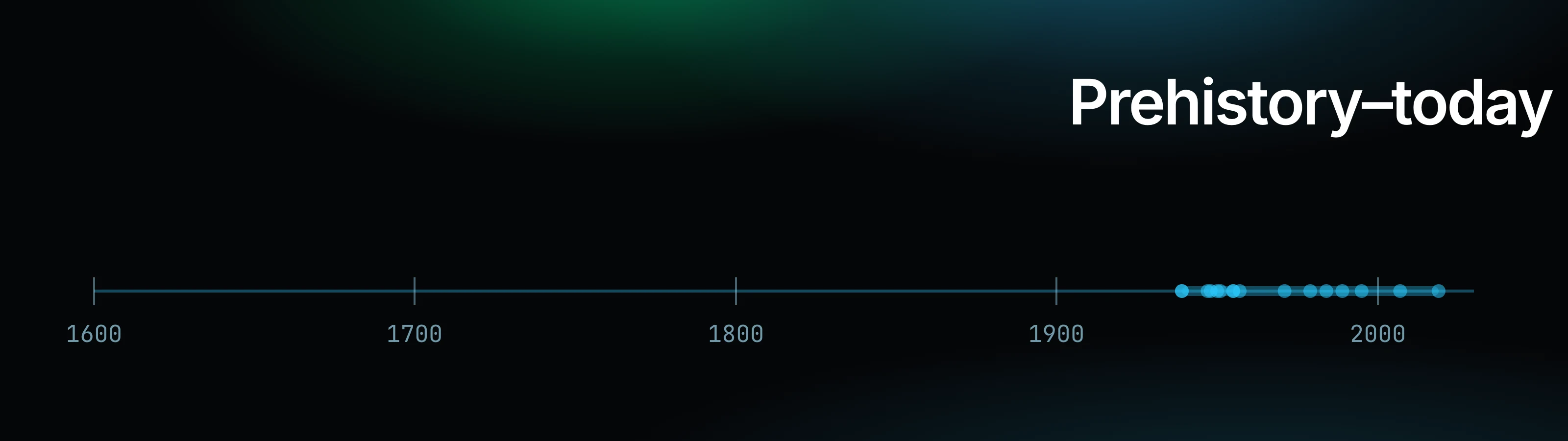
People have always made decisions from whatever signals they could gather. This is the long story of how that became business intelligence and decision intelligence, in the order it happened. It is the place to start for the history of decision intelligence on this blog.
01Prehistoric Foundations (10,000+ BCE)
Early humans made survival decisions from observation and pattern. Hunter-gatherers followed animal migrations, the seasons and the places food could be found: the first data collection and analysis. Groups whose leaders read those signals well had an advantage.
02Early Civilizations and Record-Keeping (3500–500 BCE)
Writing appeared in Mesopotamia in the late fourth millennium BCE, and much of the earliest writing is accounting: Sumerian clay tablets record harvests, stores, rations and trade. Egyptian administrators kept their own detailed records on papyrus.
In ancient China, under the Zhou dynasty (1046–256 BCE), the I Ching (the Book of Changes) became a guide that rulers and officials consulted before decisions. Its 64 figures are made of broken and unbroken lines, which the philosopher Leibniz, centuries later, compared with binary numbers.
03Classical Antiquity: Systematizing Knowledge (500 BCE–500 CE)
The Greeks formalised logical thinking: Aristotle’s syllogisms set out how to draw a conclusion from premises, a way of reasoning that has shaped argument, including business argument, ever since. Roman administrators ran censuses and tax collection across a vast empire.
04Medieval Period: Guild Knowledge and Early Trade Networks (500–1400 CE)
Medieval guilds kept the knowledge of their crafts, their markets and their prices, a store of specialist information. The Hanseatic League linked trading towns across northern Europe, and with them a steady flow of letters about prices, cargoes and credit.
05Renaissance and the Birth of Modern Commerce (1400–1600)
Italian merchants developed double-entry bookkeeping, the foundation of modern financial records: accounts kept this way survive from Genoa in 1340, banks like the Medici used it, and Luca Pacioli set it out in print in 1494. Venetian and Genoese merchants spread the risk of sea voyages through partnerships and early marine insurance.
06The Scientific Revolution and Enlightenment (1600–1800)
The scientific method changed decision-making by putting observation and tested hypotheses first. Probability theory began in the letters between Blaise Pascal and Pierre de Fermat in 1654, and changed how uncertainty could be measured, in business as everywhere else.
07Industrial Revolution: Mechanization of Decision Support (1800–1900)
The industrial age brought systematic ways of running operations. From the 1880s, Frederick Taylor timed and measured work in factories, the start of what he later called scientific management. Herman Hollerith’s tabulating machines counted the 1890 US census, the first large use of automated data processing; his company later became part of IBM.
08Early 20th Century: Statistical Process Control (1900–1950)
In 1924, Walter Shewhart, at the Western Electric laboratories that soon became Bell Labs, drew the first control chart, which separates the ordinary variation in a process from a real change worth acting on: the beginning of statistical quality management. W. Edwards Deming took those ideas around the world, most famously to Japan after 1950, and showed how statistics could drive excellent manufacturing.
09The Computer Age Begins (1950–1970)
The first business computer programs ran in the early 1950s: in 1951 LEO (Lyons Electronic Office), in Britain, began running a bakery’s valuations, and later its payroll. In 1958, Hans Peter Luhn at IBM published “A Business Intelligence System”, giving the phrase the meaning it has today: a system that sends each person the information they act on.
10The Birth of Database Management (1970–1985)
In 1970, Edgar Codd at IBM proposed the relational database, which made complex questions of data possible. IBM researchers developed the query language that became SQL, and Oracle, founded in 1977, sold the first commercial relational database built on it.
11Decision Support Systems Emerge (1970–1995)
The term “decision support systems” was set out by G. Anthony Gorry and Michael Scott Morton at MIT in 1971. In the 1980s, executive information systems gave senior leaders their own summary screens. In the 1990s, Bill Inmon (1992) and Ralph Kimball (1996) set out how a data warehouse could bring a company’s scattered data together.
12The BI Explosion (1995–2010)
Business intelligence went mainstream with tools like Business Objects, Cognos and MicroStrategy, which put reports and analysis in the hands of business users. Robert Kaplan and David Norton’s balanced scorecard (1992) tied measures to strategy.
Online analytical processing (OLAP), named by Codd in 1993 and sold in products such as Arbor Software’s Essbase (later part of Hyperion), let people “slice and dice” their figures across many dimensions to find trends.
13Big Data Revolution (2010–2015)
The growth of digital data changed business intelligence again. Google published its approach to processing data across many machines in 2004, and the open-source Hadoop, which followed it, let companies process enormous amounts of data cheaply. Web companies built systems that could analyse data at a scale few had attempted.
14The Rise of Decision Intelligence (2015–Present)
Decision intelligence emerged as a field that joins data science with the study of how people actually decide, from behavioural economics and psychology. Cassie Kozyrkov, Google’s chief decision scientist, helped popularise the idea that analysis should be built around the decision it serves.
Decision intelligence brings together:
- Predictive analytics: what is likely to happen
- Prescriptive analytics: what we should do about it
- Models of how people really decide, biases included
- Ethical frameworks: which values should guide the decision
15The Current Landscape
Today’s decision intelligence tools include:
- Systems that compare many possible scenarios before recommending an action
- Analytics that combine human judgment with what machine learning finds
- Designs that allow for the biases people bring to decisions
- Methods that look for causes, not only correlations
16Future Directions
Where decision intelligence seems to be heading:
- Systems that watch continuously and raise what needs a decision, rather than waiting to be asked
- Better ways for people and AI to decide together
- Decision tools that give people on the front line the analysis that only head office used to have
- Guardrails that keep automated decisions in line with human values
17Conclusion
From reading animal tracks to decision intelligence, the story is one long effort to choose better. What began with watching migrations has become systems that sift vast amounts of data to suggest a way forward.
The organisations that do best will balance the power of algorithms with human judgment, using machines to strengthen our natural abilities and to cover for our known blind spots.
The rest of this history takes the story one breakthrough at a time, starting with Kantorovich and linear programming in 1939; From a plywood factory to AI tells it in one piece.
First published on blog.othor.ai, 7 Mar 2025; revised 23 Nov 2026.