In this history of decision intelligence we’ve traced a long road: Dantzig’s simplex method of 1947, von Neumann’s duality, Nash’s game theory, the first decision support systems and, most recently, Khachiyan’s ellipsoid algorithm, which proved in 1979 that linear programming could be solved efficiently in theory. Yet a frustrating gap remained: Khachiyan’s method, elegant as it was, was usually slower than the old simplex method on real problems.
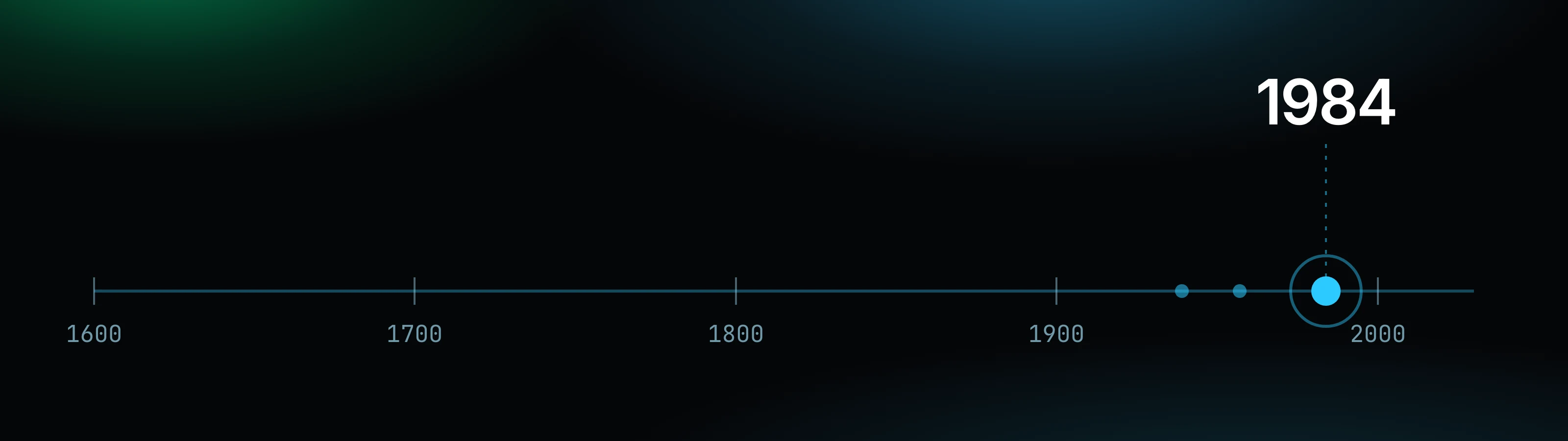
This paradox, efficiency in theory without improvement in practice, left the field in an unusual position. It had proof that efficient algorithms existed, but not the speed. Enter Narendra Karmarkar, a young mathematician at Bell Labs whose 1984 projective scaling algorithm finally bridged the gap, with both a theoretical guarantee and real speed on large problems.
01The Practical Performance Paradox
By the early 1980s, the field faced an uncomfortable situation. Khachiyan’s ellipsoid algorithm had given the proof everyone wanted: linear programming could be solved in “polynomial time”, meaning the work grows at a predictable rate with the size of the problem, not explosively.
But when people implemented the ellipsoid method, they found a disappointing reality: on practical problems it was usually far slower than the simplex method. So the proof brought confidence, while the daily work went on with the older method, whose worst case had never been tamed.
The paradox showed a real difference in computing: how an algorithm behaves as problems grow without limit is one thing; how it behaves on the problems people actually have is another. For the field to move forward, someone needed an algorithm with Khachiyan’s guarantee and much better speed in practice.
02Karmarkar’s Revolutionary Insight
Narendra Karmarkar came to Bell Laboratories in the early 1980s. Bell Labs, with its culture of turning theory into working systems, was the right place to take on the paradox Khachiyan’s work had left.
Karmarkar’s breakthrough came from a different geometric idea. Khachiyan’s method closed in on the answer by shrinking ellipsoids around it. Karmarkar’s method moved through the inside of the region of possible answers rather than along its edges: the first of what became known as interior-point methods.
The key innovation was projective scaling: a transformation that reshapes the problem at every step so that the next step can make good progress. It kept the polynomial-time guarantee Khachiyan had established.
Karmarkar published his method in 1984 and reported that on large problems it ran much faster than the simplex method. The claims were debated at first, and the comparison depended on the problem and the software. But the idea held: within a few years, interior-point methods built on it were matching and often beating the simplex method on large problems.
03The Corporate Strategy Application
To see why this mattered, consider airlines, whose planning problems are among the largest linear programs in business.
An airline has to decide which aircraft flies which route and which crews work which flights, under rules on rest, qualifications and bases, across thousands of flights a day. Written as linear programs, these problems have hundreds of thousands of variables and limits, and solving them faster means solving larger, more realistic versions, or solving them again when plans change.
Faster methods for large linear programs made it practical to plan crews and fleets with more of the real rules included, and to re-plan when disruptions hit. Interior-point methods became one of the tools for that work.
04The Public Sector Applications
Electricity planning is another domain with very large optimization problems. A utility has to decide how much each plant generates and how power moves through the network, within the limits of the lines, the rules of regulators and the demand it expects.
When those problems take a long time to solve, planners simplify them or solve them rarely. Faster methods let planners keep more of the real detail (transmission limits, environmental rules, maintenance schedules) and solve again as conditions change, moving from a plan made once a year to plans updated as the year goes on.
05The Technical Innovation: How Projective Scaling Works
While our focus is practical, the idea itself is worth seeing. The key is to reshape the problem at every step so that it stays easy to make progress.
The simplex method walks along the edges of the region of possible answers, from corner to corner, until it finds the best one. Khachiyan’s ellipsoid method shrinks ellipsoids around the answer. Karmarkar’s approach moves through the interior of the region, using projective transformations that “stretch” the problem so that each step can head firmly towards the best answer.
Projective scaling ensures that each step makes real progress while keeping the polynomial-time guarantee. That combination, practical speed with a proof behind it, resolved the paradox that had stood since Khachiyan.
For practitioners, the most important property is how the method scales. The number of steps an interior-point method needs grows slowly with the size of the problem, which is why these methods do especially well on very large problems.
06From Bell Labs to Commercial Revolution
The path from Karmarkar’s research to everyday use shows how a mathematical idea becomes business value. His work came from an industrial laboratory, with real telecommunications planning problems in view.
AT&T, Bell Labs’ parent, built the method into its own optimization system, and the commercial optimization software industry followed with interior-point solvers of its own. Over time, commercial packages came to offer both simplex and interior-point methods, letting users choose the better one for each problem.
This created a virtuous cycle: better algorithms made larger applications possible, which created demand for still better algorithms, through the 1990s and beyond.
07The Computational Infrastructure Revolution
Karmarkar’s algorithm arrived at a good moment in computing history. The late 1980s and the 1990s brought rapid gains in computing power, memory and numerical software, and interior-point methods were well placed to use them.
The simplex method relies on many small, sequential steps that are hard to spread across processors; interior-point methods spend their time on large matrix calculations, which map naturally onto the faster and parallel hardware that was arriving. Algorithm and hardware moved forward together.
The result was that problems once reserved for the largest computers came within reach of ordinary ones, and optimization moved into more parts of more organisations.
08The Academic and Industrial Response
Karmarkar’s breakthrough set off a wave of research that continues today. Mathematicians, computer scientists, operations researchers and engineers developed many variants of interior-point methods, each suited to different kinds of problem.
The industrial response followed. As solvers grew faster, uses that had been too slow or too costly became worthwhile, and the market for optimization software grew with them.
09Beyond Linear Programming: The Broader Impact
Karmarkar’s algorithm was about linear programming, but the interior-point idea reached much further. Extensions to quadratic programming, semidefinite programming and general convex optimization followed, each keeping the good properties of the interior-point approach.
That had real consequences for decision intelligence. Problems in finance, engineering design and logistics that had been out of reach became solvable, and optimization replaced rules of thumb in places that had relied on them.
Today, portfolio optimization with transaction costs and robust optimization under uncertainty are routinely solved with interior-point methods descended from Karmarkar’s work.
10The Ethical Dimension: Democratizing Optimization Power
Faster methods also spread who could use optimization. Before interior-point methods and cheaper computers, large-scale optimization belonged mostly to organisations with big computing budgets and specialists to match. As solvers improved, smaller organisations could use it too.
That raised questions of fairness and access: organisations that used these methods well gained real advantages in cost and speed, which pushed whole industries to adopt them. Understanding that pattern helps explain why mathematical research keeps turning into competitive advantage.
11The Modern Legacy: Interior-Point Methods Today
Today’s optimization landscape bears the clear mark of Karmarkar’s 1984 breakthrough. Interior-point methods are standard parts of commercial optimization software, and the ideas he introduced still guide new methods.
Supply chain planning, portfolio management, resource allocation and strategic planning all rely on solvers whose speed owes much to his work. On-demand computing has widened that reach again, putting large optimization within the budget of almost any organisation.
12Conclusion: When Theory Meets Practice
Narendra Karmarkar’s projective scaling algorithm is a turning point in the history of decision intelligence, where theory and practical invention came together. Khachiyan had given the proof; Karmarkar made efficient linear programming real for everyday problems.
His contribution reminds us that the most useful advances often bridge what is possible in theory and what works in practice. His algorithm didn’t just make solving faster; it opened new kinds of problems to optimization.
The pattern he set (a theoretical insight, then a practical breakthrough, then wide adoption) still describes how mathematical ideas become business value. Karmarkar’s example asks us to value both rigour and speed: the most useful decision tools have both.
13References
- Karmarkar, N. (1984). A new polynomial-time algorithm for linear programming. Combinatorica, 4(4), 373–395.
- Wright, S. J. (1997). Primal-dual interior-point methods. SIAM.
- Lustig, I. J., Marsten, R. E., & Shanno, D. F. (1994). Interior point methods for linear programming: Computational state of the art. ORSA Journal on Computing, 6(1), 1–14.
- Vanderbei, R. J. (2020). Linear programming: Foundations and extensions. Springer.
- Terlaky, T. (Ed.). (1996). Interior point methods of mathematical programming. Springer.
First published on blog.othor.ai, 3 Jun 2025; revised 23 Nov 2026.