Indigo Thread Co., the invented textile company we test Othor AI on, closed April 2026 with net revenue of ₹4.66 Cr. In March it had been ₹5.23 Cr. A fall of ₹0.57 Cr in one month, almost 11%. On a monthly review slide, that is a red number and a hard conversation.
It is also the best April the company has had.
01Every April falls
March is the end of the Indian financial year. Invoices are pushed out, targets are chased, and the month runs high. April starts the new year from a standing start. Put the company's last thirty-one months side by side and the shape repeats: March is the year's high, April falls from it, and August dips every year too.
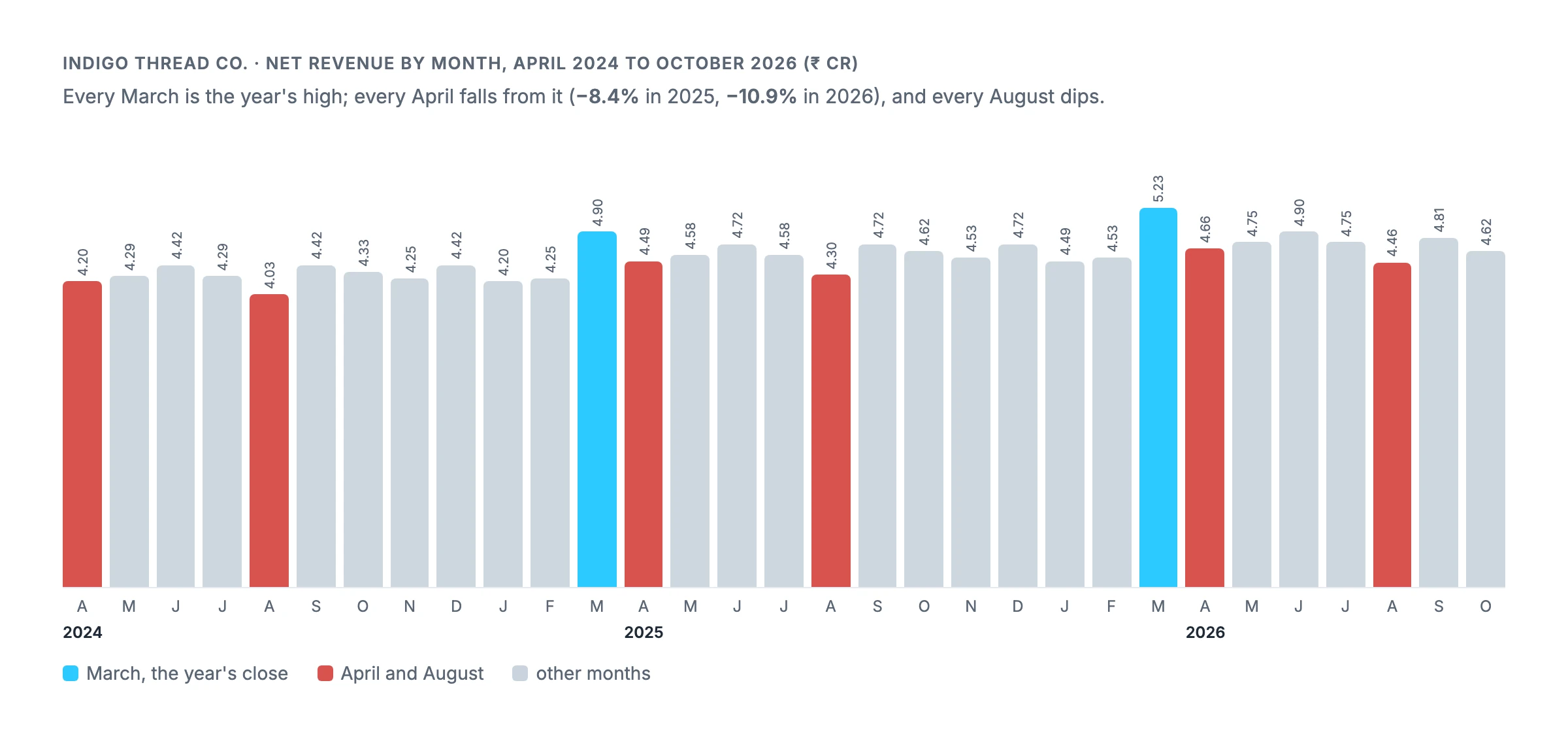
That repeating shape has a name: seasonality. A number with a season can't be read against the month before it, because the month before belongs to a different part of the year. A fall from March to April says more about the calendar than about the business.
02Compared with what?
The fairer question is how this April did against other Aprils. Against April 2025, April 2026 was up ₹0.17 Cr, or 3.8%. The same number, read two ways, tells two opposite stories.
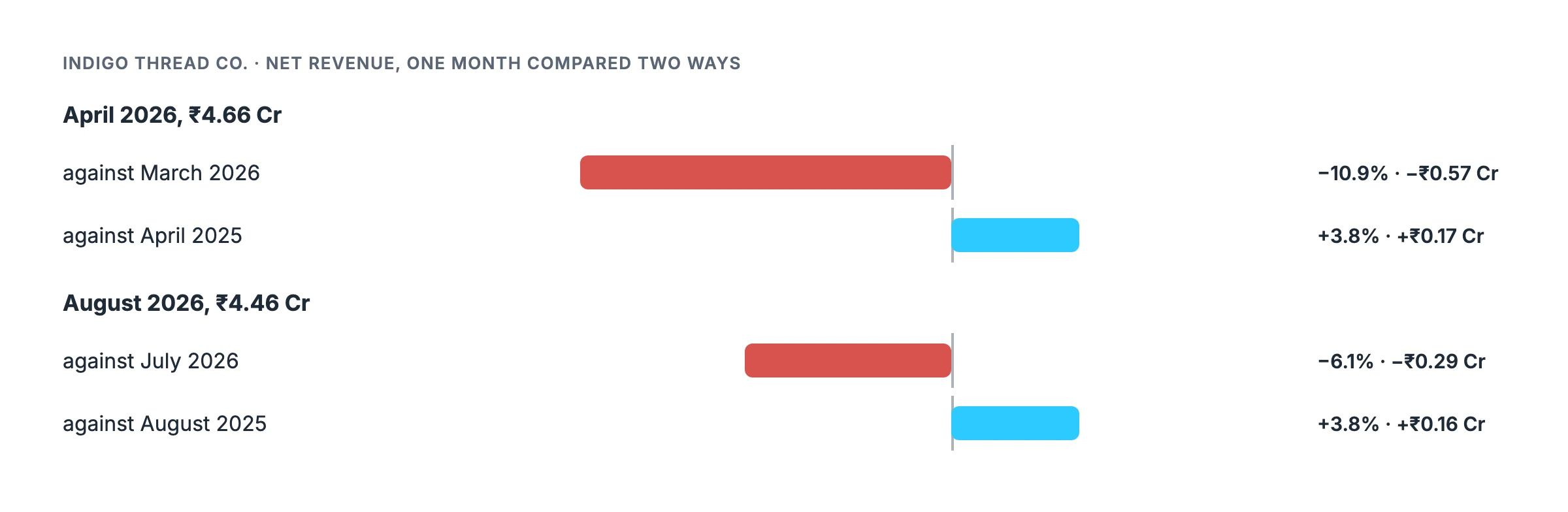
August says the same. It fell 6.1% from July in 2024, in 2025 and again in 2026, and in 2026 it was still 3.8% above August 2025. (The company's Surat plant also shuts from 10 to 24 August every year.) Anyone who panics every August is reacting to the calendar.
"Same month last year" is a good habit, but not a complete one. It ignores growth: if a business grows 4% a year, an April that is merely flat against last April is a weak April. And it breaks around anything that moves.
03Seasons that move
Diwali follows the lunar calendar, so the festive week lands anywhere from mid-October to mid-November. The sample company's festival week, as its invented records date it, was the week of 1 November in 2024, 20 October in 2025 and 19 October this year. A festive week that sits in November one year and October the next makes October look strong one year and weak the next, with nothing changing in the business. The quarter-end push behaves the same way at a smaller scale: the last five days of every quarter run hot, and the first days after them run cold.
A calendar can't know these. The owner can.
04How Othor AI looks at it
Othor AI never compares a number only with the month before. Each night it forecasts the number's next period with a likely range, and once a monthly number has two full years of history, that forecast learns the shape of the year: which months run high and which run low. It tries a few ways of forecasting and keeps one only if it would have beaten the plainest fair guess, the same month last year, over the last twelve months. Each number is then compared with its own range for that time of year.
For seasons that move, the owner tells it once. Known patterns live in the Business Model: the sample company's festival week with its date each year, the quarter-end push, the Surat shutdown. The shutdown began as a question on Home, and became a known pattern when the owner answered "same dates every year" on 28 October. From then on, those weeks are left out when Othor AI learns what normal looks like, so one festive week doesn't teach it a false normal, and anything they would have raised is set aside and shown instead of hidden.
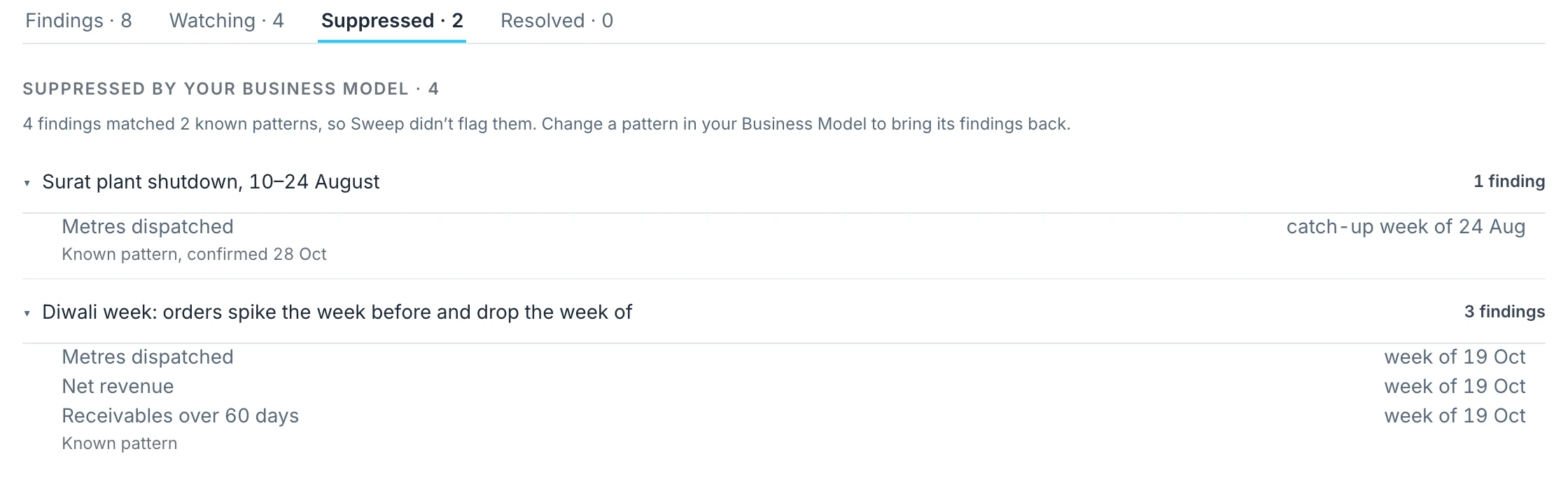
On the morning of 1 November, the Leadership brief showed metres dispatched for the week of 19 October at 40% above its range, and the tile said why: "Diwali week", the sample company's festival week (19 Oct). No alarm went out. The net revenue tile beside it, 1% below its range for October, was treated as news, because nothing known explains it.
05What to take from it
Before reacting to a fall, ask which part of the year it is being compared with. Compare a month with its own kind, allow for growth, and write down the weeks you already know are different. Othor AI does all three every night, so an April is judged as an April, and a festive week is judged as a festive week.