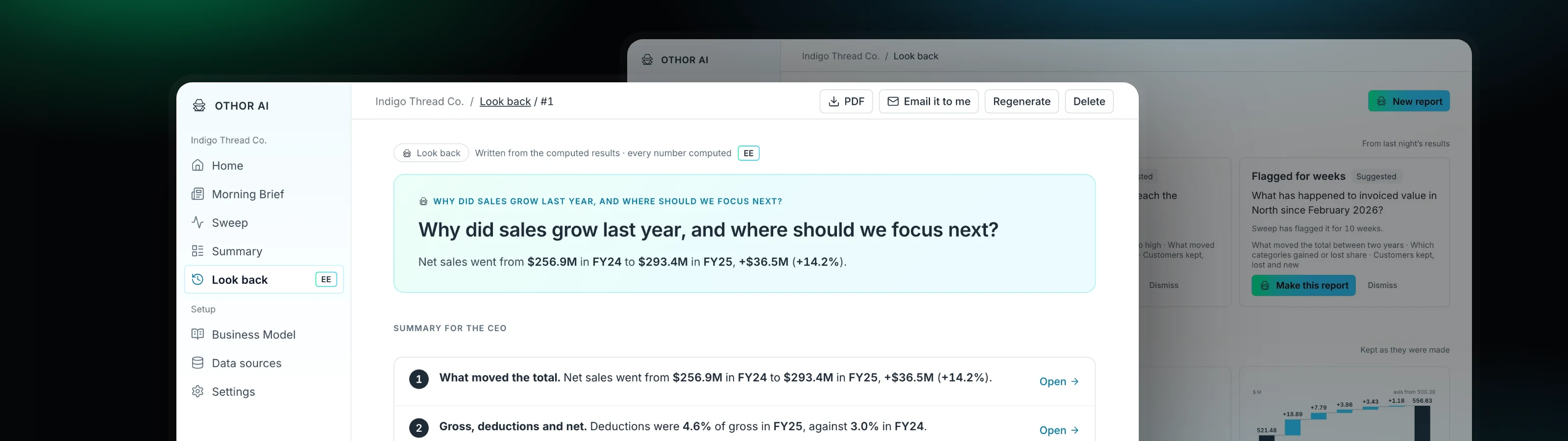
The Morning Brief looks at last night. Sweep looks at the last few weeks. But some of the most useful questions an owner asks are about a whole year, after it has closed: why did we grow, where did the money actually come from, and what should we plan for next? Look back is the part of Othor AI that answers those questions with a report you can act on.
01One question in, one report out
You start with a question in your own words. "Why did FY26 grow?" "What moved our margins this year?" "How should we budget next year?"
Othor AI turns the question into a plan: which data it will read, which period, and which analyses it will run, each in a plain line. Nothing runs until you apply the plan. If the plan reads the wrong table or the wrong window, you change it first. That one step is where you stay in charge of what the report is about.
Then code does the work. The model never invents a figure: it picks from a fixed set of analyses that code runs, and it writes the words around the results. Any sentence that carries a number code didn't compute is dropped before you see it.
02Where the change came from
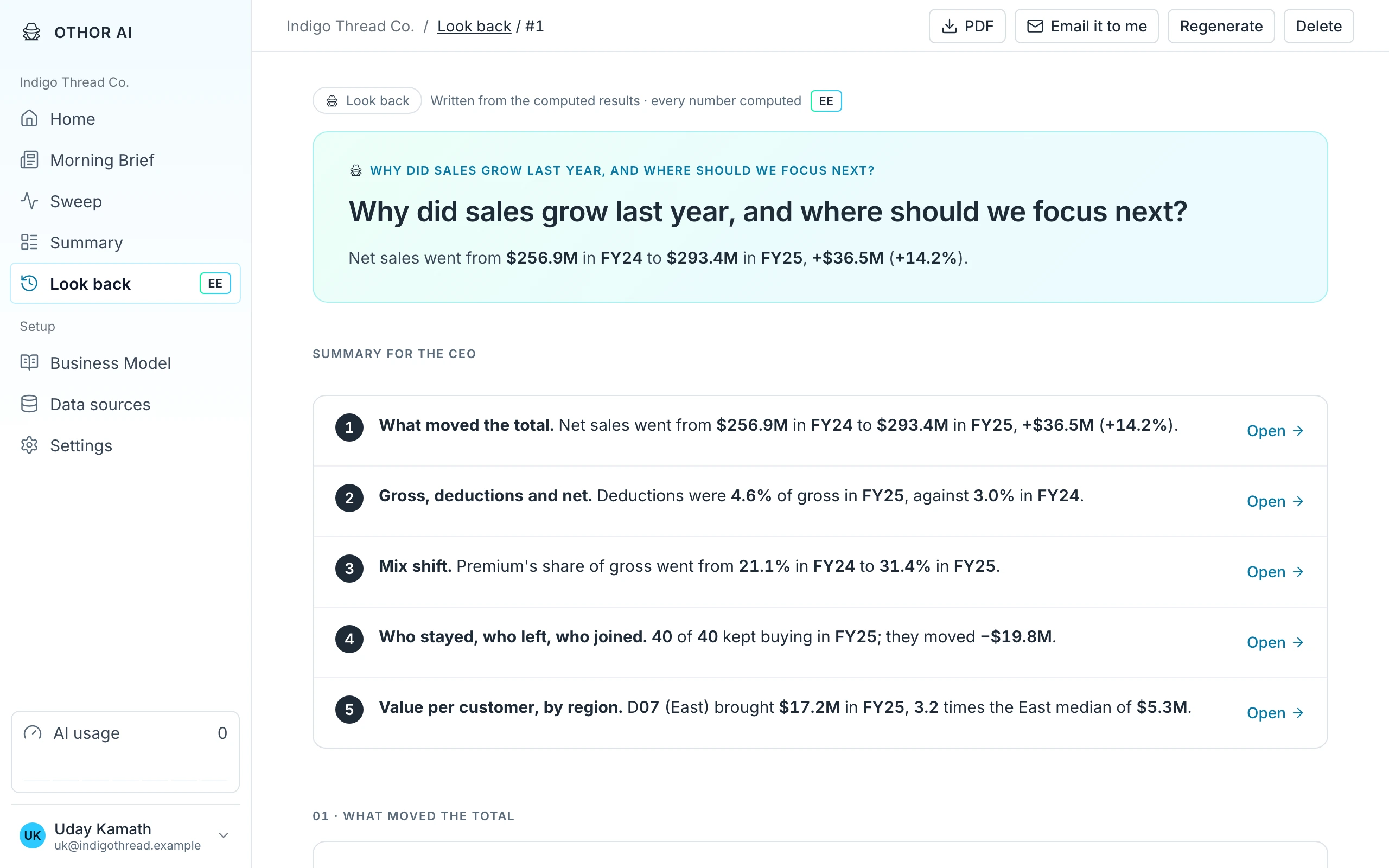
A Look back report opens with how much things changed, and then breaks the change apart. The analyses come from the questions a good finance head would ask in a year-end review:
- The bridge: last year's total, then each region, product or channel's push up or pull down, then this year's total, as a waterfall.
- Gross, deductions, net: whether returns or credit notes are hiding under a healthy-looking net figure.
- Mix shift: which categories, products or regions gained share and which lost it, even when the total looks steady.
- Who stayed, who came, who left: customers or partners kept, new and lapsed, and the value each group carried.
- Yield: value per customer or per partner across regions, with the outliers named.
- Concentration: how much rests on your top few customers, and whether that is growing.
- Scenarios for a budget: a low, middle and high case built up from the run-rate, the churn, the new names and the one-off items.
When one group drove most of the change, the report goes a level deeper into it on its own: not just "the North grew", but which part of the North, and how much of the growth that part explains.
03What you might have missed
Two sections go beyond the question you asked.
What outside moved checks the year against outside signals Othor AI already tracks, such as exchange rates, and tests whether they explain any of the change. If your export sales are in dollars, the rupee's year is part of your year. It is shown as an extra, never as the headline: what the business did comes first. Signals that don't hold up are listed as tested, with no link found.
What Othor AI would have caught replays the nightly checks month by month over the past year, and lists what the Morning Brief would have flagged, and when. It is the plainest answer we know to "would this have helped us?"
04It suggests reports before you ask
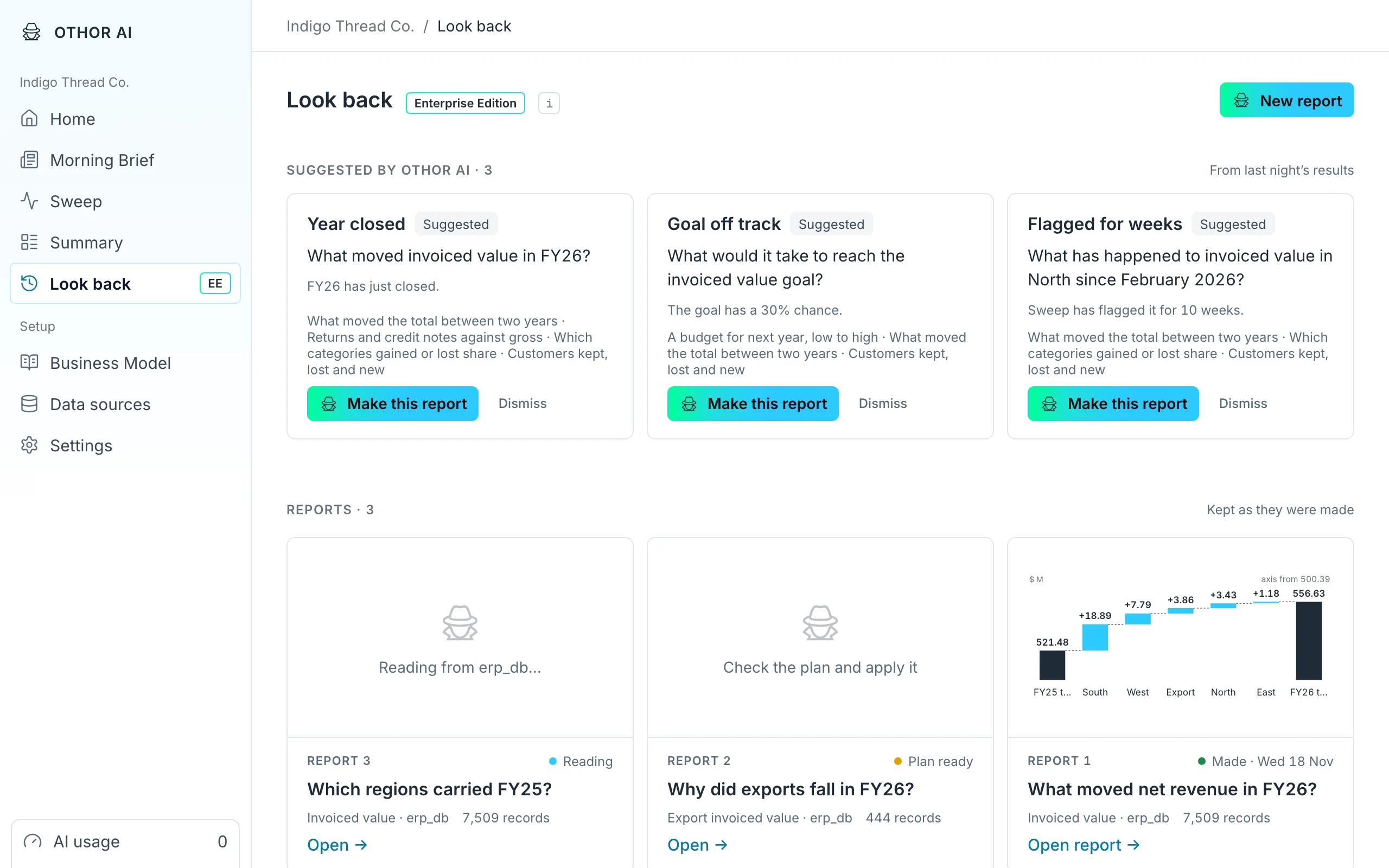
On your connected data, Look back doesn't wait for a question. After each nightly run, it proposes up to three reports worth making: a quarter or a year that just closed, a finding that has stayed open for weeks, a mix that has been shifting for months, a goal that's off track. Code picks each one from the night's results; the model only words the question. Make this report opens the plan, already filled in, and Apply is the second click.
05A report you can trust next year
A Look back report is frozen once made. It keeps its question, its plan, the data it read and the version of your business model it used, so its numbers come out the same if it is run again, byte for byte. Regenerate writes new words over the same numbers; reading the data again makes a new version beside the old one, never over it.
It ends honestly: what the data held, its gaps and oddities, and the questions worth confirming with your team. A question the data can't answer gets a plain "can't tell, because", not a guess.
You can read it in the app, download it as a PDF, or get it by email. It runs on your connected sources, or on a spreadsheet of past sales you upload once, without connecting anything.
Look back is part of the Enterprise Edition, and included on Hosted. Try it on the sample company, Indigo Thread, and ask it why last year went the way it did.