
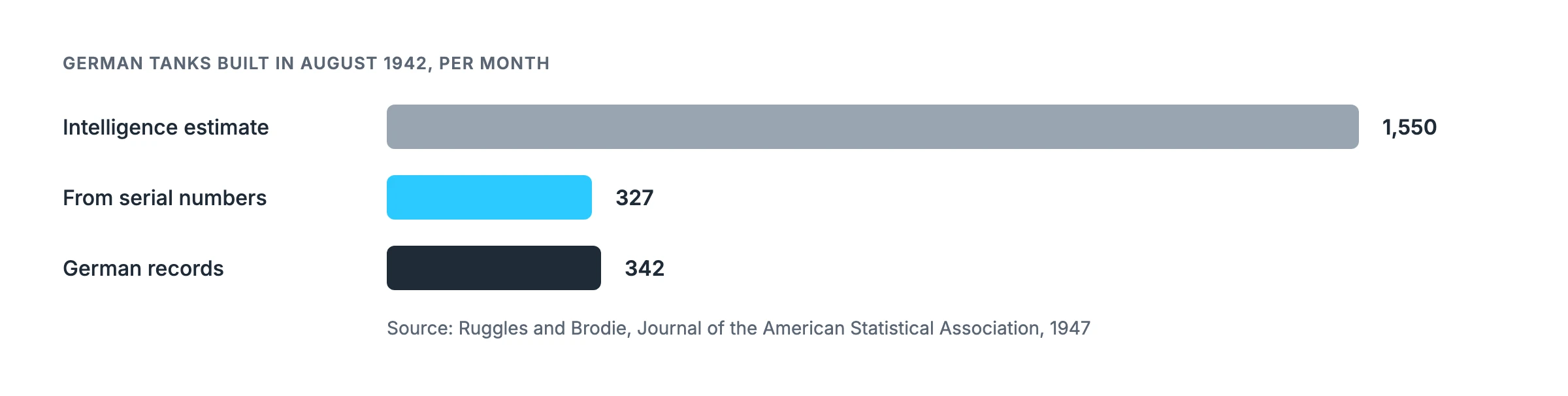
In the Second World War, the Allies needed one number badly: how many tanks Germany was building each month. Spies, prisoners and aerial photographs all gave answers, and the answers were large. For August 1942, the intelligence estimate was 1,550 tanks a month.
Allied economists tried something duller. Every German tank carried serial numbers, stamped in order at the factory, on its chassis, engine, gearbox and even its road wheels. Whenever a tank was captured or destroyed, someone wrote the numbers down.
01What the numbers said
From the serials they had seen, they estimated how many must exist. For August 1942 they said 327. After the war, Germany's own production records were found. The real figure was 342.
| Month | Intelligence estimate | From serial numbers | German records |
|---|---|---|---|
| June 1940 | 1,000 | 169 | 122 |
| June 1941 | 1,550 | 244 | 271 |
| August 1942 | 1,550 | 327 | 342 |
02How a few numbers tell you the total
The idea is simple enough to do on paper. If you have seen a few serial numbers at random, the highest one is a fair floor for the total, and the gaps between the ones you saw tell you how far past it the total probably runs. Say you have seen four tanks, numbered 19, 40, 42 and 60. The highest is 60, and on average the numbers are spread 15 apart (60 divided by 4). So the best estimate is 60 plus 15, less one: 74 tanks.
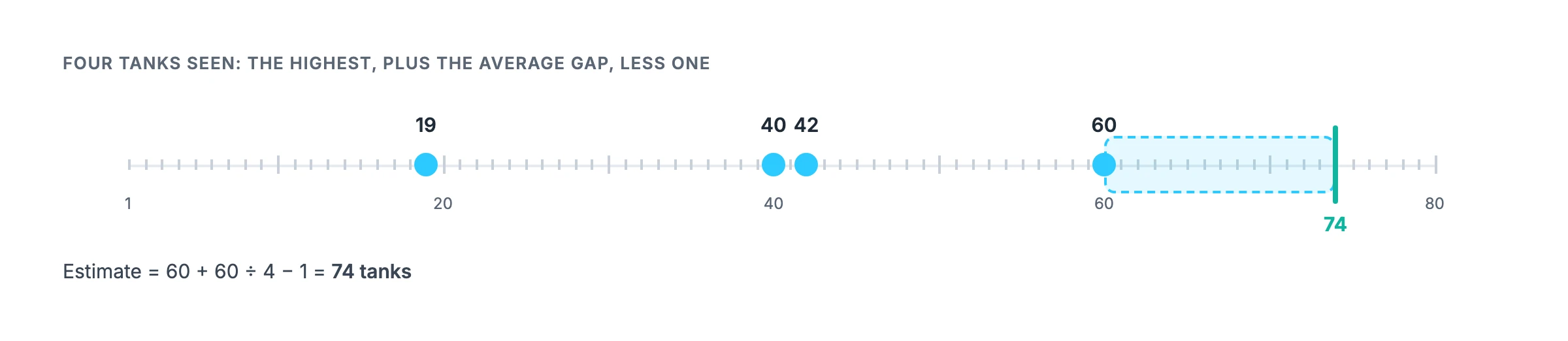
The estimate used nothing but what had actually been seen, and it was close. The intelligence figures came from what people said, and in each of the three months they were four to eight times too high.
03The lesson
Count what you can see before you trust a guess.
04In your numbers
This is how Othor AI works with a company's numbers. Every figure in a brief is counted from the records in your own systems, read in place, never estimated by a model. On the sample company's night of 1 November, it counted 14 customers still marked active in the books who haven't invoiced in more than 90 days. Together they bought ₹3.6 Cr in the last twelve months. Nobody had guessed that number; it came from the invoices.
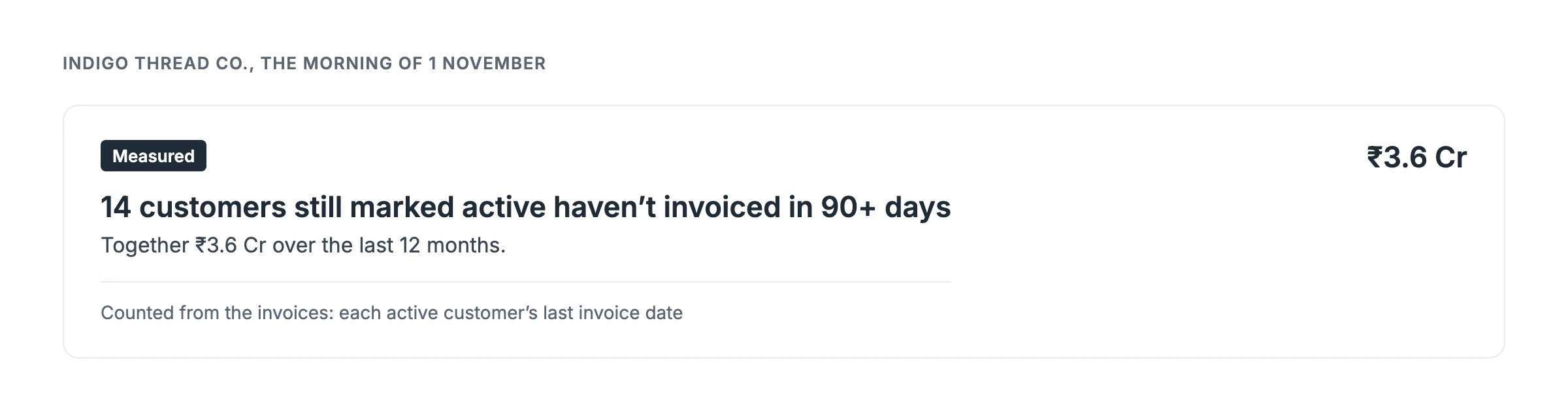
Behind each figure is how it was made: the definition, the query that read it and the night it was computed. Like a serial number, it can be checked.
05Sources
Richard Ruggles and Henry Brodie, “An Empirical Approach to Economic Intelligence in World War II”, Journal of the American Statistical Association, vol. 42, no. 237 (1947), pp. 72–91.