At a glance
Beautiful answers, to the questions you bring.
AI-native tools turn a question into a chart, a notebook or a small app in seconds. Othor AI is not a builder: it decides what to look at, tests every number every night, and reports by 6:00 AM.
Compared hereJulius · Hex
AI-native analytics tools
Julius · Hex
Ask in plain words and get a polished chart, notebook or app in seconds. Quick and good-looking; each answer is a new build on the question asked.
AI usageHuman effortIntelligence you getCode does the work
Every night it tests every confirmed number and breakdown with 11 checks, and by 6:00 AM the brief says what matters, how sure it is, and who to ask.
AI usageHuman effortIntelligence you get Maximised
01 · What it does well
From a questionto a polished answer.
Julius
Connect a database and ask in plain words; Julius writes the query and draws the chart. Notebooks can run on a schedule and share the result.
Hex
Threads answers plain-language questions on your warehouse and models, and the Notebook Agent writes SQL, Python and charts. Every answer is backed by a project you can open, and an agent can run on a schedule to email or post fresh answers.
Fast to start
No dashboard project: a few prompts give a team something good to look at the same day.
Open to inspect
Both show the query or code behind a chart, so an analyst can check and change it.
02 · Where it stops
Each answer isa new build.
The question sets the scope
A scheduled notebook re-runs what someone built. It doesn’t go through every number and breakdown to find what nobody asked about.
AI writes the code
The code behind each answer is drafted by a model on the day. The same result from the same data each time isn’t stated.
How sure isn’t said
A chart shows what happened. It doesn’t grade a finding as Measured, Assessed or Not determinable, or say who can explain it.
Usage drives the bill
AI work uses credits or a plan’s limit, so more questions mean more spend.
03 · Side by side
AI-native tools and Othor AI, question by question.
| The question | AI-native tools | Othor AI |
|---|---|---|
| Who decides what to look at | You, by asking; or whoever built the scheduled notebook | Nobody has to. Every confirmed number and every breakdown of it is tested. |
| What runs every night without anyone | Scheduled notebooks and agents re-run what someone set up | From 2:00 AM: read what changed, compute every number, run 11 checks. The Morning Brief arrives by 6:00 AM. |
| How many numbers and breakdowns get tested | What each question or notebook covers | Every confirmed number and every breakdown of it, with all 11 checks, corrected so chance doesn’t pass as a finding. |
| Says how sure it is | Not graded | On every finding: Measured, Assessed or Not determinable, with the question to ask and of whom. |
| Where numbers come from, and does the same data give the same numbers | Queries and code a model writes for each answer, which you can open and check | Code, never a model. The same data gives the same numbers, and any night can be replayed exactly. |
| AI bill as use grows | Per seat, with AI credits or limits; more questions use more | Small and flat. A model drafts the setup once ($0.61 for our sample company); the nightly run uses none; smoother wording for each brief is optional, about 1¢ a morning. |
| Data access | A connection to your database or warehouse, or files you upload | A login that can only read, in place. Results are kept, not copies of your tables. Personal columns are never read. |
| Effort each week | Asking and checking answers; keeping the notebooks that run on a schedule | About 1 min each morning to read the brief, and a few taps on Home. |
| Open source, or on your servers | Not open source; runs on the vendor’s cloud (Hex offers a single-tenant option) | The open core is open source (Apache-2.0). Hosted on othor.ai, or on your own servers. |
04 · An example
A few customers, carrying more and more.
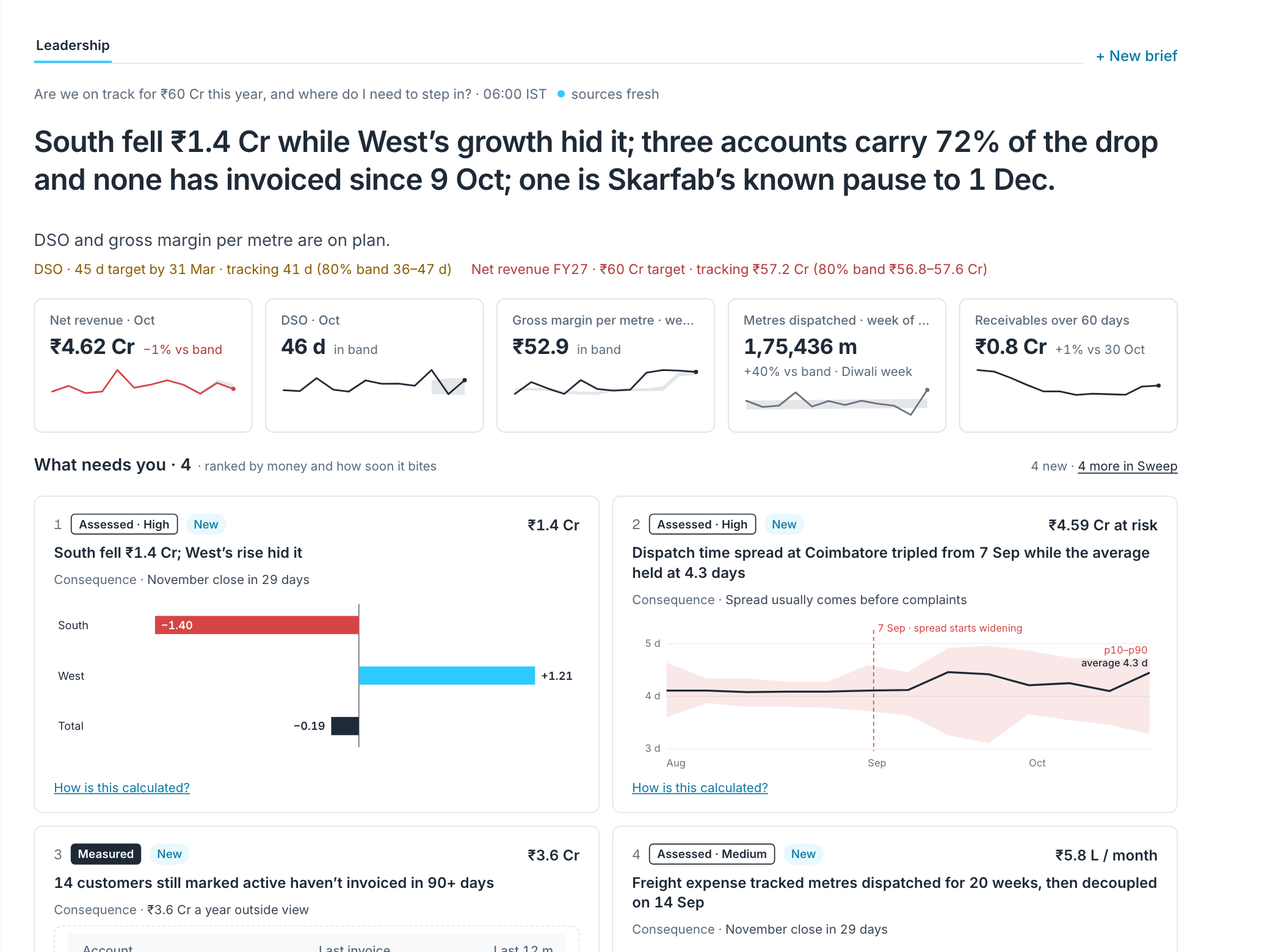
Morning Brief · Indigo Thread Co.
A few customers carry most of the order book, and their share is risingMeasured
Found byA few names carrying most of the value
From the brief of Othor AI’s invented sample company.
Why a chat-to-chart tool would likely miss it
Revenue was growing, so the chart looked good. The risk was in who it came from, a question nobody had typed. Othor AI measures how concentrated every confirmed number is, every night, and says when the share is rising.
05 · Use both
Build with them. Be briefed by Othor AI.
Your data team keeps its notebooks and apps; the owner gets the brief.
Julius or Hex for
Deep dives, one-off analyses and apps your data team builds and shares.
Othor AI for
What runs whether anyone asks or not: every confirmed number tested every night, and the brief by 6:00 AM with how sure each finding is.
Othor AI
Get the brief, not another build
Start a 14-day free trial; the first brief arrives the morning after you connect a source.
Other comparisons
The other ways, side by side with Othor AI.
- 01BI with an AI copilotDashboards your team builds, now with an assistant that answers questions and writes summaries. Strong for exploring; it looks where someone pointed it.Compare
- 02Chat AI on your dataUpload a file or connect a drive and ask anything; it writes and runs code to answer. Brilliant for a question you have; it waits for the question.Compare
- 03Automated insights and anomaly alertsMachine learning watches the metrics you choose and alerts you when one moves. The closest to Othor AI; the difference is what gets watched and what each alert tells you.Compare
- 04The analyst and spreadsheet wayAn analyst or consultant in Excel or Google Sheets, now faster with AI for formulas and charts. Judgement you trust; only the numbers someone has time for.Compare
Compared as of November 2026, from each vendor’s public documentation. Products change, and some features depend on the plan. Tell us if something here is out of date.
Excel is a trademark of Microsoft Corporation; Google Sheets is a trademark of Google LLC; Python is a trademark of the Python Software Foundation; Julius and Hex are trademarks of their respective owners. All other names are trademarks of their respective owners. Othor AI is not affiliated with or endorsed by them.