Two professions have spent a century answering the question “should anyone be told about this?”, and they answer it with different words. Statisticians ask whether an effect is significant: whether it is unlikely to be chance. Auditors ask whether it is material: whether it is large enough, in money or in meaning, to change a reasonable person’s decision.
The words sound alike and are often used as if they meant the same thing. They don’t. With enough data, almost any difference becomes statistically significant, including differences too small to matter to anyone. And a difference large enough to matter can fail every significance test, because the business it sits in is noisy.
This post follows both ideas to their sources, from a brewer at Guinness to the US Supreme Court and the auditing standards, and then shows how Othor AI keeps the two questions apart every night: what each gate does, where the money figure comes from, why the order of the gates matters, and what the gates don’t do.
01Two things nobody needs to hear
Imagine two lines in a Monday report.
The first says that sales of a small product line stepped down six weeks ago, and that the step is statistically certain: the chance of a pattern like this arising by luck is well under one in a thousand. It is entirely true. It is also worth about ₹42,000 a week, or ₹2.5 lakh so far, in a company that turns over ₹5 crore a month.
The second says that one large customer’s orders swung by ₹38 lakh this month. That is a lot of money. But this customer has always ordered in lumps, and swings like it have happened many times before with nothing behind them. No test can tell this month’s swing apart from the customer’s ordinary ups and downs.
Which line should reach the owner at six in the morning? Neither, on its own terms. The first is real but small. The second is large but not shown to be real. A brief that carried both would be half noise and half trivia, and its reader would learn within a week that nothing in it needs acting on.
Most reporting tools never face this choice, because they never test anything: they show numbers and let the reader decide. A system that tests every number and every breakdown every night has to decide what to say, and it has to decide two questions at once. Is it real? Does it matter?
02The statistician’s word: significant
The habit of calling a result “significant” when its p-value falls below 0.05 goes back to Ronald Fisher’s Statistical Methods for Research Workers (1925). Fisher wrote that it was “convenient” to take the point at which a deviation would arise by chance about once in twenty trials as a limit for judging whether it was worth taking seriously. He meant a working convention for scientists running experiments, not a rule of nature. It became one anyway: journals, regulators and textbooks turned “p < 0.05” into a pass mark.
A p-value answers a narrow question. Suppose nothing is going on: no real change, no real difference. How often would chance alone produce data at least as extreme as what we saw? A small p-value says “not often”. That is all it says. It doesn’t say how big the effect is, or whether the effect is worth anything. And it depends on two things at once: the size of the effect, and the amount of data.
The second is the one that matters for a business. Give a test enough data and it will detect almost any difference, however small, because the noise in an average shrinks as the sample grows while the effect stays put. The psychologist Paul Meehl, crediting his colleague David Lykken, called the background of tiny, real, uninteresting correlations the “crud factor” (1990): in a big enough sample, nearly everything is related to nearly everything else, a little.
A well-known teaching example is the Physicians’ Health Study of aspirin and heart attacks, which enrolled about 22,000 doctors. Its result was so clear that the aspirin arm was stopped early in 1988, yet the share of the variation in outcomes that aspirin explained was about one tenth of one percent (Sullivan and Feinn use it in 2012 to argue that “the P value is not enough”). That small effect was still worth acting on, because heart attacks are serious and aspirin is cheap. The point is that the p-value didn’t tell you so. The judgement came from somewhere else.
Statisticians have warned about this for decades. Roger Kirk called practical significance “a concept whose time has come” in 1996. In 2008 the economists Stephen Ziliak and Deirdre McCloskey published The Cult of Statistical Significance, a book-length record of research in economics, medicine and psychology treating “significant” as if it meant “important”. And in 2016 the American Statistical Association took a formal position on a matter of statistical practice for the first time (Wasserstein and Lazar). Its fifth principle reads: “A p-value, or statistical significance, does not measure the size of an effect or the importance of a result.”
For a nightly brief this is not an academic quarrel. On the night of 1 November, the eleven checks ran 360 tests on the sample company we build Othor AI on. At the usual 5% line, about eighteen of them would look like findings by chance alone if nothing at all were going on. Even after a strict correction, the results that survive will include effects that are perfectly real and perfectly unimportant. Significance is necessary. It isn’t enough.
03A brewer’s question
There is an irony in the history. The t-test, one of the most used significance tests in the world, was invented to make money decisions.
William Sealy Gosset joined Arthur Guinness and Sons in Dublin as a brewer in 1899. Guinness ran experiments on barley, hops and brewing methods, always with small samples, because every trial cost real barley and real time. Gosset worked out how to judge such small samples and published the method in 1908 as “The probable error of a mean”, under the pen name “Student”, because Guinness let its scientists publish only without their names.
Ziliak’s reading of Gosset’s notebooks and letters (“Guinnessometrics”, 2008) argues that Gosset never thought of his test as a pass mark. The question he cared about was a business one: is the gain from switching to this barley large enough, and sure enough, to pay for the switch? How much certainty he needed depended on what was at stake. A cheap change with a big expected gain could go ahead on modest odds; an expensive one needed better odds.
Abraham Wald made the idea formal in Statistical Decision Functions (1950): a decision under uncertainty should weigh the chance of each outcome by what each outcome costs. Significance tells you about the chance. Something else has to tell you about the cost.
04The auditor’s word: material
Accountants reached the cost side of the question from a different direction, and they reached it in law.
In 1976 the US Supreme Court decided TSC Industries v. Northway, a dispute about what a company had to tell shareholders before a vote. The Court held that a fact is material if there is “a substantial likelihood that a reasonable shareholder would consider it important” in deciding how to vote. The test is not whether the fact is certain, nor whether it is large in some absolute sense, but whether it would change a reasonable person’s decision.
Accounting standards took up the same idea. The US Financial Accounting Standards Board’s Concepts Statement No. 2 (1980) described materiality as the size of an omission or misstatement that would probably change or influence the judgement of a reasonable person relying on the information. The International Accounting Standards Board sharpened its definition in 2018: information is material if “omitting, misstating or obscuring it” could reasonably be expected to influence the decisions of the people who rely on the accounts. “Obscuring” was new, and it matters here: burying an important item under unimportant ones is itself a failure.
Auditors then need a number, to plan how much work to do and decide which errors to chase. The auditing standard ISA 320, adopted in India as SA 320, doesn’t prescribe one. It leaves it to professional judgement, usually a percentage of a benchmark, and its guidance gives two examples: about 5% of profit before tax for a manufacturer, and about 1% of total revenue or expenses for a not-for-profit. Firms build on that with a lower working figure that leaves room for errors not found, and with a “clearly trivial” level (ISA 450) below which misstatements needn’t even be collected.
The profession has also learned the limits of the number. In 1999 the US Securities and Exchange Commission’s Staff Accounting Bulletin No. 99 said that a rule of thumb such as 5% may be a reasonable place to start but can’t be the whole analysis. It listed reasons a small misstatement could still be material: it hides a change in earnings or a trend, turns a loss into a profit, affects compliance with a loan covenant, raises management’s pay, or conceals an unlawful transaction. Small in money is not the same as small in meaning.
So the auditor’s question has three parts. Would it change a decision? Is it above a money threshold chosen from the size of the business? And are there reasons it matters despite its size? A brief that respects the owner’s attention needs answers to the first two every night, and an honest statement about the third.
05Two gates, four boxes
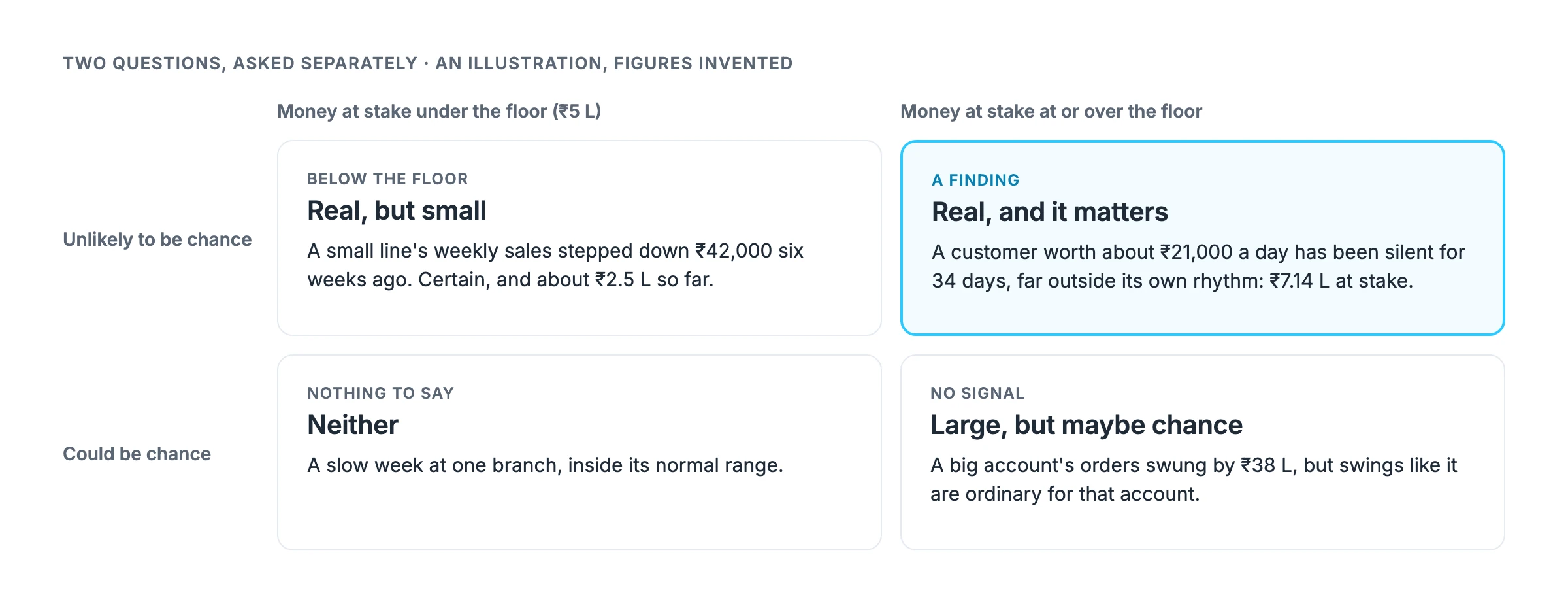
Put the two questions side by side and you get the four boxes in the first figure.
Real and material. Unlikely to be chance, and the money at stake is large enough to matter. This is a finding. It belongs in the brief.
Real but immaterial. Certain, and small: the ₹42,000 weekly step. Worth keeping a record of; not worth the owner’s morning.
Material but not shown to be real. Large, and inside the normal ups and downs of the thing measured: the ₹38 lakh swing at a lumpy customer. Reporting it would teach the owner to chase ghosts. If it is real, more data will show it, and it will pass on a later night.
Neither. Most of what happens in a business on any given day.
The trap is to collapse the two gates into one. A tool that ranks by p-value alone fills the top of its list with the tiny certain effects of the biggest, most data-rich numbers. A tool that ranks by rupees alone fills it with the noisiest large accounts. Both lists look serious, which is why both mistakes are easy to make and hard to notice.
Kept apart, the gates do different jobs. Significance protects the owner from noise. Materiality protects the owner’s attention. Only results that pass both reach the brief.
06How Othor AI asks the two questions
Every night, Othor AI runs eleven kinds of check on every confirmed number and every breakdown. Each check produces results, and a result becomes a finding only if it passes a fixed sequence of gates. A result that doesn’t keeps the first reason that stopped it, so the record says exactly why something was not reported.
| Gate | What it asks | If not, the result is |
|---|---|---|
| 1. Eligible | Did the check have enough history and the records it needs? | not eligible |
| 2. A signal | Is the raw p-value under 0.01? | no signal |
| 3. Material | Is the money at stake at least the company’s floor, ₹5 lakh by default? A result with no money fails here too. | below materiality |
| 4. Significant across the night | After the false-discovery correction over every test of the night, is its q-value at most 0.01? | not significant after correction |
| 5. Not a known pattern | Is it outside the patterns the owner has named: a festival week, a plant shutdown, a pause with an end date? | suppressed |
| 6. Not held, not repeated | Has the owner not snoozed or muted it, and is it not the same problem another check already found? | snoozed, muted, or also seen as another finding |
(A goal’s projection takes a short detour after the money gate: where the year is heading against a target goes to the brief’s goal line, and is never reported as a finding.)
Here is what those gates did to the sample company’s night of 1 November.
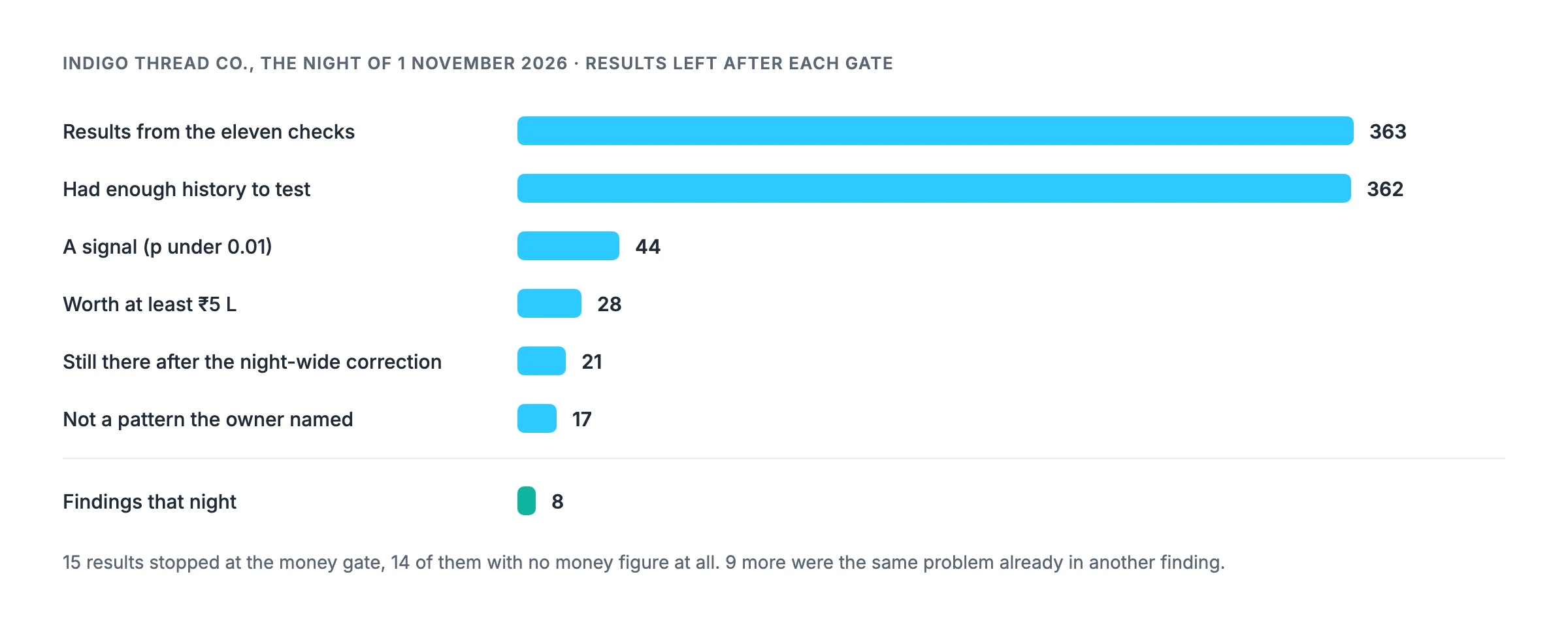
Of 363 results, 44 had a signal. Fifteen of those stopped at the money gate. One was the textbook “real but small”: a step in the cash balance, clear enough to pass the first test and worth ₹4.17 lakh, under the ₹5 lakh floor. The other fourteen carried no money figure at all; the next section explains why. Seven more failed the night-wide correction, four matched patterns the owner had already named, and nine were the same problems seen from another angle, already in another finding. Eight findings were left, the smallest worth ₹27.6 lakh.
Two details of the sequence are worth slowing down for. The money gate sits between the two statistical gates, yet it doesn’t change the statistics: the correction is computed once, over every eligible test of the night, before any gate is applied, and the results that fail the money gate are still counted in it. A later section explains why that matters. And no result reaches the brief without a rupee figure. “No money, no finding” is a design choice with consequences, good and bad, and we come back to it at the end.
07Where the money comes from
A materiality gate is only as good as its money figure. If “money at stake” were a guess, the gate would be decoration. In Othor AI each check works out its own figure, records the basis in words beside it, and the finding’s Test tab shows the arithmetic. The rules differ because the checks look at different things.
| Check | Money at stake |
|---|---|
| Missing records | The account’s average daily value over the last twelve months, times the days without an invoice. An account worth ₹21,000 a day and silent for 34 days carries ₹7.14 lakh. |
| Changepoint | The weekly step, times the weeks it has held. A ₹42,000 step held for six weeks carries ₹2.52 lakh. For a balance such as receivables, the step itself. |
| Net hiding gross | The fall in the part that fell. The check only fires when the offsetting moves are at least three times the net change and the largest fall is above the floor. |
| Forecast breach | The distance outside the forecast’s range. For a number not in rupees, through the rupee value of one unit, such as line revenue per metre dispatched. |
| Concentration | The value above the share limit among the top customers. |
| Two systems disagreeing | The difference for the period. The floor applies to the period’s total, so two late credit notes of ₹2.9 lakh in one week make one ₹5.8 lakh difference, and pass. |
| Rising variance | The rupees flowing through the process since the spread started widening (for dispatch time, the line revenue). |
| Broken relationship | Twelve months at the excess per month. |
| Bimodal average, pile-up under a limit, lead and lag | None. A split average has no rupees at stake until a target is set; a pile-up under an approval limit has none until the owner says what an over-limit item costs; a lead is an insight, not a loss. |
Two of the checks that do compute money leave it empty when the number isn’t in rupees and has no rupee value declared for one unit. That was most of the fourteen on 1 November: a forecast breach on days sales outstanding and on margin per metre, and steps in the count of active customers and in dispatch time. The other two were a split average order value and a pile-up under the approval limit.
Every figure here is an estimate of exposure, not a forecast of loss. A quiet account may come back next week; a step may reverse. The money answers a narrower question: how much of the business is this about? That is the question materiality asks.
08Why the correction counts the results the money gate drops
Here is a subtle point that most home-made alerting gets wrong.
When you run many tests you must correct for their number, or chance will hand you a steady stream of false findings. Benjamini–Hochberg, the correction Othor AI uses, controls the false-discovery rate: among the results you report, the expected share that are flukes. Its strength depends on the number of tests. Fewer tests, gentler correction.
That creates a temptation. Throw away the immaterial results first, then correct over the ones left. The count shrinks, the correction relaxes, and more of the material results pass. It looks harmless: why pay a statistical price for tests you were never going to report?
It isn’t harmless. Bourgon, Gentleman and Huber showed in 2010, for genomics, that filtering tests before a false-discovery correction keeps its guarantee only if the filter is independent of the test result when nothing is going on. A filter on a gene’s overall variation can qualify. A filter on the size of the observed effect can’t, because a large observed effect is exactly what chance produces in the tests that come out significant. Money at stake, for most of the checks above, is computed from the observed effect: the step, the gap, the distance outside the range. Filtering on it first would let noise that happened to look large through more easily.
So Othor AI computes the q-values over every eligible test of the night (360 on 1 November) before any gate is applied, and only then applies the money gate. The floor decides what is worth telling; it never makes the statistics easier to pass. The price is a slightly stricter correction than the minimum. The benefit is that “at most 1 in 100 could be chance” on a finding means what it says.
09After the gates: money ranks the brief
Passing both gates gets a result into the night’s findings. The Morning Brief then has room for at most four items, ordered by a score that multiplies three numbers: money at stake, times urgency, times a weight for how sure the finding is.
Urgency is 1.0 when the consequence date is within 30 days, 0.6 within 90, and 0.3 beyond that or with no date. The weights are 1.0 for Measured and for Assessed · High, 0.8 for Not determinable, 0.7 for Assessed · Medium and 0.5 for Assessed · Low. Scores within 10% of each other count as a tie, broken by how sure the finding is. And an item that was in yesterday’s brief keeps its place unless its score moved by more than 10%, so the order doesn’t jump on small changes. (Words of estimative probability explains where the grades come from.)
So materiality works twice: once as a gate, keeping small things out, and again as a scale, putting the largest exposures first. A smaller use of the same floor shows in the charts. When a finding’s chart breaks a change down by plant, region or customer, the parts that moved by less than a fifth of the floor (₹1 lakh of ₹5 lakh) fold into “Other”. The chart shows the pieces that could matter and sums up the rest.
10Choosing the floor
The default floor is ₹5 lakh per finding for a company that reports in rupees, and $5,000 for one that reports in dollars. The owner can change it: it is one line on the Business Model page, under The business, “Problems worth reporting · over ₹5 L”. It takes money as people type it (“₹5 L”, “5 lakh”, “500000”), and next to it Othor AI suggests 1% of a typical month’s revenue, worked out from the last night’s numbers.

Saving the line writes a new version of the Business Model, with an event that shows the amount before and after. It applies from the next night, and Undo is in History. Because the floor is part of each night’s recorded inputs, an older night replays with the floor it had, and a finding that falls under a raised floor leaves the open list as “Below the materiality floor”, never silently.
How should an owner pick the number? The audit standards offer a useful comparison, and a useful warning.
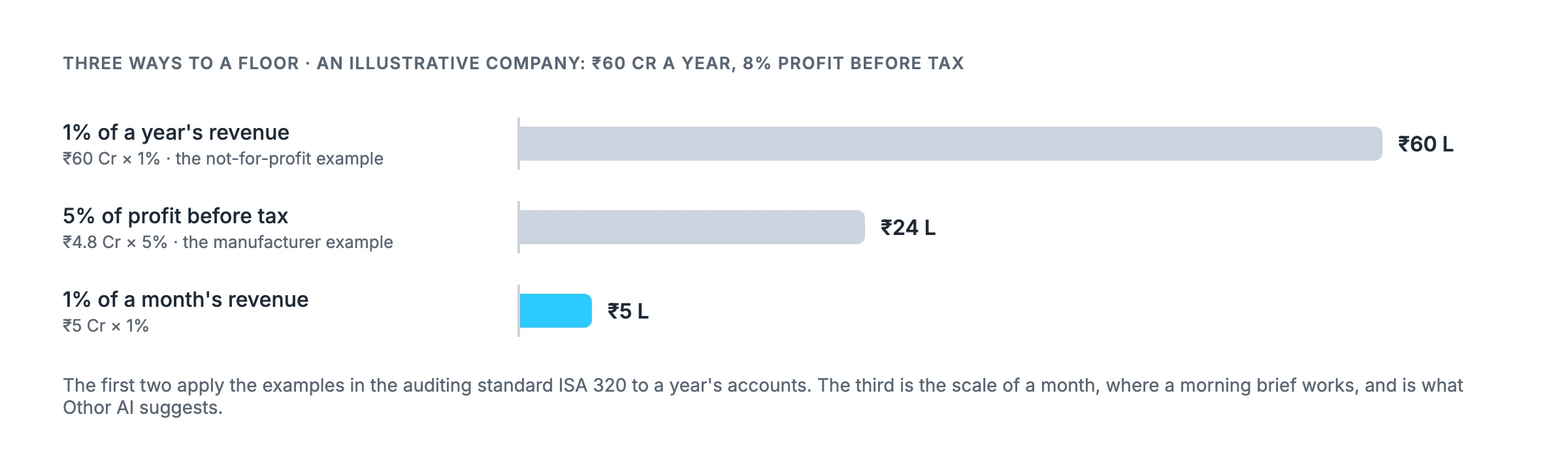
Take a company with ₹60 crore of revenue and an 8% margin before tax: ₹4.8 crore of profit. ISA 320’s manufacturer example, 5% of profit before tax, gives ₹24 lakh. That is a sensible figure for an auditor, whose question is whether a year’s accounts are misstated in a way that would mislead a reader. It is far too high for a morning brief, which deals in weeks and months: an account going quiet or a plant’s yield stepping down is worth knowing about long before it adds up to a year’s misstatement. One per cent of a month’s revenue, ₹5 lakh for this company, is closer to the scale at which an owner would pick up the phone.
Three practical rules follow.
Start from the suggestion, then watch Sweep for a week. If the brief is full of items you wouldn’t act on, raise the floor. If your team tells you about problems that never made the brief, check whether they were stopped as “below materiality”, and lower it.
Think in consequences, not percentages. The Supreme Court’s test is the right one: would a reasonable owner do something different if they knew? For one business that is ₹2 lakh; for another, ₹25 lakh.
Remember it is one number. The floor is set for the whole company, not per number or per plant, and a ₹5 lakh gap matters more in a ₹50 lakh product line than in a ₹50 crore one.
11What the gate doesn’t do
The gate is deliberately simple, and it has limits worth stating plainly.
It has no qualitative override. The SEC’s bulletin lists reasons a small amount can still be material: it hides a trend, breaches a covenant, conceals something unlawful. The money gate only knows money. A ₹3 lakh oddity that is the first sign of something serious sits below a ₹5 lakh floor and stays out of the brief. Some of the qualitative cases are covered elsewhere: a goal heading for a miss is tracked on the brief’s goal line, and two systems that disagree are tested on their own. But no rule says “report this regardless of size because of what it is”. The owner’s remedy is to lower the floor.
Some results never carry money. The split average, the pile-up under a limit and lead and lag carry no rupee figure, and nor do steps and forecast breaches on numbers that aren’t in rupees, so their results never reach a brief, whatever their statistics. The pile-up is the clearest loss: values bunching just under an approval limit is a classic sign of a control being worked around, exactly what an auditor would call material in meaning. Those results are still computed and kept each night, but an owner who reads only the brief won’t see them.
The money is an estimate of exposure. Each figure comes with its basis and arithmetic, and two of them (a weekly step times weeks held, a daily value times days silent) grow with time. That is right for exposure, but it means a slowly developing problem crosses the floor later than a sudden one of the same weekly size.
It doesn’t learn the floor. The 1% suggestion is a starting point worked out from revenue, not a judgement learned from what the owner acted on.
Significance is still not importance, even above the floor. A result that passes both gates is real and large. Whether it is important to this owner this week is a judgement the brief leaves to them, which is why every finding ends with one question for a named person.
12A habit for your own reviews
Whatever tools you use, the two gates make a good habit for any review meeting. When someone presents a change, ask two questions, in order. Could this be chance? Ask how the number usually moves, and whether this move is outside that. Then: how much is it about? Ask for the rupees at stake, with the arithmetic. If the first answer is “we didn’t check”, the item is a hypothesis, not a finding. If the second is small, it is a footnote, not an agenda item.
And when you set your own threshold, write it down and date it. Auditors document their materiality because a threshold chosen after the fact can justify anything. A floor written down in advance is a promise about what you will and won’t spend attention on.
13Conclusion
Statistics and auditing grew up a long way apart, and each gave us a word for “worth mentioning”. Statistical significance asks whether a pattern could be chance; in large data it says yes to almost everything that is real, however small. Materiality asks whether a pattern would change a decision; it needs a money figure and a judgement about the size of the business. Gosset, at the brewery, asked both at once, because his barley cost money. Somewhere along the way the two came apart, and many reports now answer one and imply the other.
A nightly brief has to answer both, for hundreds of results, before six in the morning, without a person in the loop. Othor AI does it with gates in a fixed order: a raw p-value under 0.01, a money floor of ₹5 lakh by default that the owner sets and can undo, and a false-discovery correction at 1 in 100 that counts every test of the night. Every money figure comes with its arithmetic. What passes is ranked by money, urgency and how sure the finding is. What fails keeps the reason it failed.
The gates don’t make the judgement for the owner. They make sure the judgement is spent on things that are both real and large.
14References
- R. A. Fisher. Statistical Methods for Research Workers. Oliver and Boyd, 1925.
- “Student” (W. S. Gosset). The probable error of a mean. Biometrika, 6(1): 1–25, 1908.
- S. T. Ziliak. Guinnessometrics: the economic foundation of “Student’s” t. Journal of Economic Perspectives, 22(4): 199–216, 2008.
- S. T. Ziliak and D. N. McCloskey. The Cult of Statistical Significance. University of Michigan Press, 2008.
- A. Wald. Statistical Decision Functions. Wiley, 1950.
- P. E. Meehl. Why summaries of research on psychological theories are often uninterpretable. Psychological Reports, 66(1): 195–244, 1990.
- R. E. Kirk. Practical significance: a concept whose time has come. Educational and Psychological Measurement, 56(5): 746–759, 1996.
- G. M. Sullivan and R. Feinn. Using effect size, or why the P value is not enough. Journal of Graduate Medical Education, 4(3): 279–282, 2012.
- Steering Committee of the Physicians’ Health Study Research Group. Preliminary report: findings from the aspirin component of the ongoing Physicians’ Health Study. New England Journal of Medicine, 318(4): 262–264, 1988.
- R. L. Wasserstein and N. A. Lazar. The ASA statement on p-values: context, process, and purpose. The American Statistician, 70(2): 129–133, 2016.
- TSC Industries, Inc. v. Northway, Inc., 426 U.S. 438 (1976).
- Financial Accounting Standards Board. Statement of Financial Accounting Concepts No. 2: Qualitative Characteristics of Accounting Information. 1980.
- US Securities and Exchange Commission. Staff Accounting Bulletin No. 99: Materiality. August 1999.
- International Auditing and Assurance Standards Board. ISA 320, Materiality in Planning and Performing an Audit; ISA 450, Evaluation of Misstatements Identified during the Audit (adopted in India by the ICAI as SA 320 and SA 450).
- International Accounting Standards Board. Definition of Material (Amendments to IAS 1 and IAS 8). October 2018.
- Y. Benjamini and Y. Hochberg. Controlling the false discovery rate: a practical and powerful approach to multiple testing. Journal of the Royal Statistical Society, Series B, 57(1): 289–300, 1995.
- R. Bourgon, R. Gentleman and W. Huber. Independent filtering increases detection power for high-throughput experiments. Proceedings of the National Academy of Sciences, 107(21): 9546–9551, 2010.