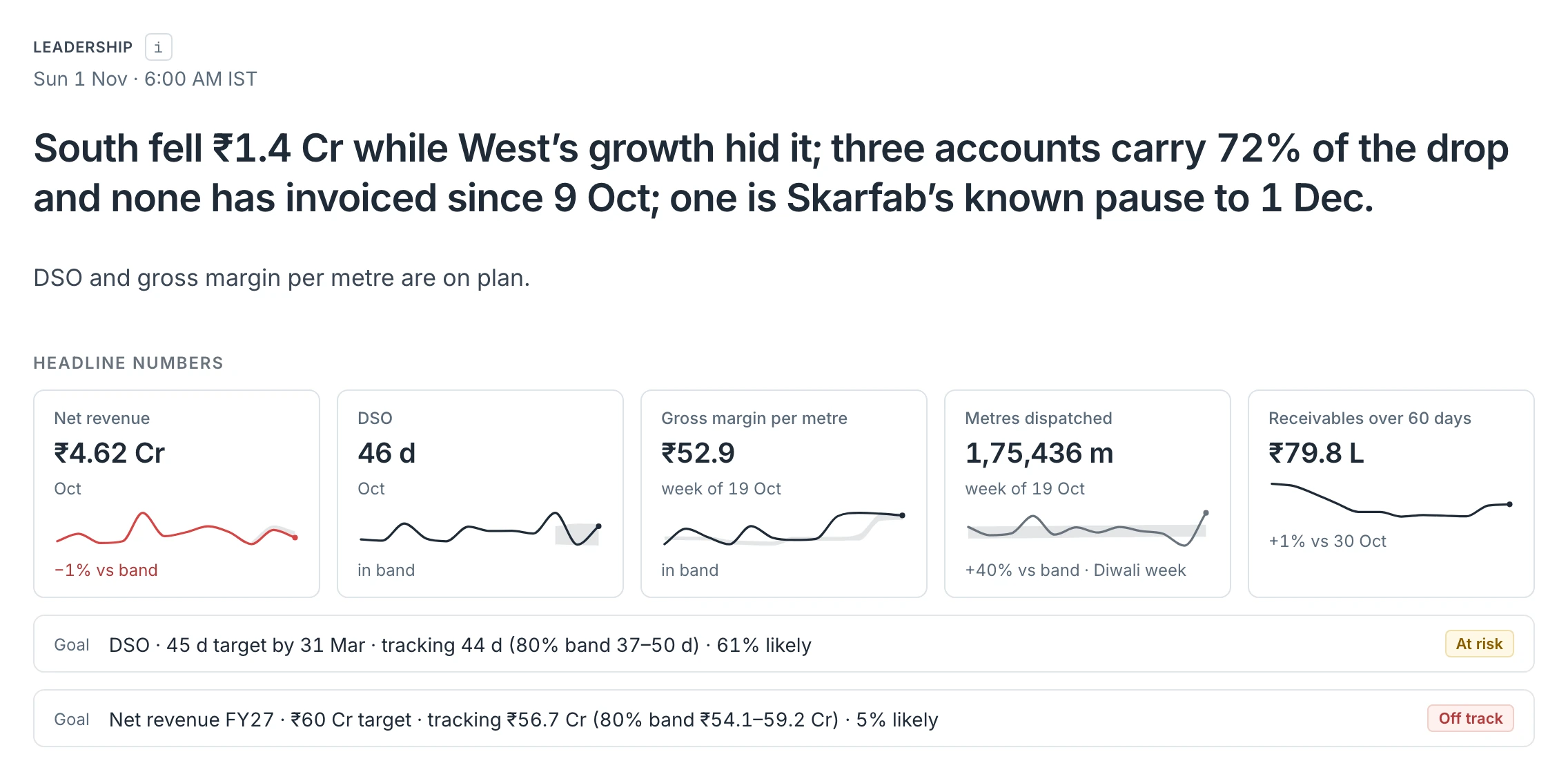
At 6:00 on Sunday 1 November, the Leadership brief for Indigo Thread Co., the invented textile company we test Othor AI on, opened with one sentence: "South fell ₹1.4 Cr while West's growth hid it; three accounts carry 72% of the drop and none has invoiced since 9 Oct; one is Skarfab's known pause to 1 Dec."
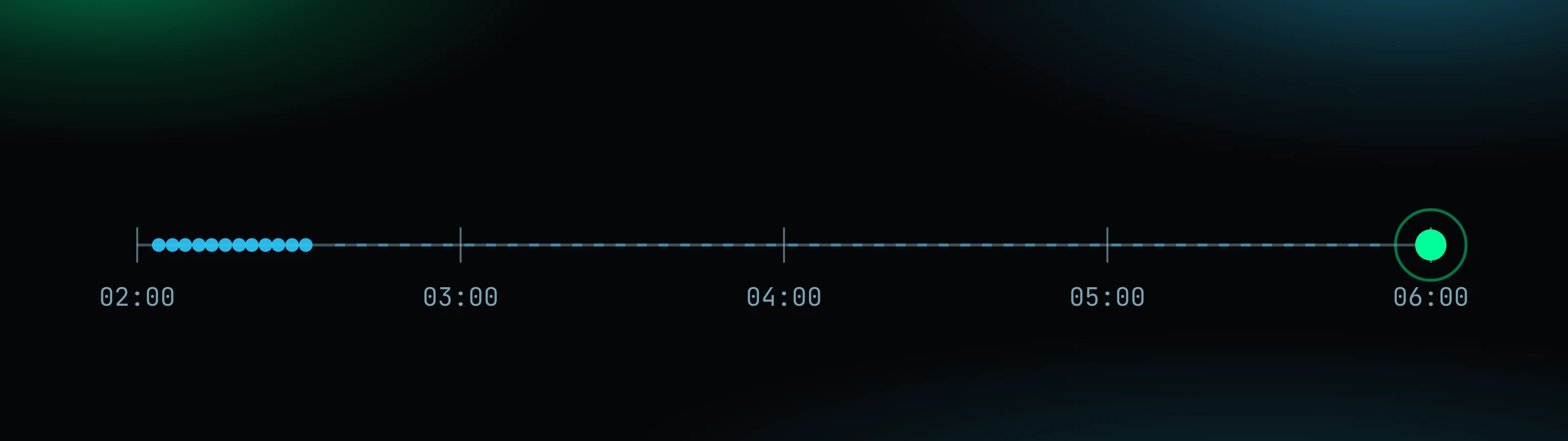
At 2:00 that sentence didn't exist. Nobody wrote it, and no AI model made up any of its numbers. This is what happened in between.
One night, from 02:00
- Readeach source, read-only, only what is new where it can
- Buildevery number, by every breakdown, by day, week and month
- Forecastthe next period, written down before the actual is known
- Testevery number and breakdown for what no single report shows
- Filterchance, small money, known patterns, snoozes
- Rankfor each brief: money at stake, then urgency
- Writesentences from templates, numbers from the results
- Sealthe run, so it can be replayed byte for byte
↺ 06:00: each brief goes to its readers; the morning's double-check replays the night.
0102:00: read, without touching
The run starts at 2:00 in the company's time zone. It reads each connected source through a login that can only read: a database login that could write is refused at setup. Where it can, it reads only what changed since last night; small tables and Google Sheets are read whole. Columns holding personal details, such as names and phone numbers, are never read at all.
Then it builds every confirmed number, net revenue, DSO, metres dispatched and the rest, by every breakdown the owner confirmed (region, customer, plant) and by day, week and month. A copy of what it built is kept with the run, so the night can be run again later from exactly the same inputs.
02Forecast first, then test
Before comparing anything, it writes down a forecast for each headline number: where the next period is likely to land, and a range around it. Writing it down before the actual arrives is what makes the later comparison honest; a forecast made after the outcome isn't a forecast.
Then the Sweep runs: eleven kinds of check over every number and breakdown, plus External Signals in the Enterprise Edition, from "a total that hides big moves underneath" to "a customer who has gone quiet for longer than their own rhythm". On 1 November that came to 362 tests.
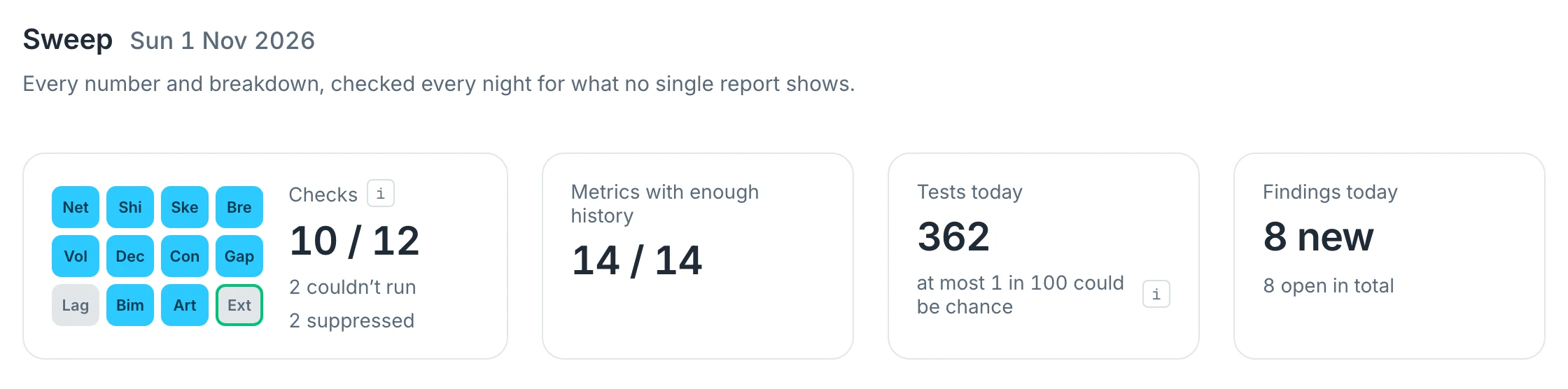
With 362 tests, some will look surprising by luck alone. So the results are filtered as a set, so that at most 1 in 100 of the findings could be chance. Anything worth less than the owner's floor (₹5 lakh by default) is dropped. Anything explained by a pattern the owner has already told Othor AI about, such as the sample company's festival week, is set aside and listed. What's left, eight findings that night, is graded by how sure Othor AI is ("Assessed · High") and ranked for each brief by money at stake and how soon it matters.
03Write, then seal
Each brief is assembled from the ranked findings: a headline, the headline numbers against their ranges, goals with how likely they are, what needs you, and one question to ask today. The sentences come from templates, and every number in them is inserted from the computed results.
A language model may then smooth the wording. It sees the computed results, never a row of the company's data, and every number it writes is checked against them; a sentence with a number that doesn't match is thrown away and the template's sentence stays. If the model provider is down, the brief goes out in template words, with the same numbers.
Finally the run is sealed: its inputs, every query it ran, its settings and its outputs are recorded and chained to the night before. On the sample company the whole run takes under a minute (28 seconds on our test server, measured on 13 November).
0406:00: delivery, and a double-check
At 6:00 each brief goes to its readers by email, its charts as pictures in the message and its links signed so they open without a login. If the run hasn't finished, delivery waits and tries again every five minutes; if it still hasn't finished four hours after the brief's time, the owner gets a note saying what failed, and no half-made brief goes out. If a source couldn't be read, the owner hears about it as soon as the run ends, not at 6:00, and the brief still goes with those numbers marked.
After the briefs are out, the night is run once more from its saved inputs, and the two must match byte for byte. System Health's "Checked" light shows the answer: "Re-running gives the same numbers."
05What to take from it
The Morning Brief is the last page of a night's work, not a summary someone wrote. Every number in it can be traced back through its test to the query that read it, and the same night can be run again to prove it.