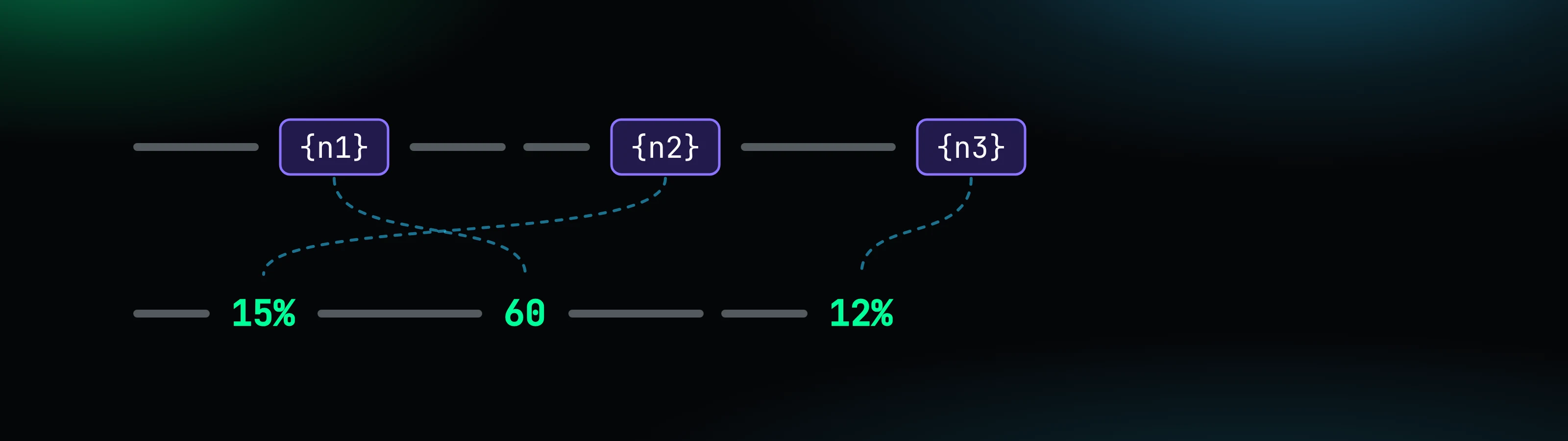
Yesterday's post showed three language models wording the same morning brief, and one place where a model's sentence put a right number under the wrong label. It ended with a better route: the model never writes a number at all. It writes a slot, like {n1}, and code fills in the value.
This is how we tested that route: by teaching a small open model, on a laptop, to do exactly that. Here is what we did, what it scored, and where it fell short.
01The job
After the nightly run, Othor AI's brief is already complete in template sentences, every figure in place. If a model is connected, it's asked to make those sentences read better: the title, the one-line summary, the situation and the actions. That's the job we taught.
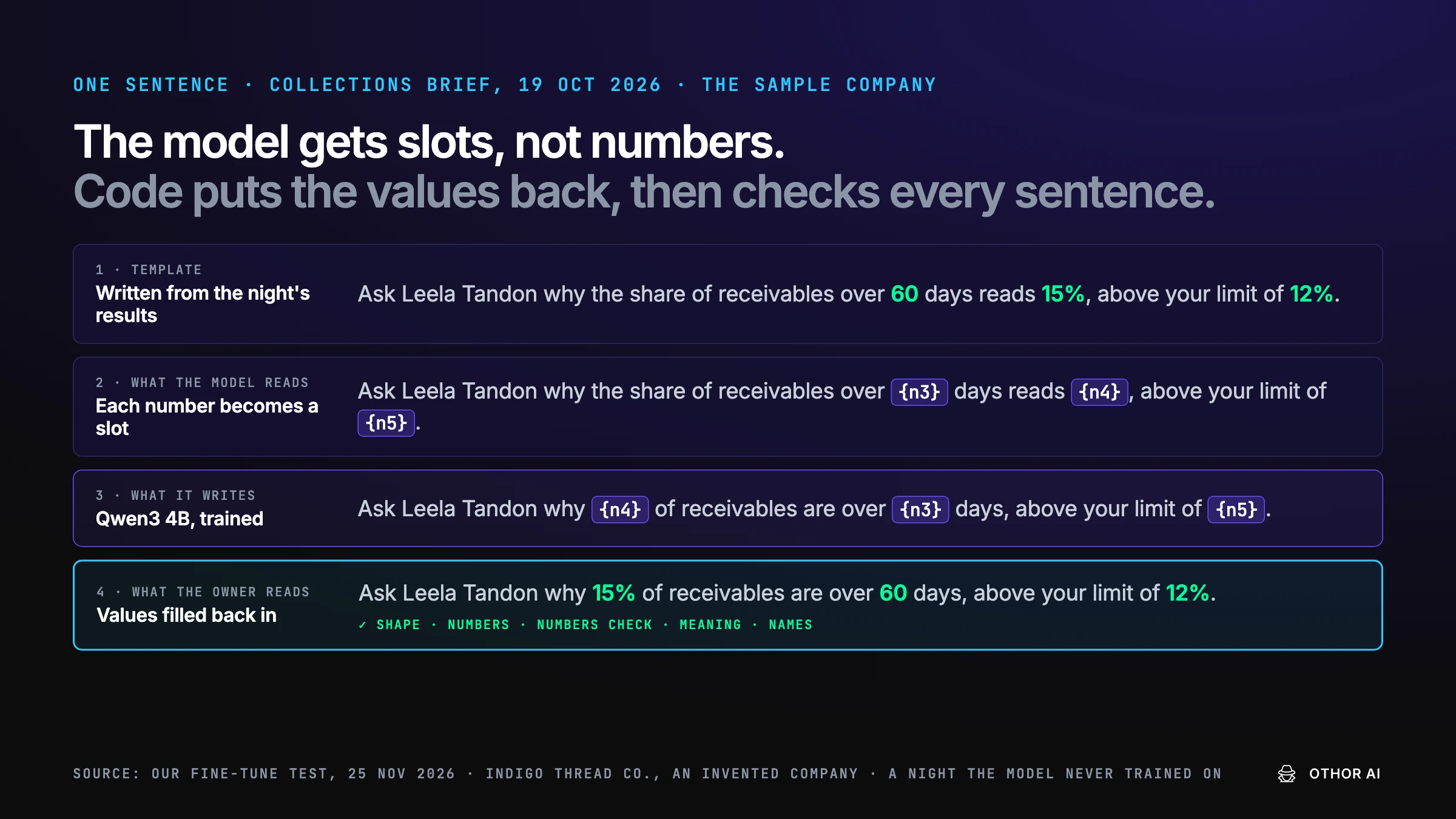
We changed one thing about it. Before the model sees a brief, every amount, percentage, date and count becomes a slot: {n1}, {n2} and so on, the same value always the same slot. The model is told to put each slot where its fact belongs and never to write a digit or a number in words. Afterwards, code puts the values back.
02The setup
- The machine: a MacBook Pro with Apple's M4 Max chip and 36 GB of memory. No cloud computer.
- The tools: Apple's MLX library (mlx-lm 0.32.2) and LoRA. LoRA leaves the model as it is and trains a small add-on beside it: here 15 million extra weights, a 59 MB file.
- The models: Qwen3 4B, an open model from Alibaba, shrunk to 4-bit so it fits on a laptop. We also trained the smaller Qwen3 1.7B to compare.
- The data: only our own invented sample companies. We ran 140 nights of Indigo Thread Co. (15 Jun to 1 Nov 2026) through the real nightly run, with no model, which gave 611 brief inputs across 12 kinds of brief. A second invented company, in a different trade, gave 60 more. The model never trained on that one; it was there only to test.
- The teacher: Claude Opus 5.5 wrote the example answers, through Othor AI's own model gateway and with the product's own prompt. We turned its answers into slots and kept one for training only if it passed every check below: 336 of 500.
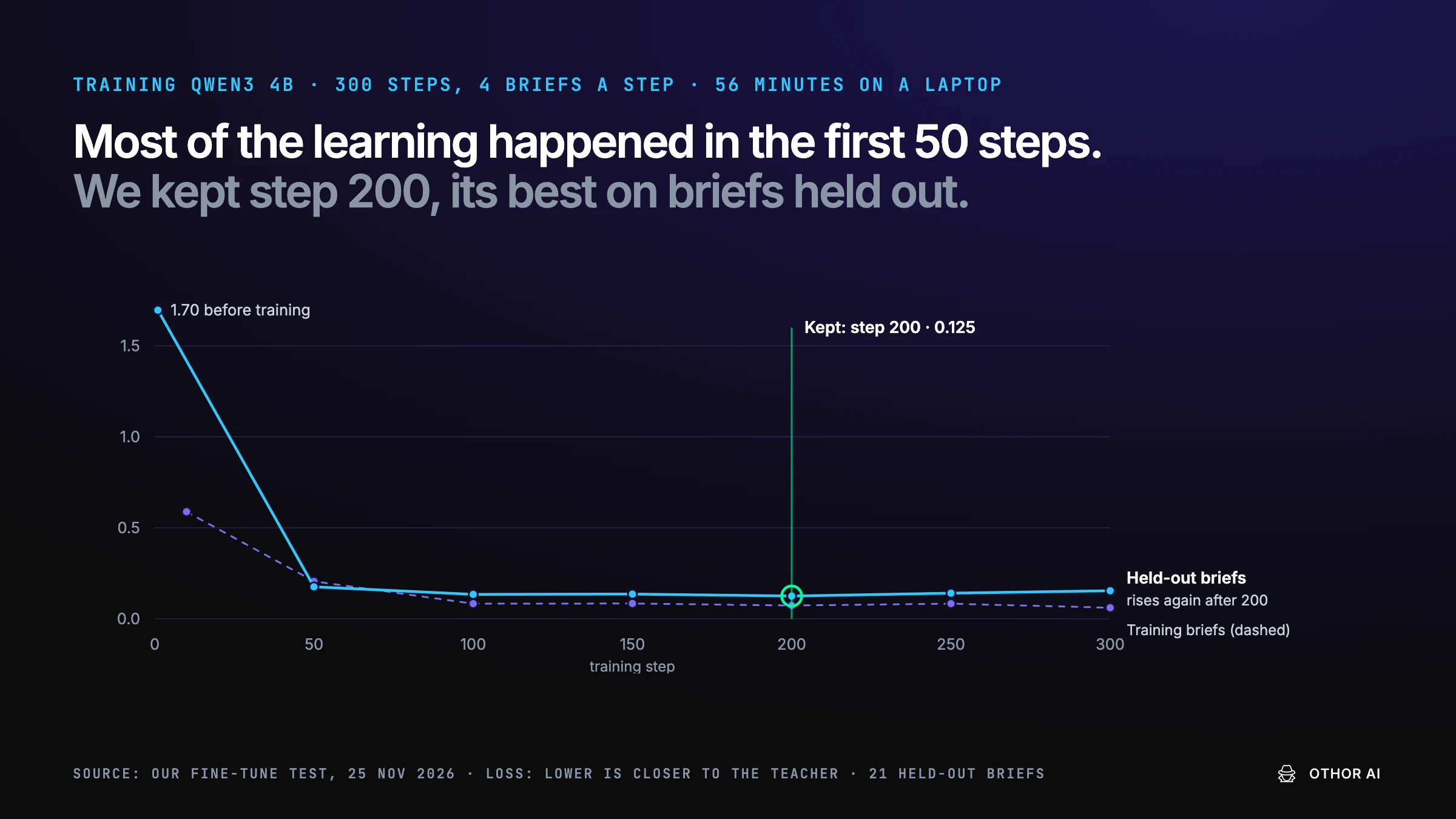
We split the nights by date, not at random: training on nights up to 5 Oct, a check during training on 6 to 18 Oct, and the test on 19 Oct to 1 Nov. Training the 4B model took 56 minutes and at most 11.3 GB of memory. Claude's 671 answers cost $7.29. The whole run, from the first night to the last score, took about 2 hours 25 minutes.
03How we scored it
Every answer on the test briefs, from every model, went through five checks after the values were filled back in:
- Shape: the reply is the form the product expects, one sentence for each action.
- Numbers: every slot is a real one, with no stray digit and no number in words.
- The numbers check: the product's own check, which compares every number in a sentence with the numbers the night computed.
- Meaning: every number in the template's title, line and situation is still there, and each action keeps exactly its own.
- Names: every place, plant and customer the template names is still named.
We also counted how often a model reworded a brief at all: changed at least a tenth of its text.
04What it scored
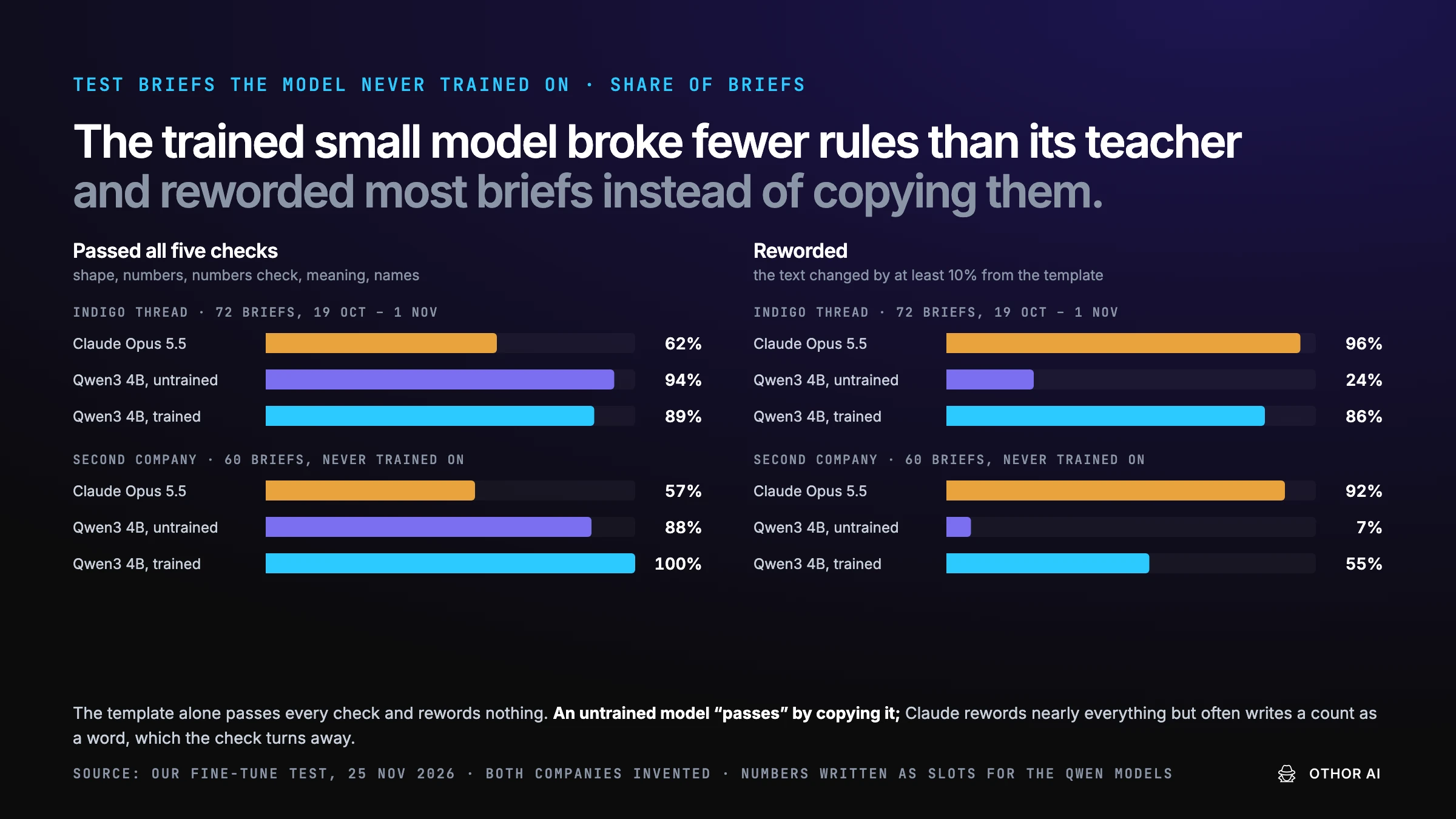
Three things stand out.
- An untrained model passes by doing nothing. The untrained 4B scored 94% on Indigo Thread, but reworded only 24% of briefs; on the second company, 7%. Copying the template breaks no rules and adds nothing.
- Training made it do the job. The trained 4B reworded 86% of Indigo Thread's briefs and passed all five checks on 89%. On the company it had never seen, it reworded 55% and passed on every one of the 60.
- The teacher broke more rules than the student. Claude reworded nearly everything and writes the richest sentences, but passed all five checks on 62% and 57%. Most of its misses were counts written as words, "Two customers" or "Four measures", which the numbers check now turns away, and dropped counts in actions. The student learned only from Claude's answers that passed, so it learned a stricter Claude.
Two of the trained model's sentences, with the values filled back in, from nights it never saw:
- Template: "Still open, day 35: Dispatch time spread at Coimbatore doubled from 27 Jul while the average held at 4.2 days."
Trained 4B: "Still open on day 35: dispatch times at Coimbatore have become far less predictable, with the spread doubling from 27 Jul even as the average held at 4.2 days." - Template: "Win orders beyond your biggest customers: four customers now hold 58% of the order book."
Trained 4B: "Win orders beyond your biggest customers, because four of them now hold 58% of the order book."
Running it, the trained 4B took about 2.2 seconds a brief and 3.9 GB of memory.
05Where it fell short
- Test nights look like training nights. Indigo Thread's findings repeat for weeks, so 89% shows the model handles new nights, not new kinds of finding. The second company is the fairer test.
- A new kind of finding broke it. On 1 Nov the sample company had a finding the model had never seen. Four of its answers stopped before they were finished, and one left out two facts. The product keeps the template when that happens, so nothing wrong would show, but nothing was gained either.
- The checks cover numbers and names, not every claim. The trained 1.7B once added "and still needs a reason", which the brief never said, and passed every check. Claude does the same in small ways.
- A slot can still land in the wrong place. The model can't invent a number, but it could swap two slots inside one sentence. Our meaning check catches a slot in the wrong sentence or action, not a swap within one.
- Small and narrow. 336 examples, from one company and one teacher. The model picked up Claude's habits, like "Still open on day N". Nobody has yet read its sentences for tone.
06What came of it
The trained model isn't part of Othor AI, and we're not putting it in on this evidence. The slots are. Since release 0.37 every model Othor AI works with, Claude included, writes each figure in a brief or a chat answer as a slot, and code fills it in. A sentence with a number of its own keeps the template's words, and each action may use only its own figures. Since the same release, a company can also choose the model Othor AI writes with, including one running on its own machine.
The test also showed how little it takes to try this: one laptop, a couple of hours, a few dollars of teacher answers, and only invented data. The numbers never depended on the model. Now the model doesn't even write them.
Every figure in this post is from our test of 25 Nov 2026 on two invented sample companies.