
Requirements, collection, processing, analysis, dissemination and feedback: what Sherman Kent’s discipline asks of a morning brief, and where a machine can only half-follow it
Open source (Apache-2.0): github.com/othorai/othor-ai
Abstract. Every intelligence service teaches its new analysts a diagram: a circle of boxes that starts with what the decision-maker needs to know and ends with the decision-maker’s reaction, which starts the circle again. It is called the intelligence cycle. Its usual six steps are requirements, collection, processing, analysis, dissemination and feedback. Its intellectual roots go back to Sherman Kent’s Strategic Intelligence for American World Policy (1949), which argued that intelligence is a kind of knowledge, an organisation and an activity, and that the activity should be run with the discipline of scholarship.
The cycle has been criticised for seventy years, mostly by the people who work inside it. Willmoore Kendall, reviewing Kent’s book in 1949, thought it kept analysts too far from the decisions they served. Arthur Hulnick, a CIA veteran, argued in 2006 that the cycle is a poor description of how intelligence really works: collection runs ahead of requirements, analysts collect for themselves, and feedback from policymakers rarely comes.
This post maps the six steps onto something much smaller than a national intelligence service: one company’s data, read once a night. We describe how Othor AI’s nightly run, which starts at 02:00 company time and hands a Morning Brief to the owner at 06:00, carries out each step in code: what it reads and never reads, how it processes and stores the night, how it tests and grades what it finds, how it decides what reaches the owner and whom to ask, and what flows back into the next night. We then do what the critics did for the original: we say where the analogy breaks. The nightly run is requirements-light by design. It does no second pass of collection in the night. And its feedback step is real but thin: the owner’s corrections come back as inputs, forecasts are scored against what happened, but nothing yet records whether a brief led to action, and the product’s goal of tracing a wrong finding to the assumption behind it is a mission, not a feature.
01Introduction: a bulletin that waits for the night
Picture a business owner’s Monday. A finance head brings the sales review. A plant head brings the dispatch numbers. Someone has made a dashboard; nobody has opened it since the week it was made. The owner asks the questions they always ask, gets the answers they usually get, and leaves with a feeling that something is moving under the numbers that nobody in the room has named.
Governments faced the same problem at a much larger scale in the 1940s. They had more information than ever, from more sources than ever, and they kept being surprised. The answer they built was not a bigger pile of reports. It was a process: someone decides what the leaders need to know; someone gathers the material; someone turns it into something readable; someone judges what it means; someone delivers it, on time, to the person who has to act; and the leader’s reaction tells the whole machine what to do next. Drawn as a circle, that process became the intelligence cycle.
A business is not a state, and the owner of a ₹300 crore manufacturer is not a head of government. But the shape of the problem is the same. There is more data than anyone can look at. The thing that matters this week is rarely the thing anyone asked about. And the person who has to act needs a short, graded, sourced account of what changed, delivered before the day starts, with a clear next step.
Othor AI is built to run that process every night on one company’s data. This post walks through it, one step of the cycle at a time, using the actual order of the nightly run. Along the way we try to be as hard on our own version as the intelligence profession has been on its diagram.
02Where the cycle comes from
Kent’s three words
Sherman Kent was a Yale historian who spent the Second World War in the Research and Analysis Branch of the Office of Strategic Services. In 1949 he published Strategic Intelligence for American World Policy. Its structure is three sentences. Intelligence is knowledge: what a nation must know about other nations to protect itself and act well. Intelligence is organisation: the people and offices that produce that knowledge. Intelligence is activity: the work of producing it.
The third part is the one that matters here. Kent described analysis as a disciplined sequence that any good researcher would recognise: a problem appears; the analyst works out what the problem really is; data is collected; the data is critically evaluated; the evaluated data is studied for hypotheses; more data is collected to test the hypotheses; and the result is presented. He insisted that intelligence work should hold itself to the standards of scholarship: sources named, reasoning shown, conclusions stated with the confidence they deserve. Fifteen years later he would apply the same insistence to the words analysts use for probability, which was the subject of our post on words of estimative probability.
From a method to a circle
The six-box circle most people now call the intelligence cycle was set down in military and government doctrine in the decades after the war, and it has changed shape many times since. Current versions use slightly different names. US joint doctrine, for example, speaks of planning and direction, collection, processing and exploitation, analysis and production, dissemination and integration, and evaluation and feedback. Textbooks such as Mark Lowenthal’s Intelligence: From Secrets to Policy teach a similar list. We use the plain six: requirements, collection, processing, analysis, dissemination, feedback.
Kent’s book is not a diagram of six boxes. It is better read as one of the sources of the cycle’s central idea: that intelligence is a production process serving a consumer, and that each stage has its own discipline.
The critics
The cycle’s critics are worth reading before anyone borrows the diagram, because their objections apply to business reporting too.
Kendall (1949). Reviewing Kent’s book, the political scientist Willmoore Kendall argued that Kent’s analysts stood too far from the policymakers. Kent wanted intelligence to stay independent, close enough to know what the decision-makers needed but far enough not to be captured by their wishes. Kendall thought this produced encyclopaedic reports about the world rather than help with the decisions actually on the table. The tension between close enough to be useful and far enough to be honest has never gone away.
Hulnick (2006). Arthur Hulnick, who had spent decades in the CIA, published an article whose title is its thesis: “What’s wrong with the Intelligence Cycle”. In practice, he wrote, policymakers rarely state requirements; collectors gather what they can and analysts work from what has been collected. Collection and analysis run in parallel, not in sequence. And feedback, the step that is supposed to close the circle, mostly doesn’t happen: busy leaders do not write back to say which report helped.
Clark (2004). Robert Clark proposed replacing the circle with a network around a shared picture of the target, in which collectors, analysts and customers all work on the same model and update it together. The idea is that the model of the thing being watched, not the sequence of steps, is the centre of good intelligence.
We will come back to all three. Each one turns out to describe a real limit of a nightly run on a business, and Clark’s idea, a shared model at the centre, turns out to describe the part of the product that works best.
03The night at a glance
Before taking the steps one by one, here is the whole night on one page.
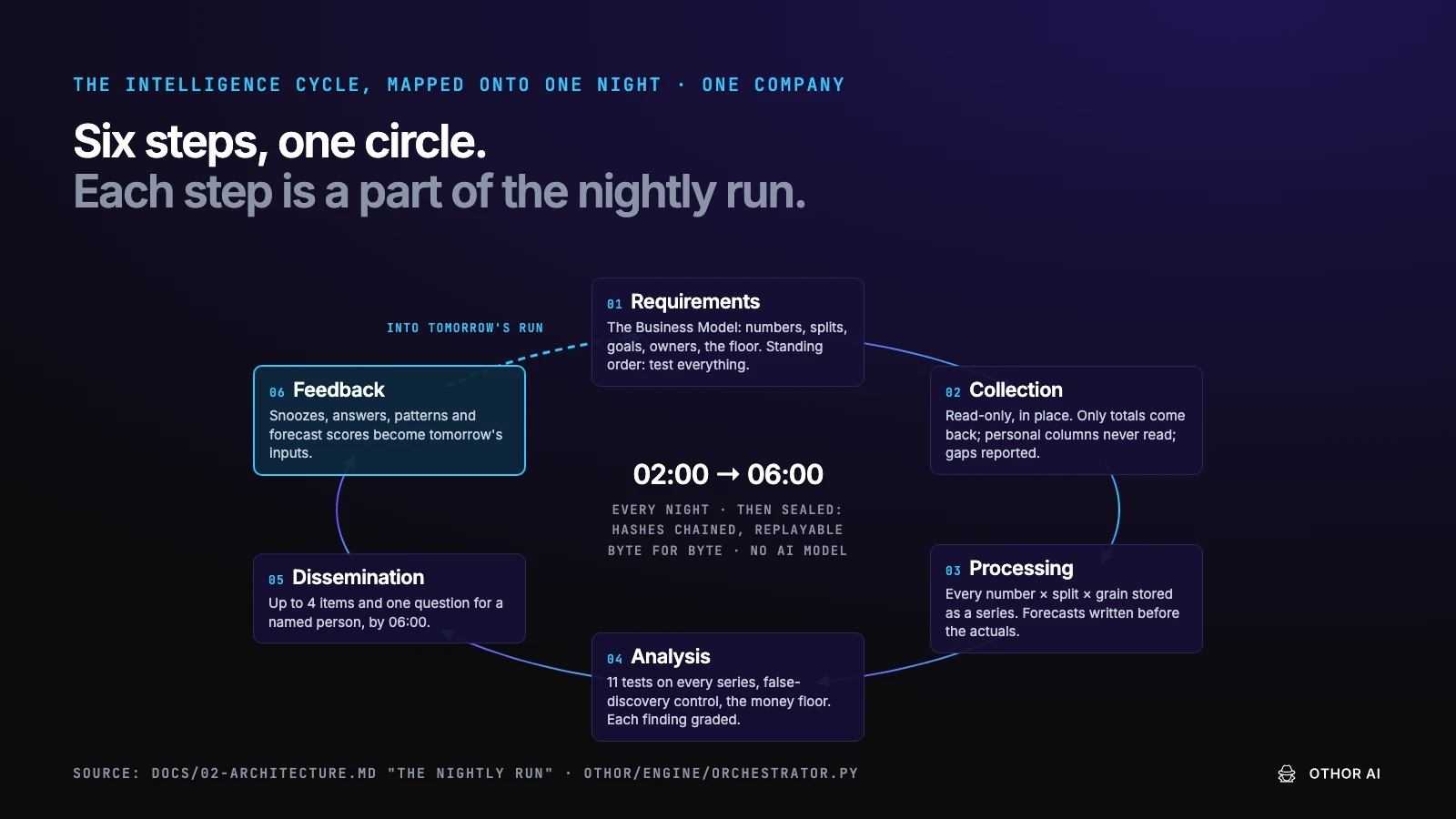
The run is a list of steps, each one recorded as a row with its own status, so a step that fails can be re-run without repeating the ones that finished. In order: read and materialise each source; back-fill where a number has no history in the source; derive the night’s series; forecast; detect; raise questions; assemble the briefs; seal. Delivery is a separate job that runs at the brief’s time, 06:00 by default. None of these steps calls an AI model. That is not a policy written in a document; it is a rule checked by the build, which fails if the engine or the brief-making code ever imports the AI module.
04Requirements: what does the owner need to know?
In the classic cycle, requirements come first and drive everything else. A minister asks: what are the chances of an attack on Yugoslavia this year? The question decides what gets collected.
A business owner rarely asks a question that precise, and when they do, it is usually the question they already ask every month. The most valuable findings are about things nobody asked: a large customer that has quietly stopped ordering while the total held up; two systems that disagree about the same month’s sales; a cost that started rising faster than the revenue it is supposed to follow. Hulnick’s complaint, that real requirements are vague and collection runs ahead of them, is not a failure in this setting. It is the job.
So Othor AI’s requirements step has two parts.
The standing requirement is “everything”. The first principle in the product’s vision document is “Observe everything, decide later what matters.” Every night, every eligible series (every confirmed number, split by every confirmed breakdown, at every grain) goes through all eleven tests. Nobody has to choose which numbers to watch for a test to run on them. This is the deliberate break with requirements-driven collection, and it is why the false-discovery control in step 4 is not optional: if you test everything, you must pay for it statistically.
The specific requirements live in a shared model of the business. Othor AI calls it the Business Model (the Ontology in the code). It is a set of versioned records: the company’s numbers and how each is computed, the breakdowns (plant, region, customer, product), the goals (“₹60 Cr net revenue in FY27”), the watches (an indicator, a threshold and an owner, checked every night), the known patterns (Diwali week, a plant shutdown, a quarter-end push), the people who own each area of the business, the materiality floor below which a problem is not worth reporting, and each brief’s scope: which numbers it covers and who receives it.
The model is compiled into a fixed specification with a hash, and the night runs against that version. Change a goal, add a breakdown, raise the floor, and the change is a new version with its own event, applied from the next night. Older nights replay with the model they had.
This is where Clark’s idea fits better than the circle. The Business Model is the “target model” at the centre: the owner, the IT head who set it up and the nightly run all read and write the same picture of the business. The run’s own questions (step 6) are mostly requests to correct or complete that picture.
Where the analogy breaks: a state’s requirements change with events, sometimes hourly; a business’s model changes when someone edits it, and the run acts on it from the next night. There is no way for the owner to say “watch this more closely tonight” other than by changing the model, or by pressing Run again now, which repeats the night’s steps on demand, at most three times a day.
05Collection: read-only, in place, and honest about gaps
Intelligence collection has many disciplines (human sources, intercepted signals, imagery, open sources) and a long history of collecting more than anyone can read. Othor AI’s collection is narrow by comparison, and the narrowness is a design choice.
One kind of source: the company’s own systems. Today the connectors are PostgreSQL, MySQL and Google Sheets. The nightly run reads only the sources the company has connected.
Read-only, checked at the door. When a database is connected, Othor AI inspects the login’s grants. If the login can insert, update, delete or change the schema, the connection is refused with a plain message: “This user can change data. Create a read-only user and try again.”
In place, totals only. For databases, the compiled queries run on the company’s own database through that read-only login. What comes back is aggregates: a number per period per breakdown value, plus a small number of evidence rows for a finding (at most fifty, with personal columns never selected). The compiler rejects any number whose definition, filter or join touches a column marked personal. Google Sheets tabs are read whole, because sheets can’t be queried in place, and loaded into a local analytics store.
Incremental where it can be. Where a source has a watermark (an updated_at column, an invoice date on an append-only table), the run reads what changed plus a look-back window, 35 days by default, to catch late credit notes. Otherwise it reads small tables in full.
Gaps are reported, not hidden. A source that can’t be read marks its series stale with the last good date. The run continues. Tiles that depend on it say “as of Friday”. Findings that depend on it are skipped and listed in Coverage as “could not run”. If a source isn’t read, the owner gets a notice as the run ends, instead of a brief that quietly pretends the night was complete.
The run also writes what intelligence officers would call collection requirements back to the customer. When a test can’t run because the model lacks something (a number has no source, two systems have no agreed key to compare on, a customer series has no status), the night’s questions step puts it to the owner as a question in the Othor AI chat, often with a suggested answer computed from the data. “Why you haven’t seen this” lines, generated by rule from facts, explain why a kind of problem could not be seen: “erp_db has no churn status; customers stop ordering, so no row is created.”
Where the analogy breaks: there is no adversary. Nobody inside a company is, in the ordinary case, trying to deceive the nightly run, and the run does not try to detect deliberate manipulation of the source data. Cross-source contradiction (two systems disagreeing about the same thing) and a pile-up of values just under an approval limit are the closest it comes to the counter-intelligence instinct, and both are framed as questions, not accusations.
06Processing: turning reads into series, and committing before the facts arrive
In intelligence doctrine, processing is the unglamorous step: decrypting, translating, transcribing, putting raw material into a form an analyst can use. In the nightly run it is the step that makes everything after it trustworthy.
Every number, every split, every grain. The run materialises each number × breakdown value × grain (day, week, month) as a series in the company’s analytics store. Breakdowns with very many values are capped (the top 50 by size by default, the rest as “Other”), and the cap is recorded in the specification.
A snapshot of the night’s inputs. The series values are written to a snapshot for the run. Together with the specification’s hash, the image version and the source watermarks, they are the night’s inputs, and the night’s inputs are hashed.
Definitions are versioned. If the meaning of a number changes (a new filter, a different date column), its earlier history is archived under the old definition and never mixed with the new one. A cosmetic change (a rename, a description) does not start a new version.
Forecasts are written before the actuals. For each headline number, the forecast step writes tonight’s forecast, with an 80% band, before the period it describes has happened. The forecast of record for a period is the latest one stored before the period started. The product will not reconstruct a forecast after the fact for a real company: “a forecast made after the outcome isn’t a forecast”. This is the processing step’s contribution to honesty. When the analysis step later says “the actual fell outside the band”, the band was on file before anyone knew.
Kent would have recognised the spirit of this. His analysts were expected to state their judgements before events proved them right or wrong, and to be held to them.
07Analysis: test, grade, and say what isn’t known
This is the step the rest of our long reads have described in detail, so here is the short version, framed as the cycle frames it.
Tests. Eleven tests run on every eligible series: among them changepoints (the week a baseline moved), a total hiding a falling segment, customers who have gone silent outside their own rhythm, two sources disagreeing, forecast breaches, concentration, rising variance, broken relationships between numbers that usually move together, and values piling up under a limit. Each produces a statistic, a p-value or a score mapped to one, an effect size and, for most tests, a money figure computed by code with its arithmetic shown.
Discipline against chance. A night’s run produces hundreds of tests. Every p-value of the night goes into one Benjamini–Hochberg correction at q = 0.01, so that the expected share of false alarms among what is reported stays near one in a hundred (Analytic Tradecraft as Code).
Discipline about size. A result must also clear a money floor, ₹5 lakh per finding by default, set by the owner (“Significant is not material”).
Known patterns. A result covered by a confirmed known pattern (Diwali week, a confirmed shutdown, a customer’s announced pause with an end date) is set aside and listed, not reported. An unconfirmed pattern suppresses nothing.
Grading. Each surviving finding gets a state, in the spirit of Kent’s estimative words. Measured: a computed fact, with no claim about cause. Assessed (High or Medium): the claim rests on a statistical test or an attribution. Not determinable: the fact is measured, but the explanation the owner needs cannot be determined from the connected data; the finding lists the possible reasons, which ones the checks ruled out, and what would settle the rest. Needs confirmation: two systems disagree, so the run does not know which is right; this never enters a brief’s items and becomes a question instead.
A rule against over-claiming. A brief title may not state a cause for an item that is less than 70% explained by its decomposition. It must say what is measured instead. Code checks the title before the issue is made.
The Not determinable grade is the run’s version of a distinction intelligence writers have long made between puzzles, which have an answer that more information would find, and mysteries, which don’t. Gregory Treverton, who later chaired the US National Intelligence Council, popularised the distinction. A puzzle in a business is “which customers carried this fall?”, and the run answers it with a drill-down. A mystery is “why did they stop ordering?”, and the connected data usually can’t say. The honest move is to state what is measured, rule out what can be ruled out, and pass the rest to the person who can find out.
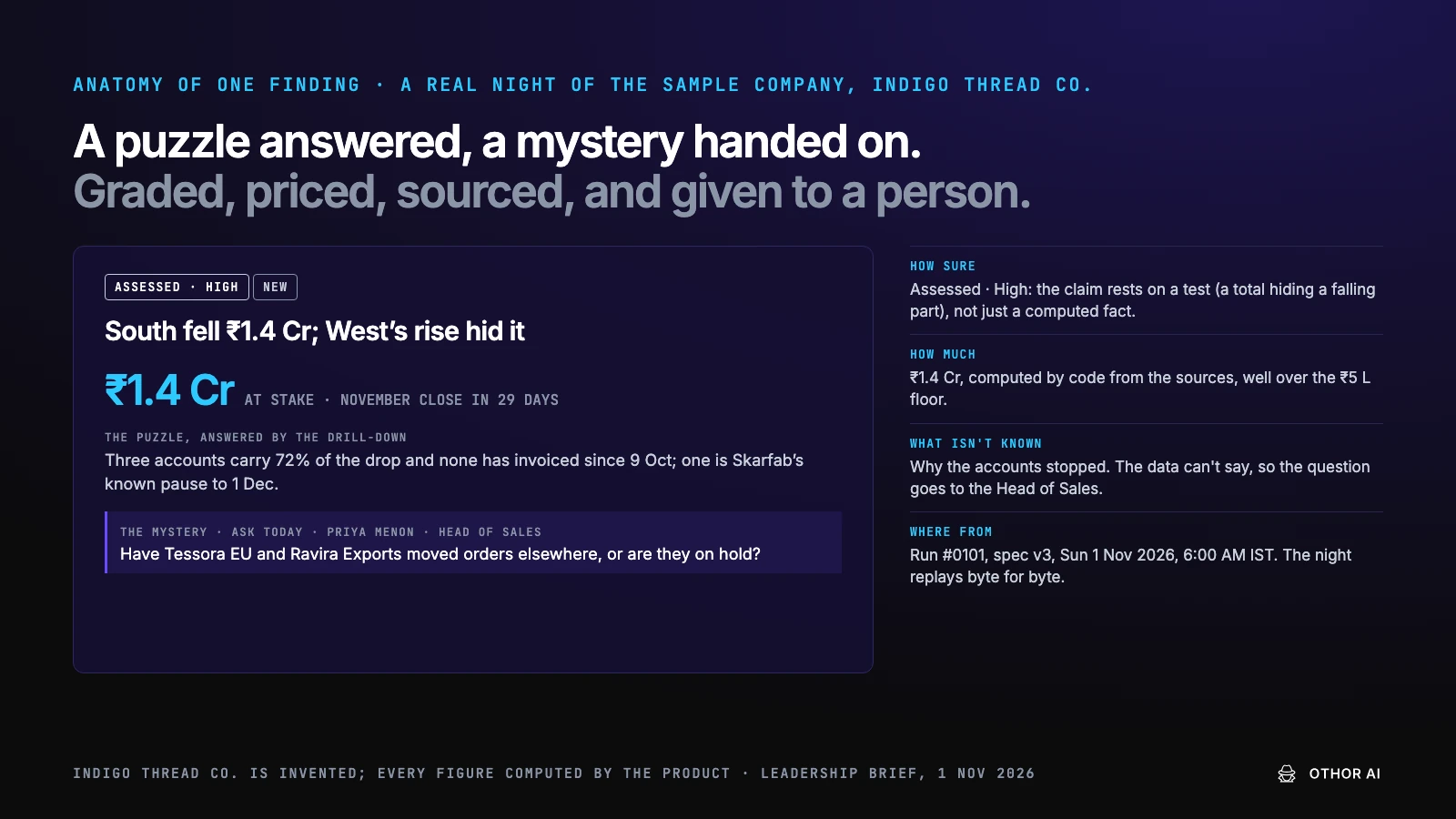
Where the analogy breaks: Kent’s method had a sixth step, “further collection of data to confirm or disprove hypotheses”. The nightly run does one pass. It does not form a hypothesis at 03:00 and go back to the source for more. Its answer to an open question is to grade it Not determinable, name what would settle it, and give the question to a person.
08Dissemination: four items, one question, before the day starts
An intelligence product that arrives after the decision is history. Doctrine is full of rules about timeliness, format and getting the product to the person who can act on it. The nightly run’s dissemination step has the same three concerns.
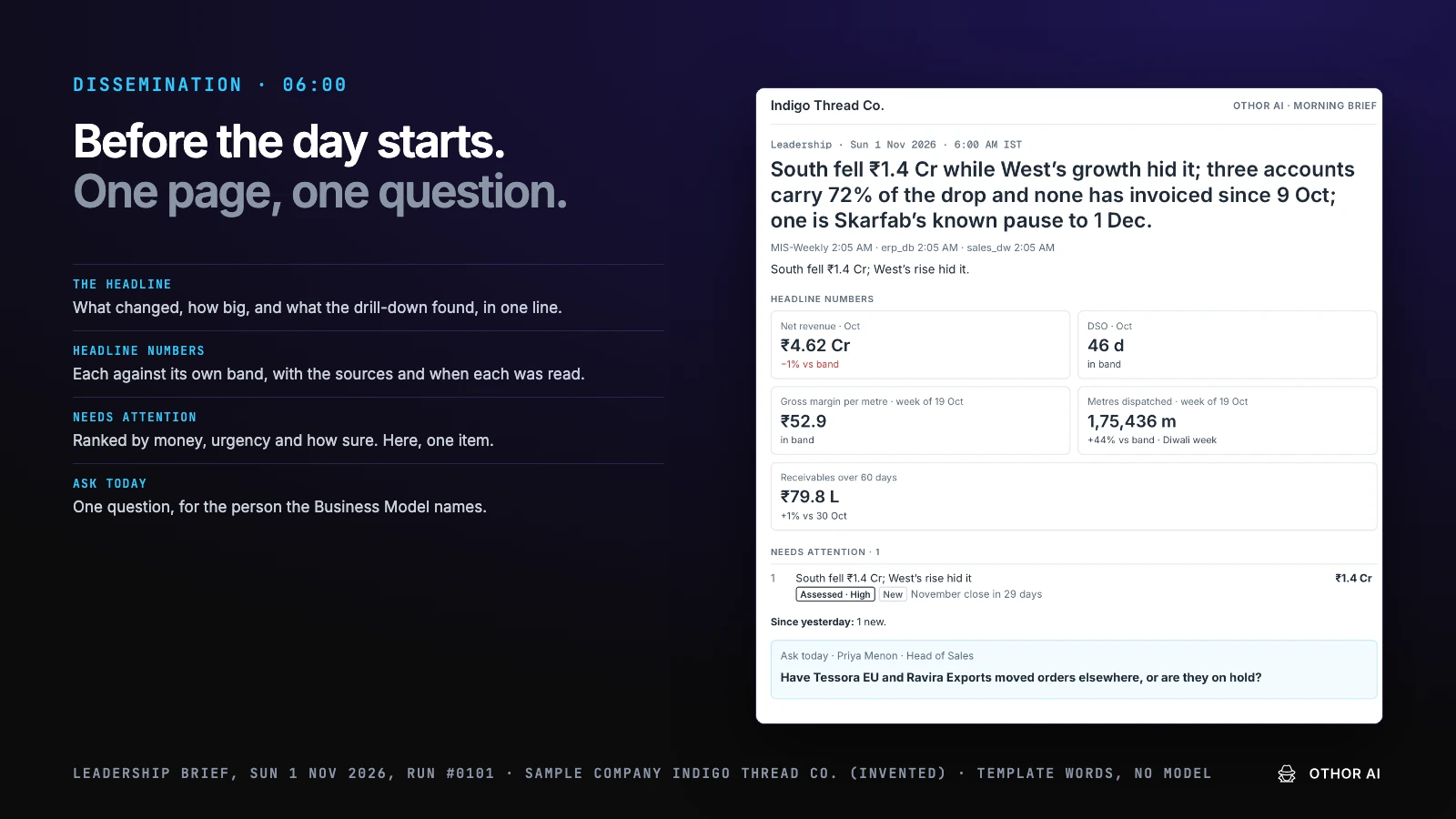
Selection. Each brief has a scope: all of the company, or a set of numbers. Findings in scope are ranked by one function: money at stake × urgency × grade weight. Urgency comes from the consequence date: 1.0 within 30 days, 0.6 within 90, 0.3 beyond or with no date. Measured and Assessed High weigh 1.0, Not determinable 0.8, Assessed Medium 0.7. A brief carries up to four items. An item that was in yesterday’s issue keeps its rank unless its score moved by more than 10%, so the order doesn’t shuffle for no reason. On a quiet night, the title says nothing needs the owner, and the tiles carry the page.
A question for a named person. The top item’s question goes to the person the Business Model names as the owner of that area: “Ask today”. Code checks that it is one question, answerable today, for one named person. This is the product’s answer to Kendall: the brief does not stop at describing the world; it points at the next conversation the owner should have. It still does not make the decision. The “What to do” section suggests at most three next steps, each built by code from what the issue already holds, with every figure copied from a stored item, goal or watch.
Words, and who writes them. Every sentence in the brief has a template that code fills from computed values; the brief is complete without any model. An optional model rewrite runs after the night is sealed, outside the run and outside replay. It receives sentences and computed values, and its output is checked: every numeral in it must appear in its input, or the template stays. The page records which words it shows and why.
Timing. Delivery runs at the brief’s time, 06:00 company time by default, as email to each recipient with a signed link to a read-only page. A link is bound to one recipient, one issue and one purpose, and expires. If the run has not sealed by then, delivery checks again every five minutes; if the brief is four hours late, the owner gets a “didn’t finish” notice instead. If the run failed or a source was not read, the owner is told as the run ends, not at 06:00.
Where the analogy breaks: classic dissemination is tailored to many consumers with different clearances and needs. Othor AI supports several briefs with different scopes and recipients, but the design centre is one reader, the owner. And it deliberately does not track whether the reader opened the email: in the hosted service, mail goes out with no open or link tracking.
09Feedback: what really comes back
This is the step Hulnick said mostly doesn’t happen in government. It is also the step where it is easiest for a product to over-claim. So we separate what is built from what isn’t.
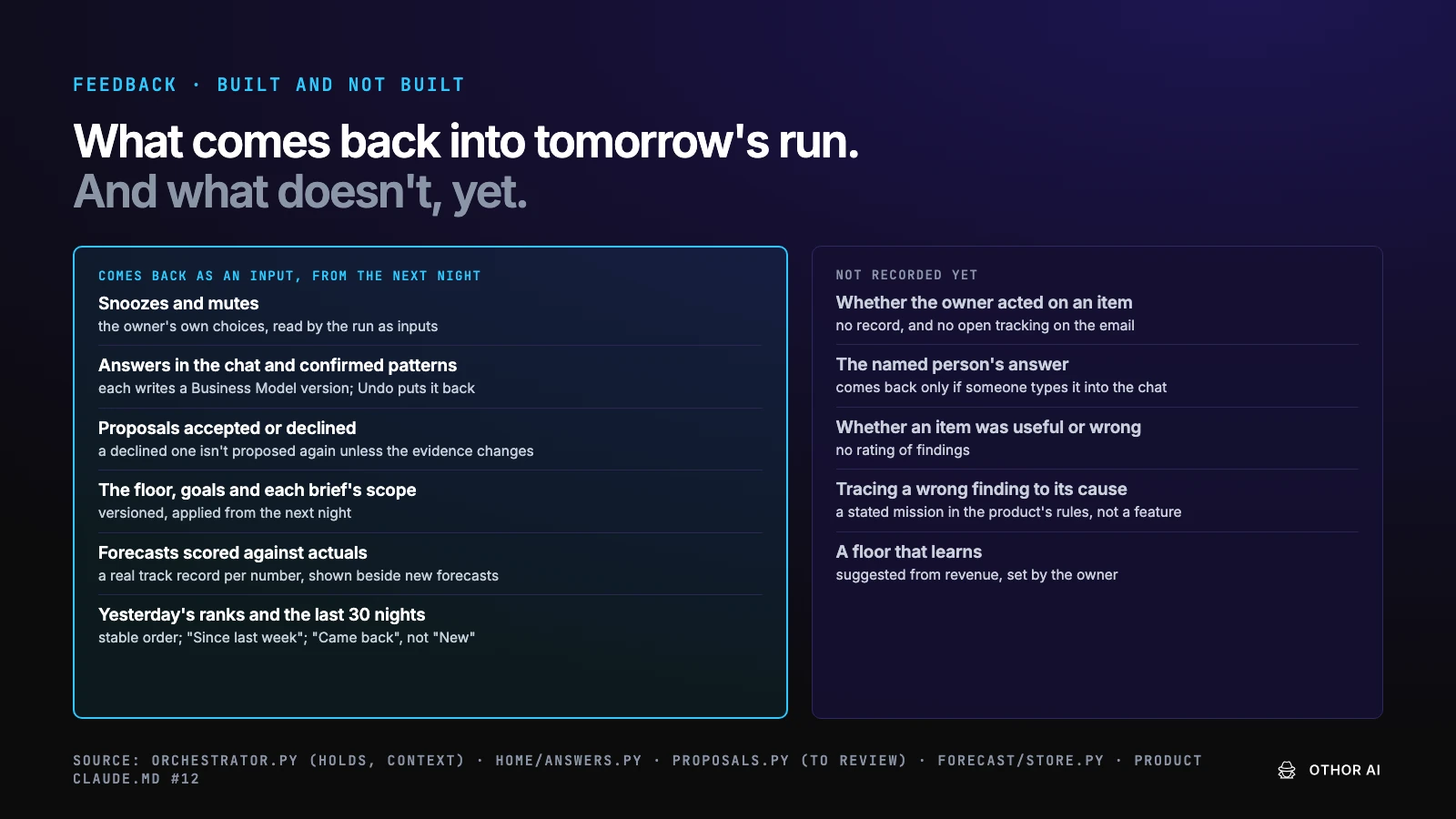
What is built
The owner’s actions are run inputs. When the owner snoozes a finding (for seven days) or mutes a pattern, the pages apply it at once, and from the next night the run reads it as one of its inputs: a matching result is held and listed under Suppressed, never silently dropped and never marked Resolved. A snooze ends by date and the finding comes back with its first-seen date.
Answers become the model. The run’s questions come to the owner in the Othor AI chat: which of two systems is right; what happened to a customer that went quiet; are these dates the same every year? A quick reply maps to a typed record of the Business Model with no model involved; a free-text answer is drafted into a record by the AI, checked against the record’s schema and the numbers guard. Each answer writes a new version of the Business Model, applied from the next run, and Undo puts it back. A finding that an answer explains leaves the Sweep as “Explained by your answer”. This is the most real feedback loop in the product, and it runs through Clark’s shared model, not around a circle.
Proposals learn not to repeat themselves. After the run, rules propose changes, listed under To review on the Business Model page: a recurring calendar window becomes a proposed known pattern (“Quarter-end invoicing push, last 5 days of Dec”); a contradiction resolved the same way twice becomes a proposed definition change; a forecast breach on a goal becomes “mark FY27 revenue as at risk”. Each proposal has a fingerprint, and one the owner declines is not proposed again unless the evidence changes materially.
Forecasts are graded against reality. Each period’s forecast, made before the period began, is scored once its actual is complete. Each number builds a real track record: how many actuals fell inside the band, and the typical miss. Until there are six scored forecasts, the product shows a labelled backtest instead. This is feedback in the strictest sense: the system’s own past judgements, checked against what happened, shown next to its new ones.
The brief remembers. Each issue carries a “Since last week” section built from the last thirty nights: what was reported, what was fixed and how (back to normal, explained by your answer, a known pattern, set aside by the owner, too small to matter), what is still open and for how long. A finding that resolves and fires again within the week comes back as “Came back” with its history, not as “New”.
What is not built
Nobody records whether the owner acted. The brief suggests steps; the product does not ask afterwards whether they were taken, and it does not track opens. That is partly a privacy choice. But it means the system cannot learn which kinds of findings this owner acts on.
The named person’s answer doesn’t come back on its own. “Ask today” names a person. If the owner asks and gets an answer, it re-enters the system only if the owner (or someone with access) types it in as an answer in the chat.
There is no “this was wrong” button that traces the error. The product’s own rules state the goal: when a finding is said to be wrong or misleading, Othor AI should trace it through its provenance to the Business Model entry behind it, say whether it was the system’s assumption or the owner’s mapping, and propose a correction as a draft. The rules call this “a mission we build toward, not a check on today’s plans”. Today, the owner’s tools are the indirect ones above: snooze, mute, answer, change the model.
The floor doesn’t learn. The materiality floor is set by the owner, with a suggestion computed from revenue. It is not adjusted from what the owner acted on.
So the honest summary is this: the nightly run closes the loop on its own judgements (forecasts scored, findings tracked night to night) and on the owner’s corrections to its model. It does not yet close the loop on the owner’s decisions. That is the same gap Hulnick found in government, and we don’t think it is solved by adding a thumbs-up button. It is solved, if at all, by making the model the place where the owner’s knowledge goes, which is why the answers loop matters more than any rating would.
10The step the diagram leaves out: an audit trail of the cycle itself
Intelligence services review their failures after the fact, sometimes years later, with commissions and declassified files. They rarely can re-run the analysis as it was on the night.
The nightly run can. When a run ends, it is sealed: the input hash covers the specification, the run date and every input file; the output hash covers the outputs; and the run hash chains the previous run’s hash, the run number, the kind, the specification, the software image and both hashes. Timestamps and run IDs never enter the inputs or outputs, so two runs on the same inputs produce the same input and output hashes. othor replay <run_id> re-executes the night from its stored inputs and compares the outputs byte for byte. The build replays the sample company on every change to the code, and a difference fails the build. The model’s rewritten words are stored, not regenerated, on replay.
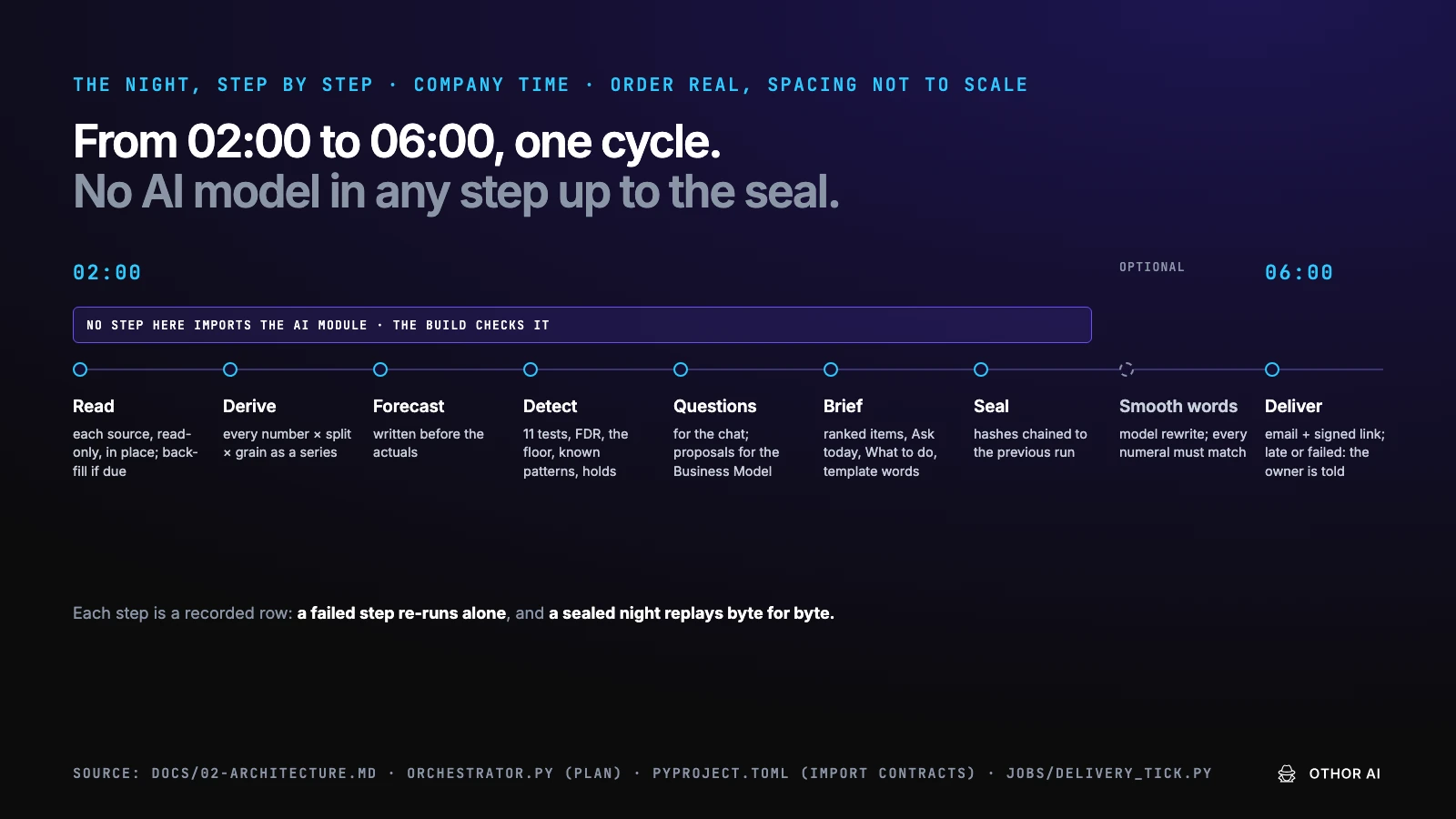
This matters for the cycle because it changes what feedback can mean. When the owner asks “why did the brief say that on the 14th?”, the answer is not a reconstruction from memory. It is the night itself, re-run, with every query, every series and every gate it passed.
11Where the analogy breaks, all in one place
It is tempting to borrow a famous diagram and stop there. Here is the list of ways a nightly run on a business is not the intelligence cycle, gathered from the sections above.
- Requirements-light by design. The classic cycle starts from a question. The nightly run starts from “test everything”, and pays for it with false-discovery control. Specific requirements live in the Business Model, but they shape what is reported more than what is examined.
- One kind of collection, no adversary. The run reads only the company’s own connected systems, read-only. It is not built to detect deliberate deception in the data.
- One pass a night. No hypothesis-driven second collection in the small hours. Open questions are graded Not determinable and handed to a person.
- The analyst is code. The tests, the grades, the ranking and the titles are rules. That is what makes them replayable and checkable, and it is also their limit: the run has no judgement beyond its rules. Where a human analyst would say “this small thing worries me”, the run has the floor and the owner’s ability to lower it.
- One consumer. The design centre is the owner. Several briefs and recipients are supported, but nothing like the layered distribution of a national service.
- Feedback closes on the model, not on decisions. Snoozes, answers, confirmed patterns and forecast scores flow back; whether the owner acted does not.
- The cycle is four hours long. A national intelligence cycle can take weeks for an estimate. The nightly run’s speed is what makes it useful to a business, and also why it cannot wait for anyone.
None of these make the comparison useless. The cycle is a checklist of the questions any reporting process should be able to answer: who decided what we look at; what did we read and what didn’t we; did we write down our expectations before the facts came in; how sure are we and why; did it reach the person who acts, in time, with a next step; and what did we learn from how it landed. A process that can answer all six is rare in business reporting. A process that answers the last one well is rare anywhere.
12A habit for your own Monday review
You don’t need software to borrow the cycle. Before the next review meeting, take the six steps as six questions about the pack you are about to read.
- Requirements. Who decided what is in this pack, and when was that last questioned? What would we not see because nobody asked for it?
- Collection. Which systems fed it, and which didn’t this week? Is anything “as of last Friday” without saying so?
- Processing. Did anyone write down what they expected before the month closed? If not, every surprise is a surprise only in hindsight.
- Analysis. For each claim, is it measured, assessed or not determinable? Does any headline state a cause the numbers don’t fully explain?
- Dissemination. Does each item end with a question for a named person, or with “to be discussed”?
- Feedback. Which of last month’s items led to an action? Write that down. It is the only way to find out which parts of the pack are worth the time.
The last question is the one most packs skip, and, as section 9 admits, it is the one we have not fully built either.
13Conclusion
Sherman Kent asked that intelligence be produced with the discipline of scholarship: sources named, reasoning shown, judgements stated before events and held to afterwards, conclusions as sure as the evidence allows and no surer. The intelligence cycle turned that discipline into a production process, and seventy years of critics showed where the process diverges from real life: requirements are vague, collection runs ahead, and feedback rarely comes.
Othor AI runs the cycle every night on one company’s data, from 02:00 to 06:00 company time. The Business Model holds the requirements, and the standing requirement is to test everything. Collection is read-only, in place and honest about gaps. Processing commits forecasts before the facts arrive. Analysis tests every series, corrects for chance across the whole night, applies the owner’s money floor and grades every finding Measured, Assessed or Not determinable. Dissemination puts up to four items and one question for a named person in front of the owner before the day starts, in words checked against the computed numbers. Feedback brings the owner’s corrections and the system’s own forecast record back into the next night. And the whole night is sealed, chained and replayable.
The weakest step is the same one Hulnick found in government: what the reader did with it. We would rather say that than draw a closed circle.
14About the author
Unni Koroth is the founder of Othor AI, an open-source Head of Intelligence for business owners, built in Bengaluru. Othor AI connects read-only to a company’s data, tests every metric and every breakdown each night, and sends the owner a Morning Brief by 6 AM. Code computes every number; the AI only drafts the words.
15References
- S. Kent. Strategic Intelligence for American World Policy. Princeton University Press, 1949.
- W. Kendall. The function of intelligence. World Politics, 1(4): 542–552, 1949.
- S. Kent. Words of estimative probability. Studies in Intelligence, 8(4): 49–65, 1964.
- A. S. Hulnick. What’s wrong with the Intelligence Cycle. Intelligence and National Security, 21(6): 959–979, 2006.
- R. M. Clark. Intelligence Analysis: A Target-Centric Approach. CQ Press, 2004.
- M. M. Lowenthal. Intelligence: From Secrets to Policy. CQ Press (many editions; first edition 2000).
- US Joint Chiefs of Staff. Joint Publication 2-0, Joint Intelligence. 2013.
- G. F. Treverton. Reshaping National Intelligence for an Age of Information. Cambridge University Press, 2001.
- R. J. Heuer, Jr. Psychology of Intelligence Analysis. Center for the Study of Intelligence, CIA, 1999.
- Y. Benjamini and Y. Hochberg. Controlling the false discovery rate: a practical and powerful approach to multiple testing. Journal of the Royal Statistical Society, Series B, 57(1): 289–300, 1995.
- U. Koroth. Analytic Tradecraft as Code. Othor AI, 19 November 2026.
- U. Koroth. Words of estimative probability. Othor AI, 20 November 2026.
- U. Koroth. Significant is not material. Othor AI, 24 November 2026.