
Military writing standards, intelligence brief formats and the ownership of a question inside a company: what a morning brief borrows from them, and what it still leaves to people
Open source (Apache-2.0): github.com/othorai/othor-ai
Abstract. Armies and intelligence services learned the same lesson about writing for busy people: put the conclusion first, and say what the reader should do about it. The US Army calls this “bottom line up front” (BLUF) and writes it into its correspondence rules. Intelligence services build their products the same way: the President’s Daily Brief, which began in 1961 as a small checklist for President Kennedy, and the National Intelligence Estimate, which opens with its key judgments. Both forms share a habit that most business reporting lacks. They are ordered by what the reader has to decide, not by the order in which the analyst did the work.
This post looks at where BLUF came from, what intelligence briefs added to it (confidence, sources, implications, and gaps stated openly), and why a business brief should go one step further and end each finding with a question for a named person. We argue that a chart hands the analysis back to the reader, while a question hands the next step to the person who can take it. Most of what a company does not know about itself is not in its database. It is in someone’s head: a sales head who knows why a customer went quiet, a plant manager who knows why dispatch slowed. The cheapest way to collect it is to ask the right person the right question on the right day.
We then show how Othor AI’s Morning Brief applies this, using a real issue from the sample company. The brief opens with the question it exists to answer. Its title is the bottom line, written clause by clause only when the data makes each clause true. Each item carries a grade, the money at stake and the date it bites. And the brief ends with “Ask today”: one question, for one person named in the company’s own owner records, which code checks before the issue is stored. We describe how the question is routed (by what it is about, not by whose number moved), what makes a question good, and where the method falls short: the answer does not come back on its own, the checks are about form, not wisdom, and a question can feel like blame if a company is not used to being asked.
01Introduction: the chart at the end of the meeting
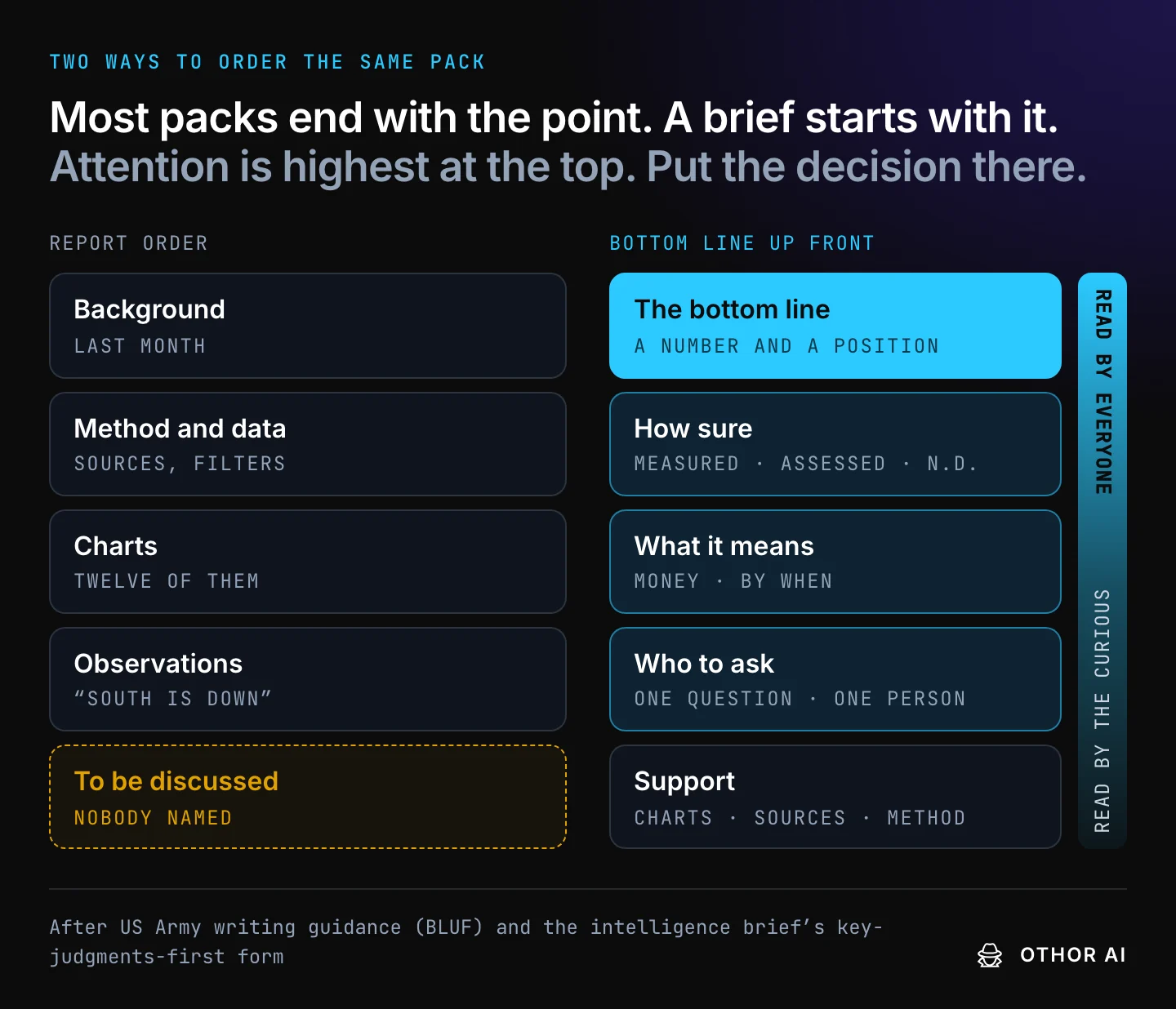
Most monthly review packs end the same way. Twenty slides of charts, a page of observations (“South is down 8%”), and a last line that says “to be discussed”. The meeting discusses it. Everyone agrees South is down. Someone says they will look into it. Nobody is named, nothing is due, and next month the same chart is in the pack, a little worse.
This is not a failure of data. The pack has more data than anyone in the room can absorb. It is a failure of form. The pack is written in the order the analyst did the work: background, method, charts, observations, and finally, if at all, a conclusion. The reader has to read to the end to find out what matters, and when they get there, the pack has handed the hardest part back to them: deciding what to do and whom to ask.
Armies and intelligence services met this problem long before business did, and they settled on two rules. Put the bottom line first. And end with what happens next. This post is about those two rules, why they work, and what it takes to make a machine follow them every night without fail.
It is also about a third idea that the military rules only hint at. In a company, the next step after a finding is almost always a conversation. The owner does not need another chart about South. They need to know which person to ask, and what to ask them, today.
02Where “bottom line up front” comes from
The Army writing standard
The US Army has had written rules for its correspondence for a long time, and in the 1980s it made them sharper. The Army’s writing guidance (Army Regulation 25-50, Preparing and Managing Correspondence, and the pamphlet Effective Writing for Army Leaders, DA Pam 600-67) sets out what it calls the Army writing standard. The two ideas everyone remembers are these. Writing should be understood by the reader in a single, rapid reading. And the recommendation, conclusion or reason for writing, the “bottom line”, goes at the beginning, not at the end.
The rest of the standard serves those two ideas: short sentences, short paragraphs, the active voice, and plain words. None of it is about style for its own sake. It is about the reader’s time. A commander reading forty memos a day should be able to stop after the first paragraph of each and still know what each one wants.
The acronym BLUF spread from there into military briefings, government email and, eventually, management writing. It is often misread as “be brief”. It is not. A BLUF document can be long. What changes is the order: the decision the reader needs comes first, and everything else is support, ranked by how likely the reader is to need it.
Older relatives
BLUF did not come from nowhere. Newspaper editors had long taught the inverted pyramid: the most important facts in the first paragraph, the details after, so that a story cut from the bottom still made sense. The usual explanation ties it to the telegraph era, when dispatches could be cut off mid-sentence and the editor needed the essential facts first. (Historians argue about the details of that story; the practice itself is not in doubt.)
In management consulting, Barbara Minto’s Pyramid Principle, developed at McKinsey and published as a book in the late 1970s and 1980s, taught the same thing to a generation of analysts: start with the answer, then group the supporting arguments beneath it. Minto also gave a name to the few lines that set up the answer: the situation the reader already accepts, the complication that changed it, and the question that the complication raises. The answer is the response to that question. We will come back to this, because Othor AI’s brief has a section called Situation and opens with a question, and the parallel is closer than we planned.
What BLUF is, in one line
Strip away the history and BLUF is a single design rule: order the document by the reader’s decision, not by the writer’s process. Figure 1 shows the difference on a typical review pack.
03What intelligence briefs added
Military writing gave us the order. Intelligence writing added three things a business brief needs just as much: a statement of how sure the writer is, a clear line between what is known and what is judged, and an honest list of what isn’t known and who might find out.
The President’s Daily Brief
On 17 June 1961, two months after the failed landing at the Bay of Pigs, President Kennedy was given a short booklet called the President’s Intelligence Checklist. It was designed to be read by one man, quickly, every day, and to fit in his breast pocket. In December 1964, under President Johnson, it was replaced by the President’s Daily Brief, which has been produced, in one form or another, ever since. Many early issues have now been declassified and published by the CIA.
What is striking about the early issues is not what they say but how they are built. Each item is short. Each opens with its point. The reader is a principal with no time, and the writers knew they were competing for minutes. The Checklist existed because the President wanted one short product that put everything worth his attention in one place.
Key judgments first
The National Intelligence Estimate, the US intelligence community’s formal statement on a major question, follows the same rule at greater length. It opens with its key judgments: the conclusions, each stated with its level of confidence, before the evidence and the argument that support them. A reader who stops after the key judgments still has the estimate. A reader who goes on finds out why.
The Office of the Director of National Intelligence sets analytic standards for US intelligence analysis in Intelligence Community Directive 203 (first issued in 2007, revised in 2015). Several of them read like a checklist for a business brief: express and explain uncertainty; distinguish the underlying information from the analyst’s assumptions and judgments; consider alternatives; demonstrate relevance to the customer and address implications; explain whether a judgment has changed since the last time. Our post “Words of estimative probability” covered the uncertainty standards. This post is about the relevance one. A finding that does not say what it means for the reader, and what to do next, fails that standard however accurate it is.
Saying what isn’t known
The third habit is the one business reporting most often skips. Intelligence writing is expected to name its gaps: what the analysts could not determine, what evidence would change their view, and what to watch. The CIA’s Tradecraft Primer (2009), a short guide to structured analytic techniques, includes several tools for exactly this: a key assumptions check, which lists what a judgment depends on that has not been proven; a quality of information check; and indicators or signposts of change, a list of the observable things that would show a judgment is going wrong.
In an intelligence service, a gap often becomes a collection requirement: a request to the people who gather information to find out the missing piece. In a company, there is usually no collection service. There is a person who knows. That is where the question for a named person comes in.
04Why a chart is not a bottom line
It is worth being precise about what is wrong with ending a finding on a chart, because charts are not bad. Every finding in Othor AI’s brief has one, one click away.
A chart hands the analysis back to the reader. A chart says “here is the data; you work out what it means”. That is fine for an analyst. It is the wrong default for an owner. The product’s own principles say it plainly: “The reader is not an analyst: the machinery stays under the hood.” And: “Data doesn’t speak; understanding does: every finding ends in plain language.”
More information does not make better decisions. Richards Heuer, in Psychology of Intelligence Analysis (1999), has a chapter titled “Do You Really Need More Information?”. It draws on experiments in which experts given more data did not become more accurate, but did become more confident. A pack of twenty charts is more information. It is not more knowledge, and it can leave the owner feeling informed when the one thing that matters is on slide fourteen.
A chart has no owner, no question and no date. It cannot say who should act, what they should find out, or by when it matters. Those three things are what turn a fact into a next step. A chart about South can sit in a pack for a quarter. A question to the head of sales about two named accounts cannot, because someone has to answer it.
A chart cannot say what it does not know. The sharpest findings are often half-explained. South fell, three accounts carry most of the fall, and the data cannot say why those accounts stopped ordering. A chart shows the fall. It does not show the gap, and it does not show who could close it.
So the brief keeps the chart, but as support. The bottom line is a sentence with a number in it, and the ending is a question with a name on it.
05The anatomy of a brief built bottom line first
Here is how Othor AI’s Morning Brief is ordered, using a real issue: the Leadership brief for Sunday 1 November 2026 on Indigo Thread Co., the invented textile company the product ships with. Every number in it was computed by the product. The words are the templates’ words; no AI model was involved.
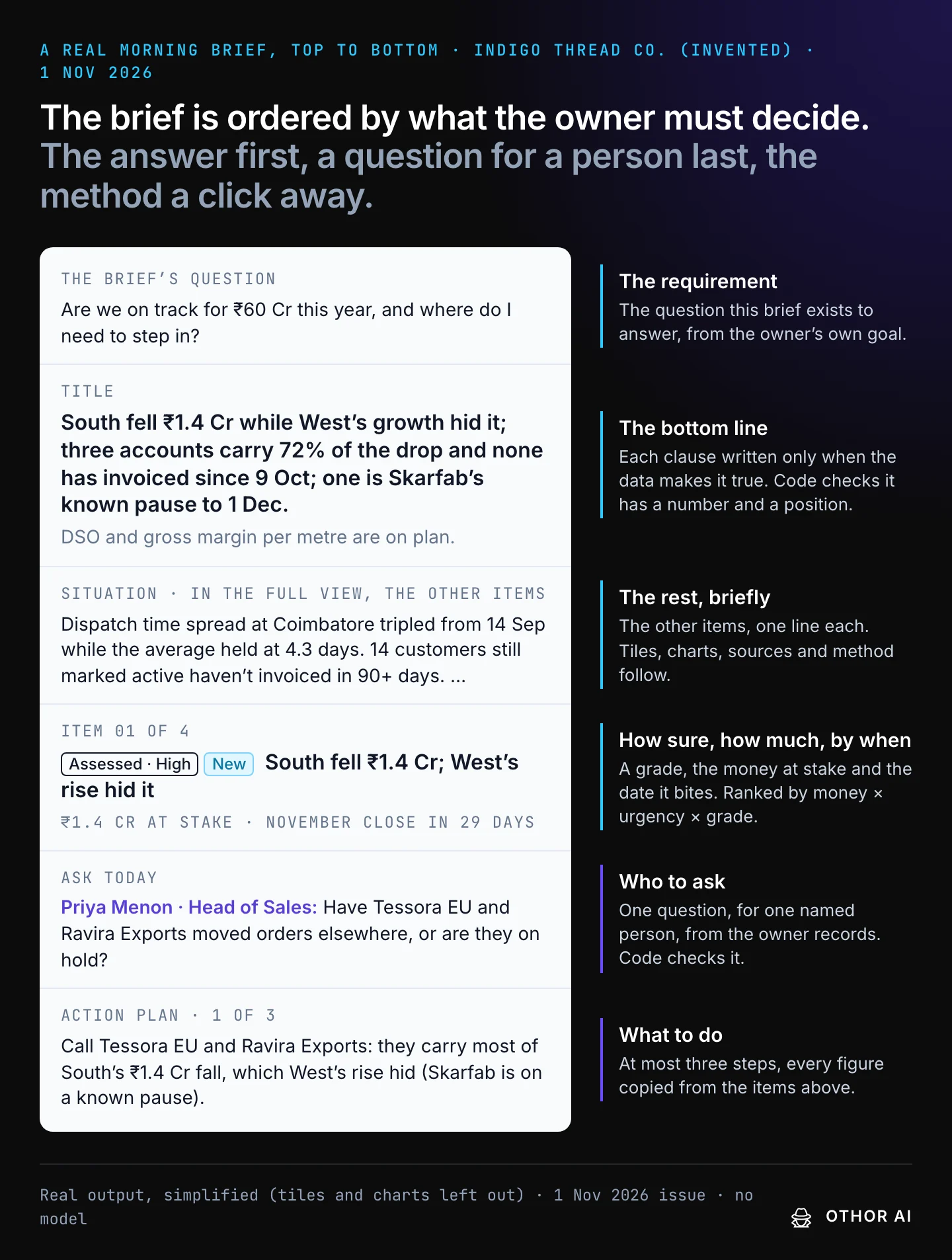
Read from the top.
The brief’s question. Every brief starts with the question it exists to answer. For the default Leadership brief, code writes it from the company’s own goal: “Are we on track for ₹60 Cr this year, and where do I need to step in?” With no goal set, it is “What changed in the business since yesterday, and where do I need to step in?” This is Minto’s question, and the intelligence cycle’s requirement, put where the reader can see it. Everything below is an answer to it.
The title is the bottom line. The title is built from the top-ranked item, clause by clause, and each clause is written only when the data makes it true. “Three accounts carry 72% of the drop” comes from computed shares. “None has invoiced since 9 Oct” appears only if every one of those accounts has been silent for two weeks or more. “One is Skarfab’s known pause to 1 Dec” appears because the owner had already told the system about that pause. If the decomposition explains less than 70% of the movement, the title may not name a cause; it says the rest is not determinable instead. Before the issue is stored, code checks that the title has a number and a position (a region, a plant, an account), never just a label like “Revenue update”.
The line. Under the title, one sentence says which headline numbers are on plan: “DSO and gross margin per metre are on plan.” This is the other half of a bottom line that briefs often forget: what the reader does not need to worry about today.
The situation, then the items. In the full view, a short Situation paragraph names the other items in one line each. Then come the items themselves, at most four, ranked by one function: money at stake × urgency × grade. Each item carries its grade (Measured, Assessed High or Medium, Not determinable), the money at stake and a consequence line: “November close in 29 days”. These are the intelligence brief’s additions to BLUF: how sure, how much, and by when.
Ask today. Then the brief’s one question: “Priya Menon · Head of Sales: Have Tessora EU and Ravira Exports moved orders elsewhere, or are they on hold?” On the page, it says which item it settles.
The action plan. Last, at most three next steps, each built by code from what the issue already holds, with every figure copied from a stored item, goal or watch: “Call Tessora EU and Ravira Exports: they carry most of South’s ₹1.4 Cr fall, which West’s rise hid (Skarfab is on a known pause).”
And the support. The tiles, charts, sources, the run that produced each number and the method behind each test are all there, one click away from each item. None of them is in the reader’s way.
The email follows the same rule, down to its subject line. The subject leads with what changed (the highest-ranked item tagged New, Worse or Came back) and ends with the date. The preheader, the grey line a mail client shows after the subject, counts what changed and names the question: “1 new · 1 worse · 4 things need you · ask Priya one question today”. An owner who reads only their inbox list still gets the bottom line and the name of the person to call.
On a quiet night, the brief says so in its title (“Nothing significant came up”), and there is no Ask today. A bottom line can be “nothing needs you”, and a question invented to fill the slot would be worse than none.
06Why the brief ends with a question, not an answer
BLUF says: lead with the answer. So why does the brief end with a question?
Because the most valuable findings are only half-answerable from data, and the brief should be honest about which half is which.
Yesterday’s post used a distinction intelligence writers make between puzzles and mysteries. A puzzle has an answer that more information will find. A mystery does not, or not from the information at hand. “Which customers carried South’s fall?” is a puzzle, and the nightly run answers it with a drill-down: three accounts carry 72%. “Why did they stop ordering?” is a mystery to the data. No column in the sales database records that a buyer moved to a competitor, or that a customer’s warehouse is full, or that a payment dispute is holding orders back.
The brief handles this in three layers.
- It answers the puzzle in the bottom line. The title says who and how much, from computed numbers.
- It grades what it cannot answer. A finding whose explanation can’t be determined from the connected data is graded Not determinable. It shows what is measured, the possible reasons, which of them the checks ruled out, and what would settle the rest.
- It hands the mystery to a person. The question goes to the person most likely to know the answer, phrased so they can answer it today.
Seen this way, the question is not a soft ending. It is the brief’s collection request. An intelligence service that cannot determine something sends a requirement to its collectors. A company’s best collector of the reasons behind its numbers is its own staff, and the cheapest collection method in the world is a direct question to the right person.
This is also why the question names only what is unexplained. In the 1 November issue, three accounts carry the fall, but one of them, Skarfab, is on a pause the owner had already confirmed. The question asks about Tessora EU and Ravira Exports and leaves Skarfab out. The code is explicit on this point: the question names only the accounts with no explanation, never one under a known pause. Asking a person about something already explained wastes their time and the owner’s credibility.
07The ownership of a question
A question needs an owner as much as a task does. This section is about why, and how the brief decides whom to ask.
Everyone means no one
In 1968 the psychologists John Darley and Bibb Latané published an experiment on what they called the diffusion of responsibility. The more people who are present when help is needed, the less likely any one of them is to act, because each assumes someone else will. The setting was emergencies, not offices, but every manager has seen the office version. “Team, please look into this” is answered by no one. A question addressed to a meeting belongs to nobody once the meeting ends.
Companies have invented many devices to fix this. Project managers use responsibility charts (one common form is called RACI: responsible, accountable, consulted, informed) whose central rule is that each task has exactly one accountable person. Apple is often said to use the term “DRI”, the directly responsible individual, for the one name attached to each item on an agenda. The devices differ; the principle is the same. A thing without a single name next to it tends not to get done.
A business brief that ends with “to be discussed” breaks that principle at the moment it matters most: when something has just been found.
Owner records in the Business Model
In Othor AI, the company’s description of itself, the Business Model (the Ontology in the code), includes owner records: a person’s name, their role, and the areas of the business they own. In the sample company there are three. Priya Menon, Head of Sales, owns orders, the order book, customers and missing records, among others. Leela Tandon, Head of Finance, owns net revenue, receivables, DSO, collections and freight. Aditya Naik, in operations, owns dispatch time and the Coimbatore plant.
The owner records are set up once, by the owner or the IT head who connects the data, and changed like any other part of the Business Model: as a new version, applied from the next night.
Routing by what the question is about
Figure 3 shows the route the 1 November question took. It has a detail worth noticing.
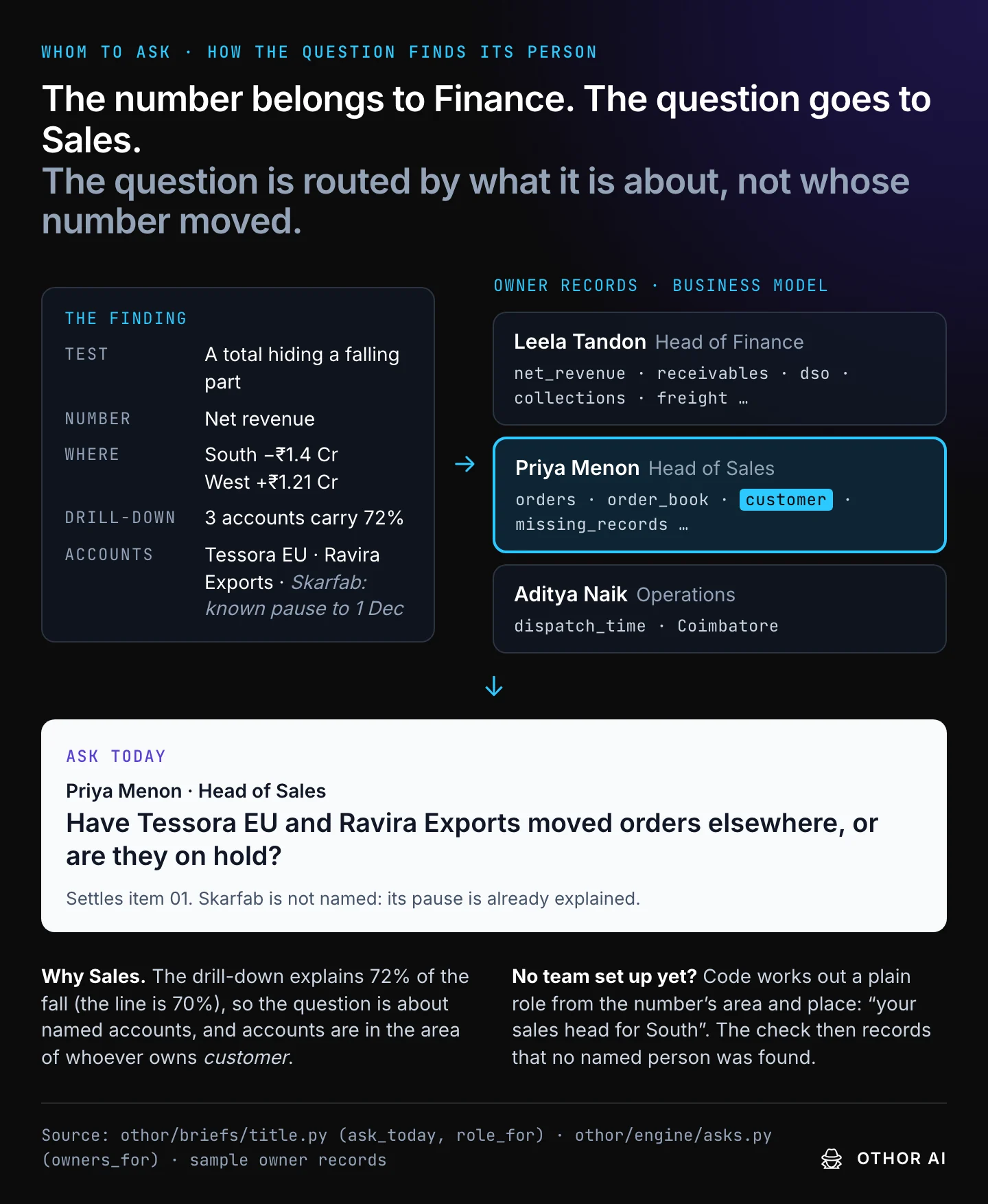
Net revenue belongs to finance. A naive system would send the question to the person whose number moved, and the Head of Finance would be asked why two customers stopped ordering, which she probably cannot answer. The brief instead routes by what the question is about. When the drill-down explains at least 70% of a fall and names the accounts, the question is about those accounts, and it goes to whoever owns customer. When it doesn’t, the top item’s own question is used, addressed to the owners whose areas match the finding: its number, its breakdown value, the test that found it, or the entities it names.
This is a small rule with a large effect. The right person for a question is the one closest to the thing the question is about, which is often not the one whose report contains the number.
When no team is set up
On day one, many companies have not entered any owner records. The brief does not invent a name. Code works out a plain role from the number’s area and, where it happened, the place: “your sales head for South”, “whoever runs collections”, “whoever keeps your books” for a disagreement between two systems. The owner knows who that is. The check on the question then records that no named person was found, so the gap is visible rather than hidden.
A brief can also be set to send its question to a specific person whatever the top item is, for example a brief scoped to operations that should always ask the operations head.
08What makes a good question
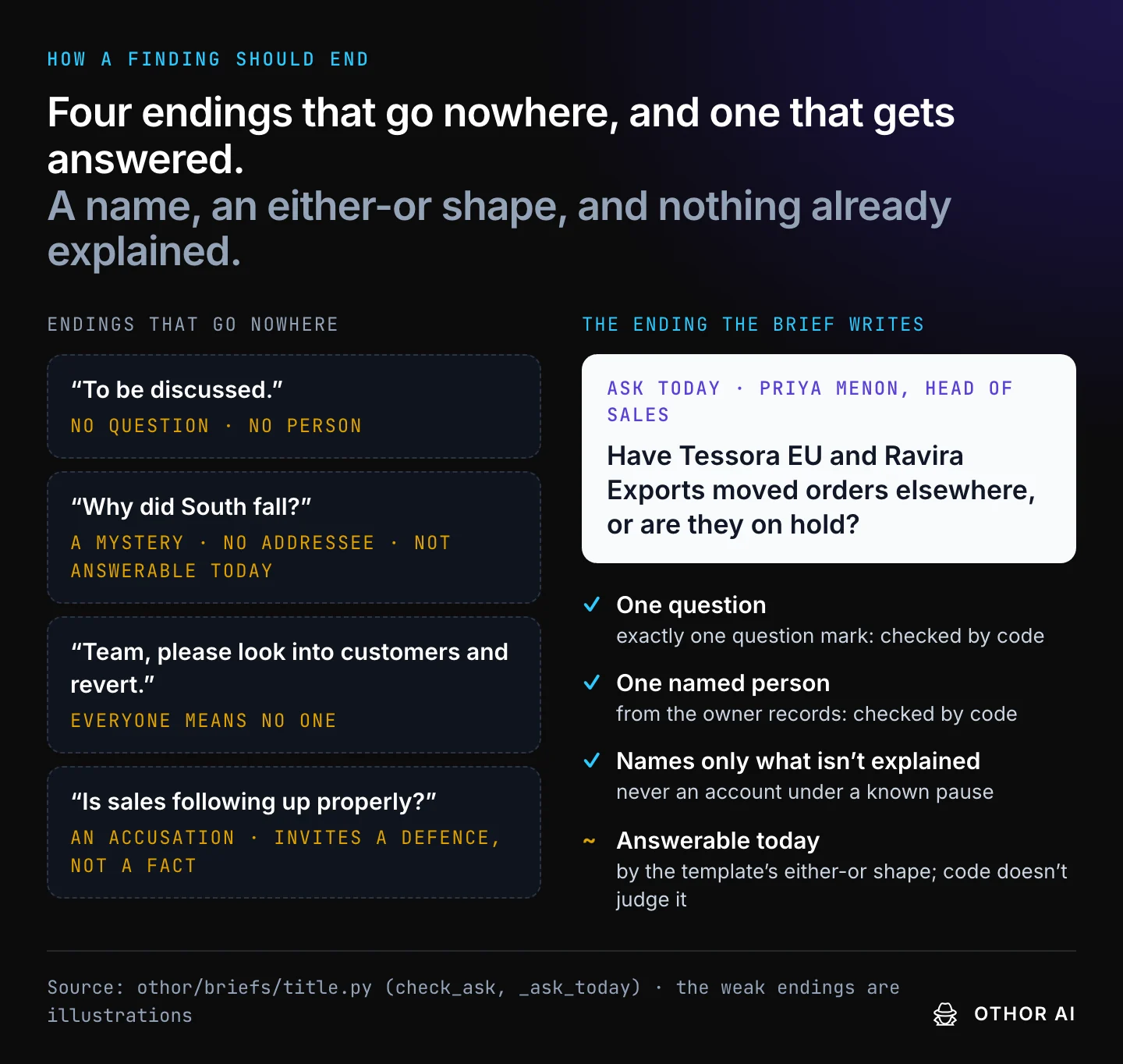
Not every question with a name on it is a good one. Figure 4 sets four common endings beside the one the brief writes.
From those examples, five properties.
One question. Two questions in one sentence get one answer, usually to the easier one. Code checks that Ask today contains exactly one question mark.
One named person. Not a team, not a meeting. Code checks that the question has a person from the owner records attached, and records it when it does not.
Answerable today. “Why did South fall?” is a fair question for a strategy offsite. It is not one anyone can answer by lunchtime. “Have these two accounts moved orders elsewhere, or are they on hold?” is: a call to each account, or a look at the last emails, settles it. The brief’s templates are written in this closed, either-or shape. To be clear about what is enforced: code checks the count of questions and the presence of a name; it does not judge whether a question is answerable today. That property comes from how the templates are written, not from a check.
Specific nouns. The question names the accounts. A person can act on “Tessora EU and Ravira Exports”. They cannot act on “some customers in the South”.
Curious, not accusing. “Is sales following up properly?” invites a defence. “Have they moved orders elsewhere, or are they on hold?” asks for a fact, and both of its answers are possible without anyone being at fault. This matters more than it looks. A question that reads as blame gets a careful answer; a question that reads as curiosity gets a true one.
The same properties apply to the questions the nightly run puts to the owner directly, in the Othor AI chat, when it cannot resolve something itself. When two systems disagree it asks “Which figure is right: A or B?” or “Which system is right about these 37 invoices?”, with quick replies for each side and “Not sure, look into it”. When a customer has gone quiet and the reason is not determinable, it asks “What happened with” the customer, explains the gap (“No invoice in 96 days, against every 28 days before. Possible: …”), and lists only the reasons the checks did not rule out. (The figures in those two examples are invented for illustration; the wording is the templates’.) Each question is tied to its finding and never asked twice.
09When the answer comes back
A question is only half a conversation. What happens to the answer?
When the owner types it in, it becomes part of the Business Model. The run’s questions to the owner arrive in the chat. A quick reply (“Yes, expected”; “No, look into it”) maps to a typed record of the Business Model with no AI involved. A free-text answer is drafted into a record by the AI, checked against the record’s schema and a guard that rejects any number not in the input. Each answer writes a new version of the Business Model, applied from the next night, and Undo puts it back. A finding that an answer explains leaves the Sweep as “Explained by your answer”. If Priya says Tessora EU is on a planned shutdown until January, and the owner records that as a known pattern, the next night’s brief will treat Tessora EU the way it treated Skarfab: named in the situation, left out of the question.
This is the loop that matters most. In yesterday’s post we said that the nightly run closes the feedback loop on the owner’s corrections to its model more than on the owner’s decisions. The question for a person is how that knowledge gets into the model in the first place. The brief asks; the person knows; the owner records the answer; the run stops asking and starts using it.
What does not happen. The person named in Ask today is not emailed by Othor AI. The brief goes to its recipients (the owner, and whoever else the owner adds); the question is for the owner to ask. If Priya answers by phone, that answer re-enters the system only if someone types it in. Nothing records whether the question was asked at all.
10Where it falls short
We have tried to be specific about what is built. Here, in one place, is what isn’t, and where the method itself has limits.
- One question per brief. Ask today is for the top item. The other items carry their own facts and, where relevant, appear in the action plan, but the brief puts one question in front of the owner, not four. That is deliberate, because one question gets asked and four become a list. It also means the second-ranked mystery waits a day.
- The answer doesn’t come back on its own. As section 9 says, the named person’s answer returns only if someone types it in. There is no direct channel from the person asked to the system.
- Nothing records whether it was asked. The brief does not track email opens, and it does not ask the next morning whether yesterday’s question was put to anyone. In the hosted service, mail goes out with no open or link tracking. That is partly a privacy choice, and it means the product cannot learn which questions get asked.
- The checks are about form. Code checks for one question mark and a named person. It does not check that the question is wise, kind or answerable today. Those properties live in the templates, which people wrote and people can get wrong.
- Owner records go stale. People change jobs. If the Business Model still names someone who left, the question goes to them. The role fallback helps only when there are no records at all. Keeping owner records current is the company’s job, and like any responsibility chart, it decays if no one owns it.
- The templates are a fixed set. Each kind of finding has its own question template. They are specific and checkable, and they are also limited. The brief does not compose a new kind of question for a situation its templates did not foresee.
- A question can feel like blame. In a company where the owner rarely asks direct questions, a daily question to a named manager can feel like surveillance. The phrasing helps, but culture decides. We would advise any owner to tell the team, before the first brief, that the questions are curiosity about the numbers, not a scorecard of people.
- A wrong bottom line, stated first, misleads faster. BLUF puts the conclusion where everyone reads it. If the conclusion is wrong, more people read the wrong thing. The defences are the ones in our other posts: every number computed by code, never by an AI; false-discovery control across the whole night; the grade on every item; a title that may not name a cause it can’t support; and a night that can be replayed exactly, so anyone can check what the brief said and why.
11A habit for your own Monday review
You don’t need software to borrow BLUF and the question for a person. Before the next review, rewrite the pack’s last page with these five lines for each item that matters.
- Bottom line. One sentence, with a number and a place: “South fell ₹1.4 Cr while West hid it”, not “Revenue update”.
- How sure. Measured (we computed it), assessed (we tested it), or not determinable (we know what happened, not why).
- What it means. Money at stake, and the date it bites: “November close in 29 days”.
- Who to ask. One name. Not a team.
- The question. One question, answerable today, naming the specific accounts, plants or invoices, and phrased so that every answer is possible without blame.
Then move the charts behind it. Anyone who needs them will find them. Everyone else gets the point in the first five lines, and leaves the meeting with a question to ask and a person to ask it of.
12Conclusion
The US Army’s writing standard asks that a document be understood in a single, rapid reading, with the bottom line first. Intelligence briefs, from Kennedy’s Checklist to the key judgments of an estimate, added a statement of confidence, a line between fact and judgment, and an honest account of what isn’t known. A business brief needs all of that and one thing more: because most of what a company doesn’t know about itself is in the heads of its own people, each finding should end with one question, for one named person, that they can answer today.
Othor AI’s Morning Brief is built that way. It opens with the question it exists to answer. Its title is the bottom line, written only from what the data makes true. Each item is graded, priced and dated. And it ends with Ask today, routed by what the question is about to the person the company’s own records name, checked by code for one question and one person, and naming only what is still unexplained. When the answer comes back and the owner records it, the next night’s brief uses it.
What the brief cannot do is ask the question for you, or make sure it was asked. That part stays with the owner, which is probably where it belongs.
13About the author
Unni Koroth is the founder of Othor AI, an open-source Head of Intelligence for business owners, built in Bengaluru. Othor AI shows business owners what their numbers and team aren’t telling them, using intelligence-agency tradecraft and 100 years of signal analysis. It connects read-only to a company’s data, tests every metric and every breakdown each night, and sends the owner a Morning Brief by 6 AM. Code computes every number; the AI only drafts the words.
14References
- US Department of the Army. Army Regulation 25-50, Preparing and Managing Correspondence (editions including 2002, 2013 and 2020).
- US Department of the Army. DA Pamphlet 600-67, Effective Writing for Army Leaders. 1986.
- B. Minto. The Pyramid Principle: Logic in Writing and Thinking. Minto International (first published as a book in the late 1970s; many later editions).
- Central Intelligence Agency. The President’s Daily Brief: Delivering Intelligence to Kennedy and Johnson. Collection overview and declassified documents, 2015.
- Office of the Director of National Intelligence. Intelligence Community Directive 203, Analytic Standards. 2007, revised 2015.
- Central Intelligence Agency. A Tradecraft Primer: Structured Analytic Techniques for Improving Intelligence Analysis. 2009.
- R. J. Heuer, Jr. Psychology of Intelligence Analysis. Center for the Study of Intelligence, CIA, 1999.
- J. M. Darley and B. Latané. Bystander intervention in emergencies: diffusion of responsibility. Journal of Personality and Social Psychology, 8(4): 377–383, 1968.
- A. Lashinsky. Inside Apple. Business Plus, 2012.
- G. F. Treverton. Reshaping National Intelligence for an Age of Information. Cambridge University Press, 2001.
- S. Kent. Words of estimative probability. Studies in Intelligence, 8(4), Fall 1964.
- U. Koroth. Words of estimative probability. Othor AI, 20 November 2026.
- U. Koroth. The intelligence cycle, run nightly on a business. Othor AI, 25 November 2026.