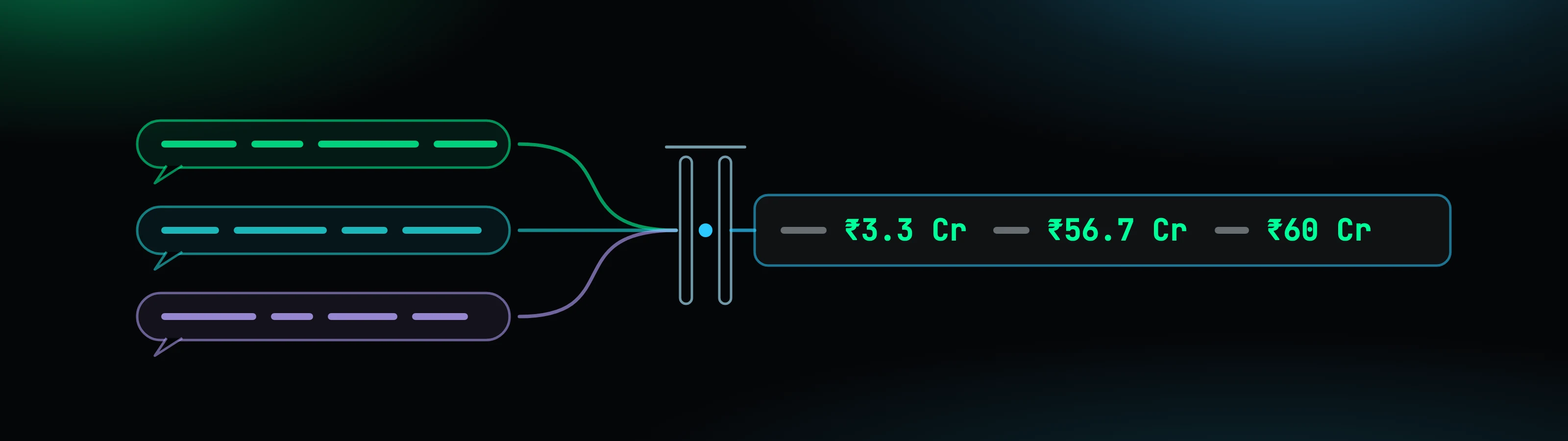
Every business owner has heard the same warning about AI: it makes things up. That's fine for a first draft of an email. It is not fine for a number you take into a board meeting.
So we built Othor AI so that a language model never supplies a number. This week we tested how far that holds. We connected the same app, on the same night of data, to three different models: Claude, and two free models running on a laptop with no internet. Then we looked at what reached the owner.
01How it works, in one paragraph
Code computes every figure: the nightly run reads the company's data, tests every number and writes the brief from templates. Only then, and only if a model is connected, the model is asked to make the sentences read better. A check then compares every number in its reply with the numbers code computed. Any sentence with a number that isn't ours is thrown away, and the template sentence stays. Since this week the check also reads numbers written as words, so "Fourteen customers" is checked as 14. With no model at all, the brief still arrives at 6:00 AM, in template words.
02The test
On 25 Nov we ran the 1 November night of our sample company, Indigo Thread Co. (an invented textile maker whose data we generate with known patterns), four times in the real app:
- with no model (the template words);
- with Claude (Claude Opus 5.5, Othor AI's usual provider);
- with gpt-oss 20B, OpenAI's open-weight model;
- with Qwen3 30B, Alibaba's open-weight model.
The two open models ran on a MacBook through Ollama, at temperature 0. Each got its own copy of the night, so every figure on screen is the app's own result. We used the same prompts, the same checks and the same screens, then asked each one to do two jobs: word the morning brief, and answer a question in the chat.
03Job 1: the morning brief
Here is the first line of the 1 Nov action plan, as each model left it:
- No model: "Find ₹3.3 Cr more net revenue by 31 Mar: at today's pace it ends at ₹56.7 Cr against the ₹60 Cr goal."
- Claude: "Find ₹3.3 Cr more net revenue by 31 Mar: at today's pace the year ends at ₹56.7 Cr against the ₹60 Cr goal."
- gpt-oss 20B: "Find ₹3.3 Cr more net revenue by 31 Mar to reach the ₹60 Cr target, as current pace yields ₹56.7 Cr."
- Qwen3 30B: word for word the template.
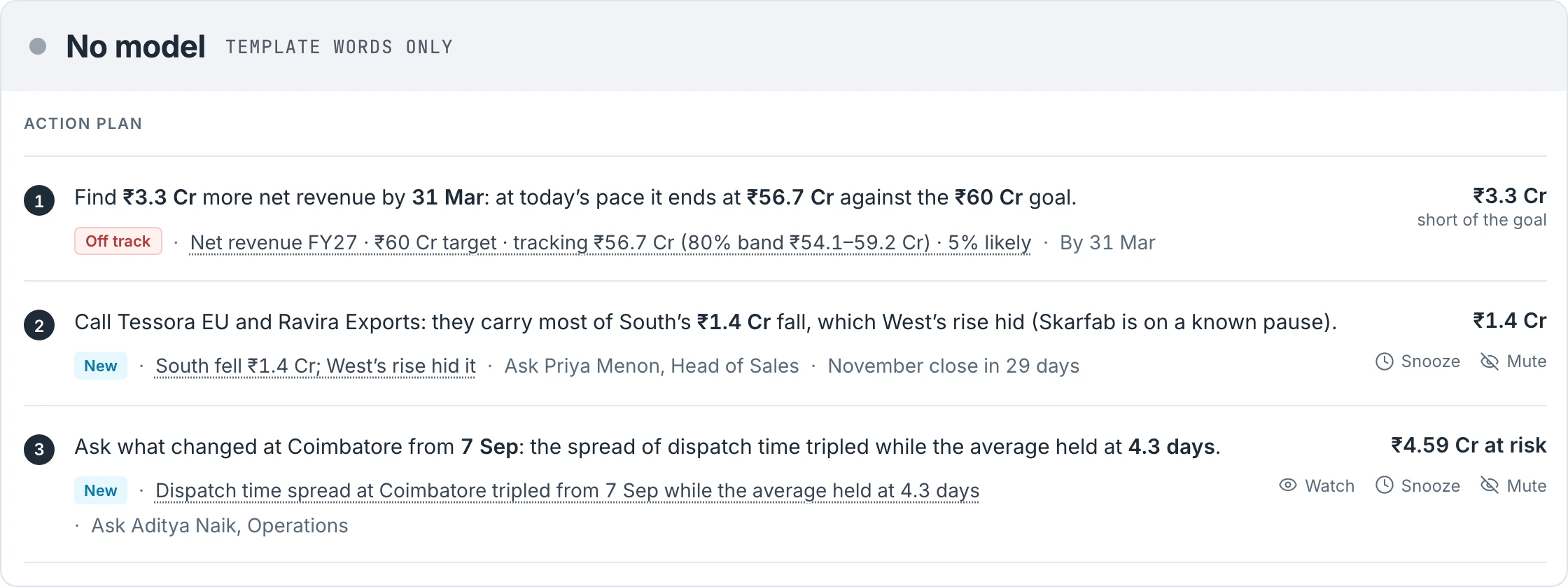
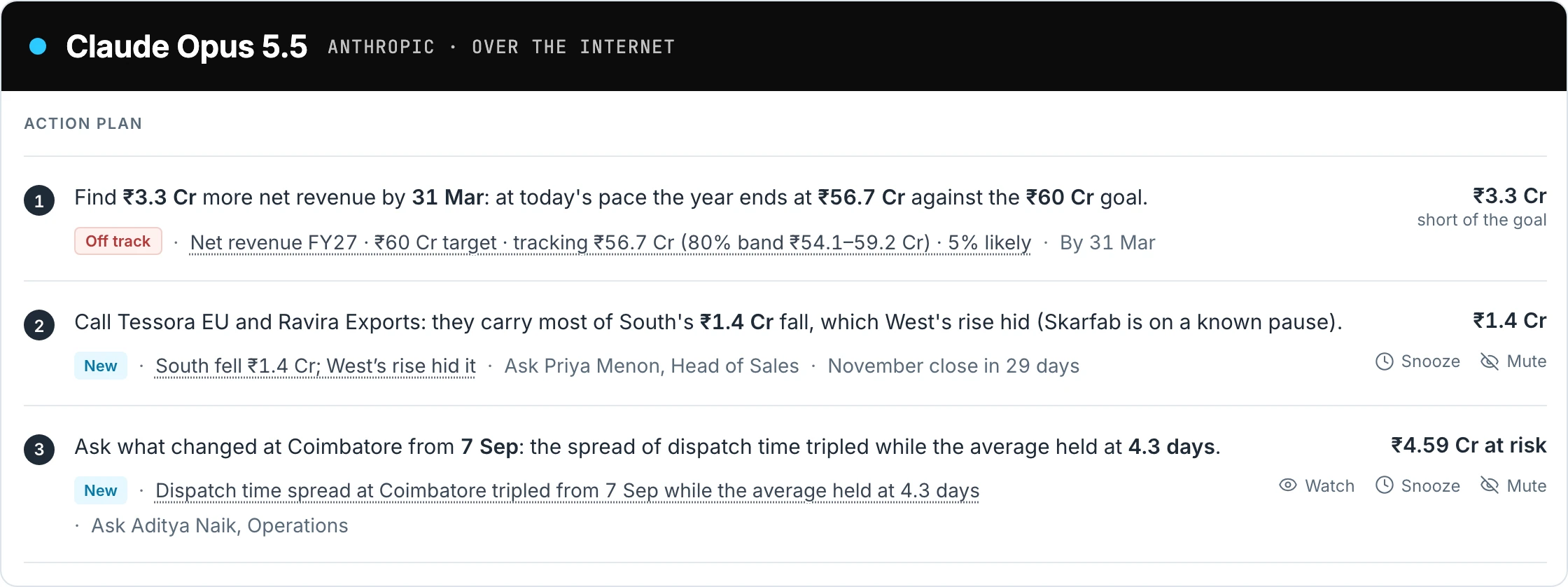
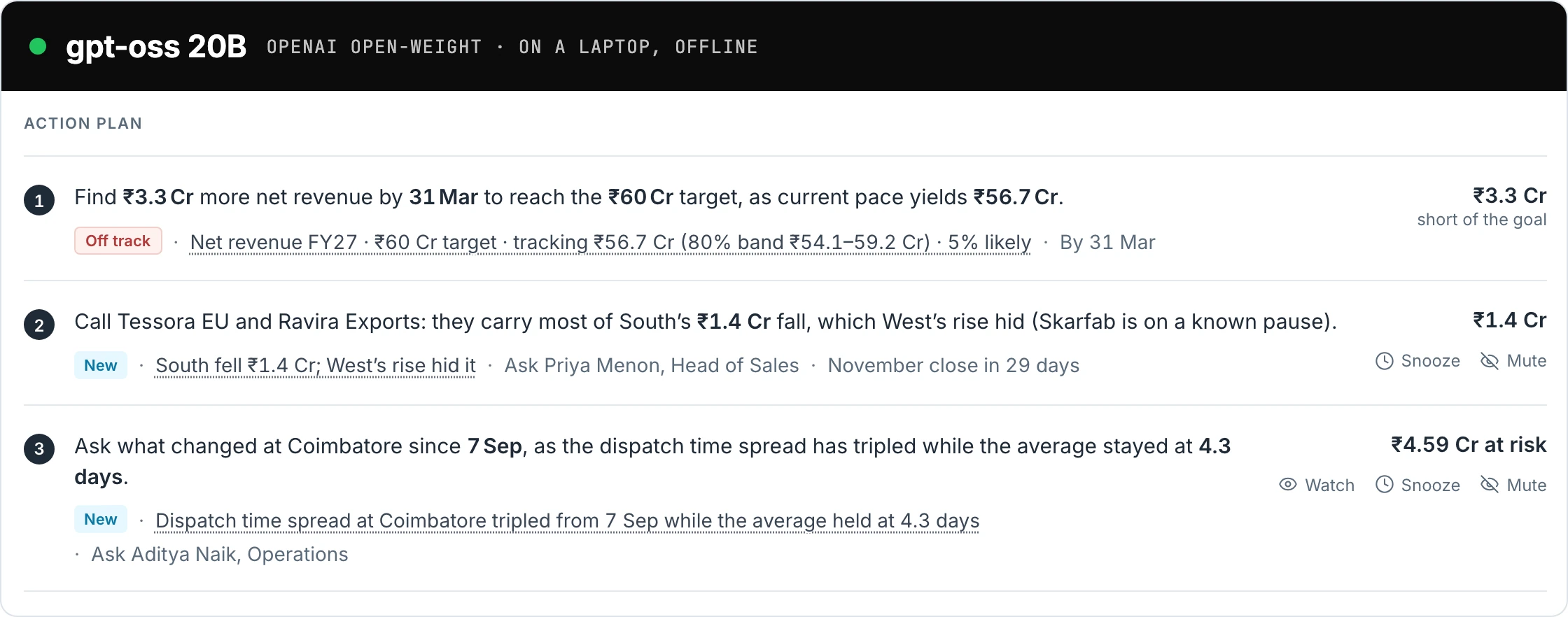
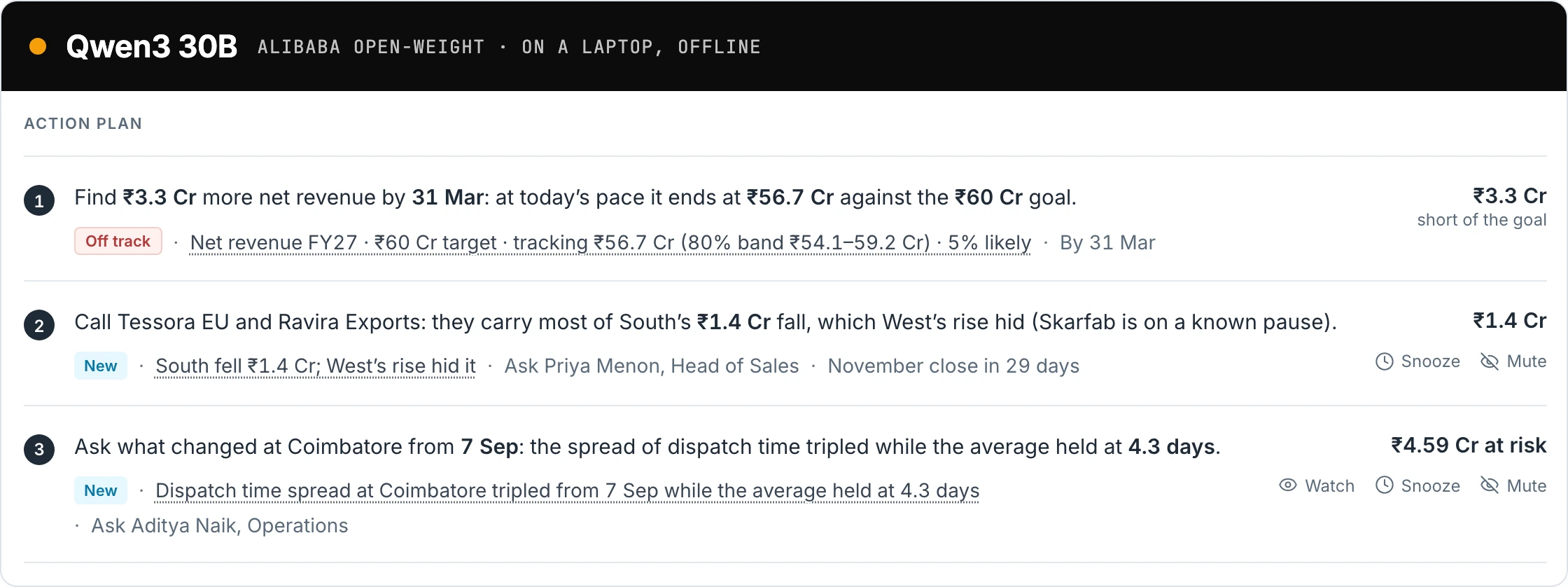
Four different sets of words, and the same four figures in every one, because none of them came from a model.
The check also earned its place. gpt-oss rewrote the second action and added "paused until 1 Dec", a date that belongs to another item, not to that action. The check didn't find it among that action's figures, so the owner sees the template sentence there instead. Nothing wrong reached the page, and nothing stopped working.
Across yesterday's wider test (10 nights, 3 models, 30 briefs), no number written by a model reached a brief.
04Job 2: a question in the chat
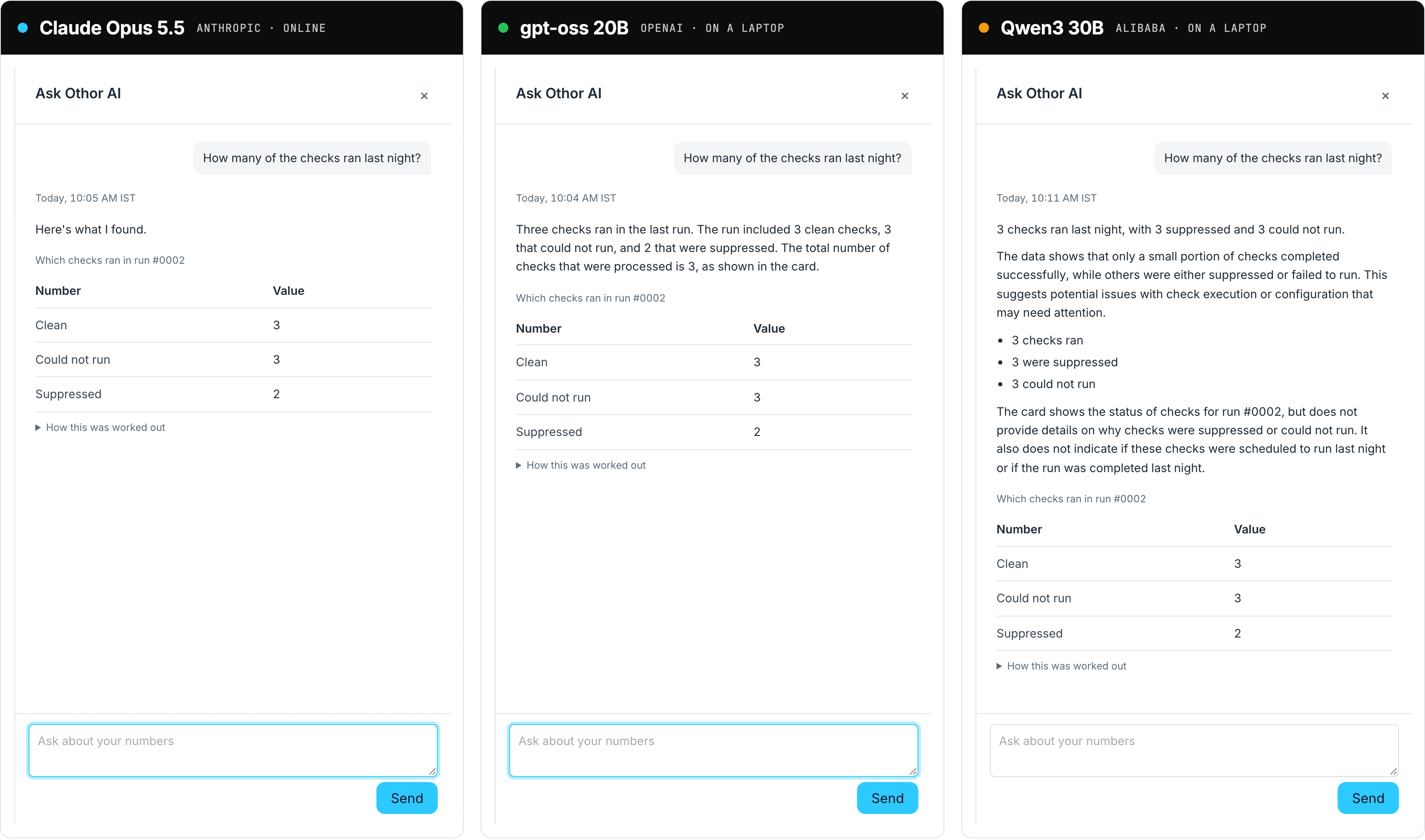
We asked each model the same question: "How many of the checks ran last night?" All three picked the right tool, and the same computed card sits under every answer: Clean 3, Could not run 3, Suppressed 2.
- Claude answered correctly, but the check threw the words away. Claude wrote the date as "1 Nov 2026", while the card stores it as 2026-11-01, so the check couldn't find "1". The owner saw only "Here's what I found." and the card: no wrong number, but no answer either.
- gpt-oss 20B repeated the card's three figures correctly, then concluded "Three checks ran in the last run". That's the wrong total: 3 were clean, 2 were held back as known patterns and 3 couldn't run.
- Qwen3 30B wrote "3 were suppressed". The card says 2.
05Where it slipped, and what we're fixing
Those last two matter, and we'd rather say so than hide it. Every number both local models wrote is a real number on the card: Qwen3's "3" belongs to "Clean", not "Suppressed", and gpt-oss's "three checks ran" is a true figure with the wrong meaning. Our check asks "is this number one we computed?", and each one was. It doesn't yet ask "is it next to the right label?", or "does the sentence draw the right conclusion?". The correct card sat right under both answers, but a reader could believe the sentence.
This was a local model on a test branch. The live product uses Claude, and running Othor AI on a local model isn't released. Still, the rule is ours, not the model's: no number shown to an owner may come from a model. So three fixes are now on our list, in the open:
- Check each number against its label, not just against the list of computed numbers (#122), and check a sentence's conclusion against the result (#120). A better route is the one we tested today in a separate experiment: the model never writes a number at all. It writes a slot, like
{n1}, and code fills in the value. A small model trained that way passed every check on 89–100% of briefs it had never seen. - Read dates the way people write them, so a correct "1 Nov 2026" isn't thrown away (#123).
- Say which sentences a model wrote and which are the template's, in the brief's (i) panel (#124).
06What this means for you
- The numbers don't depend on the model. A better model gives you better sentences and a better chat. It never gives you different figures.
- No lock-in. You can switch models without re-checking a single number.
- Private, if you want it. A model inside your own network can do the wording; the night needs no model at all.
- Outage-proof. If the model provider is down, the brief still arrives at 6:00 AM, in plain template words.
The model writes the words. Code writes the numbers. This week we found one place where a model's words could still put a right number in the wrong place, and we're closing it.
Every figure in this post comes from the app's own results on the sample company, or from our test logs of 24 and 25 Nov 2026.