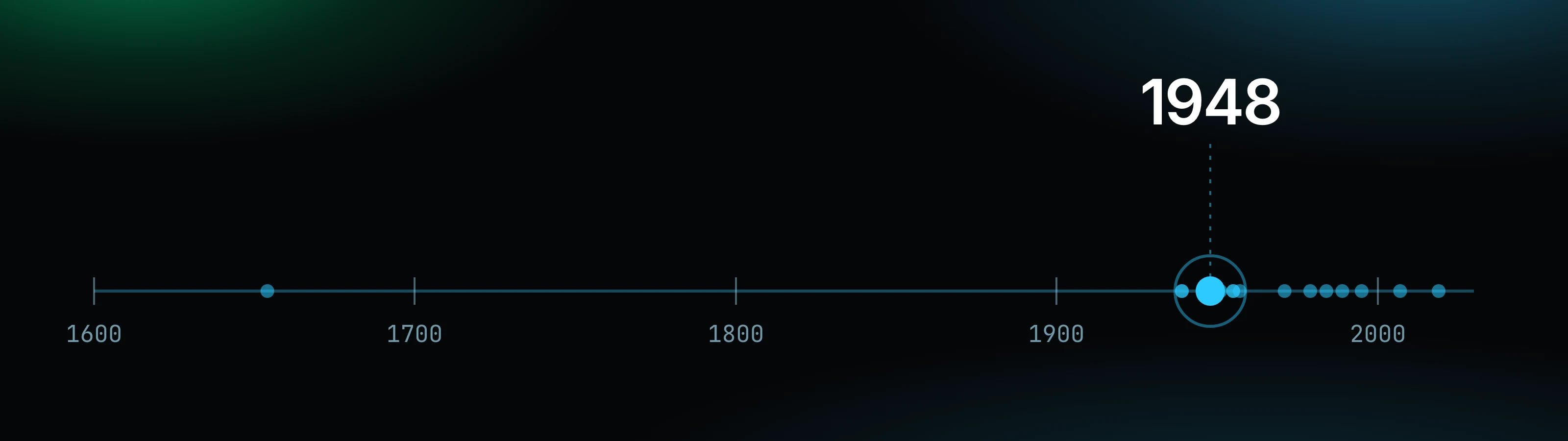
How a post-war crisis became a lesson in planning under hard limits.
01When the Sky Became a Dashboard
Decision intelligence has an origin story many business leaders don’t know. Today we rely on dashboards and analytics to make critical decisions, but there was a time when planning under constraints was literally a matter of life and death.
In 1948, the skies over Berlin became a kind of live dashboard: residents and Allied personnel looked up, counting planes and judging their chances, during one of history’s most remarkable logistical operations.
02The Crisis: Berlin Under Blockade
To understand the size of the decision, we need the context.
On 24 June 1948, the Soviet Union blockaded West Berlin, cutting road, rail and water access to the American, British and French sectors. More than two million people, along with thousands of Allied soldiers and officials, were suddenly stranded deep inside Soviet-controlled territory.
The numbers were stark. The city had stocks of food and coal for weeks, not months, and the planners’ estimates of what it needed every day ran to thousands of tons: the American commander’s first figure was 2,000 tons of food a day, and by October 1948 the target for everything, coal included, was 5,620 tons a day (Berlin Blockade).
Western leaders faced what seemed like an impossible choice:
- Abandon Berlin and give in to Soviet pressure
- Break the blockade by force, and risk another world war
- Find an entirely new way to supply a major city
03The Decision That Changed History
Instead of surrender or confrontation, the Allies made an unprecedented decision: they would supply the whole city by air, for as long as it took. The first flights left on 26 June 1948. The Americans called it Operation Vittles; the British, Operation Plainfare.
The planning challenges were immense:
- How do you feed and heat a city using only aircraft?
- How do you make the most of every aircraft’s load?
- How do you schedule flights into three small airfields (Tempelhof, Gatow and, from November, Tegel)?
- How do you keep it running day and night with limited crews and spare parts?
04Enter Dantzig: Decision Optimization Is Born
This is where the story meets the birth of modern decision intelligence. George Dantzig was a mathematician working for the U.S. Air Force, whose job in those years was planning: how to schedule training, supply and deployment for an air force. In 1947 he formulated the general linear programming problem and invented the simplex method to solve it, and from 1948 he was chief mathematician of the Air Force’s Project SCOOP, the Scientific Computation of Optimum Programs (INFORMS profile).
It is often said that the airlift was planned with the simplex method, worked out by hand. We found no primary source that shows it, and the airlift was run day to day by commanders, controllers and schedules rather than by an equation. What is true is that the airlift and Dantzig’s work came from the same place and the same years: an air force learning to plan huge operations under hard limits, and starting to do it with mathematics.
05The Simplex Algorithm Explained (Without the Math)
For business leaders without a mathematical background, here is what makes Dantzig’s approach powerful, and why it still matters:
Imagine your business has limited resources (time, money, staff) and a goal (more revenue, lower cost). You need the best way to spread your resources to reach it.
That is a problem with:
- An objective: what you want to achieve
- Constraints: what limits your options
- Variables: the things you can change
The simplex method gives a systematic way to find the best plan for problems like these. In plain language:
- Define your boundaries: write down every limit clearly
- Map the possible plans: every combination the limits allow
- Look at the corners: when there is a best plan, one of them sits at a corner, where limits meet
- Test and move: start at one corner and step to better neighbouring corners
- Stop at the best: when no neighbouring corner is better
For an operation like the airlift, the same questions apply:
- Which aircraft should carry which supplies (coal, food, medicine)
- Which routes save time and fuel
- How to schedule landings and take-offs to get the most through
- How to rotate crews and maintenance to keep going around the clock
06The Airlift in Action: Optimization at Work
The results of careful planning, and relentless improvement, were remarkable:
- In the first week the airlift averaged only about 90 tons a day
- By the second week it reached about 1,000 tons a day
- Under General William Tunner, who took command in July 1948, flights ran in tight, fixed patterns at fixed heights and intervals, and a crew that missed its landing flew home loaded rather than circling
- On 15–16 April 1949, the “Easter Parade”, 12,941 tons were delivered on 1,383 flights in 24 hours
The Soviet Union lifted the blockade on 12 May 1949, and the airlift kept flying until 30 September 1949 to build up stocks. In all, the Allies flew 278,228 flights and carried 2,334,374 tons, most of it coal (Berlin Blockade).
07The Human Element: Beyond the Algorithm
Careful planning was crucial, but the airlift also shows that decisions are made for people, and by people.
The American pilot Gail Halvorsen began dropping sweets on small handkerchief parachutes to the children watching by the runway at Tempelhof. What began as a personal gesture was taken up by his commanders as Operation Little Vittles, and the “candy bombers” became one of the best-remembered parts of the airlift, a symbol of goodwill that helped Berliners endure.
08Modern Business Applications
Today’s businesses face decisions that echo the airlift’s:
- Supply chains: how to move products efficiently through complex networks
- Resource allocation: how to spread limited budgets, people and time
- Scheduling: how to get the most from limited capacity
- Risk: how to decide well with incomplete information
The principles Dantzig set out remain at the core of modern planning tools. When your business faces constraints that seem impossible, the method of naming the variables, the limits and the goal can turn overwhelming complexity into a decision you can make.
09The Legacy for Modern Decision Intelligence
The Berlin Airlift was more than a historical triumph. It showed what disciplined planning under hard limits could achieve, in the same years that mathematics for that planning was being invented.
What took rooms of planners in 1948 is now done in seconds by software, but the core ideas are the same: know your limits, know your goal, and measure what is actually happening.
The next time you face constraints that look impossible, remember the Berlin Airlift. With clear numbers and a clear goal, even the hardest situations can show a way through.
First published on blog.othor.ai, 22 Mar 2025; revised 23 Nov 2026.