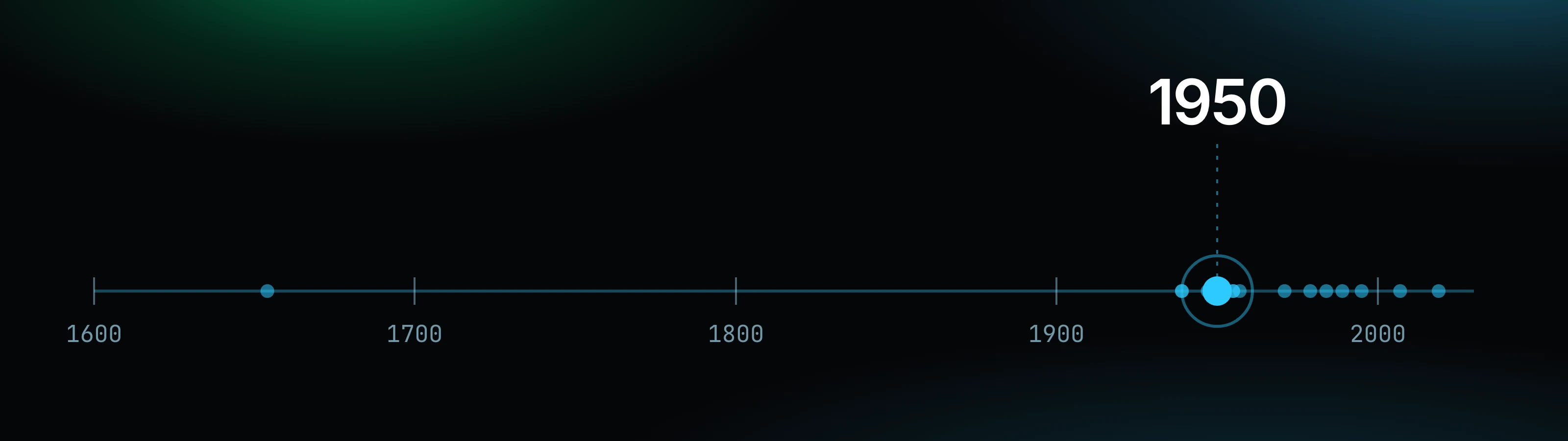
In this history of decision intelligence we’ve seen Dantzig’s simplex method and the Berlin Airlift, Kantorovich’s linear programming, von Neumann’s duality, Koopmans’ activity analysis, Bellman’s dynamic programming, Simon’s bounded rationality, stochastic programming and the first decision support systems. Each widened what we could decide well.
Yet these approaches mostly dealt with decisions where the outcome depends on nature, chance or one decision-maker’s choices. What about the far more common case, where the outcome depends on the choices of several people or organisations, each pursuing its own goals?
That dimension of decision intelligence came from John Nash, Reinhard Selten and John Harsanyi, who turned von Neumann’s first framework for games into a toolkit for strategic interaction. Their work, from 1950 to the late 1960s and beyond, earned them the 1994 Nobel Prize in Economic Sciences “for their pioneering analysis of equilibria in the theory of non-cooperative games”.
01From Zero-Sum to Non-Zero: John Nash’s Equilibrium Revolution
When John Forbes Nash Jr. arrived at Princeton as a 20-year-old graduate student in 1948, game theory was still largely defined by John von Neumann and Oskar Morgenstern’s 1944 book, Theory of Games and Economic Behavior. Its best-developed results were for zero-sum games, where one player’s gain is exactly another’s loss.
Nash saw that most real interactions aren’t zero-sum. Business competition, international relations and life inside organisations mix motives: the parties have reasons both to compete and to cooperate.
In a one-page note in 1950 and his 27-page doctoral thesis the same year, Nash introduced what we now call the Nash equilibrium: a set of strategies, one for each player, in which no player can do better by changing their own strategy while the others keep theirs. It is a deceptively simple idea that widened game theory to almost any strategic situation.
Nash proved that every finite game has at least one such equilibrium, possibly in mixed strategies, where players choose at random with chosen probabilities. The result was elegant, and it gave a lens for strategic behaviour almost anywhere people interact.
02The Corporate Strategy Application
To see what the idea does, take a market-entry decision.
Two technology companies, Alpha and Beta, are each deciding whether to enter a new market. Say the market is worth 6 to a company that has it alone, a company that enters alongside its rival loses 1 (the market can’t pay for two), and staying out is worth 0. The table gives each pair of choices, Alpha’s result first:
| Beta enters | Beta stays out | |
|---|---|---|
| Alpha enters | −1, −1 | 6, 0 |
| Alpha stays out | 0, 6 | 0, 0 |
Nash’s question is: which pairs of choices would neither company regret, once it saw what the other did? There are two: Alpha enters and Beta stays out, or the other way round. Neither is “the answer”; which one happens depends on who moves first or more convincingly.
There is also a third equilibrium, where each company enters at random with a probability of 6 in 7, the point at which entering and staying out are worth the same. In it both companies enter about 73% of the time, and both lose. Before Nash, such situations were analysed through dominant strategies or simple guesses about the rival. His idea shows why two sensible companies can still end up in the worst cell, and why commitment, timing and information matter so much: the ideas Selten and Harsanyi took further.
03The Public Sector Applications
Game theory beyond von Neumann mattered just as much for public policy and international relations. Arms control is the classic case.
Arms limitation often failed because each side feared the other would cheat. Game theorists described this as a prisoner’s dilemma: each side does better by arming whatever the other does, so both arm, though both would prefer limits.
The way out is to change the game. Verification (inspections, data exchanges, the ability to detect cheating) changes what cheating is worth, so that keeping the agreement becomes the sensible choice for both sides. That way of thinking shaped arms-control debates in the Cold War.
The same logic applies to environmental agreements: an agreement lasts when keeping it is in each country’s own interest, not only in everyone’s collective interest.
04Beyond Nash: Selten’s Perfection and Backwards Induction
Nash’s equilibrium was a revolution, but it had a weakness: some Nash equilibria rest on threats nobody would carry out if put to the test.
Reinhard Selten, a German economist, addressed this in 1965 and 1975 with the idea of subgame perfect equilibrium. Many strategic interactions unfold over time, one move after another. In such games, a sensible player looks at how each action shapes the decisions that follow.
Selten required that strategies be sensible at every point in the game, which is found by reasoning backwards from the end (backward induction). That removes the equilibria that depend on threats that wouldn’t be carried out.
This has a direct business reading. An incumbent that threatens a price war against any newcomer has to ask whether, once the newcomer is in, a price war would really be in its own interest. If not, the threat isn’t credible, and a newcomer reasoning like Selten will ignore it. Credible deterrence comes from commitments that change the incumbent’s own interests, such as capacity already built, not from words.
05Incomplete Information: Harsanyi’s Bayesian Games
Early game theory also assumed that every player knows the game’s structure, including everyone else’s payoffs. John Harsanyi, a Hungarian-American economist, saw that most real strategic situations involve real uncertainty about the others’ motives, abilities and payoffs.
In a three-part paper in 1967 and 1968, Harsanyi introduced what we now call Bayesian games. His key move was to treat a game with unknown payoffs as one in which “nature” first assigns each player a type at random, by probabilities everyone knows, and each player knows only their own type.
That made a vast range of situations analysable: negotiations where each side knows only its own limit, auctions where bidders value the item privately, competition where companies know only their own costs, and conflicts where each side knows only its own resolve.
In a negotiation, for example, it means treating the other party not as one known opponent but as one of several possible types, each with its own walk-away point and its own likelihood, and choosing offers that do well across them.
06The Organization in Strategic Context
Together, Nash, Selten and Harsanyi changed how organisations can think about their strategic position. The competitive environment is no longer fixed or predictable: other intelligent players will respond to one’s choices, and their responses have to be thought through.
That shift shows up in three changes of approach:
- From static to dynamic planning: looking at interactions over several periods rather than one-off decisions.
- From prediction to strategic resilience: instead of predicting exactly what competitors will do, finding strategies that hold up across their possible responses.
- From isolated to ecosystem thinking: looking beyond direct competitors to complementors, regulators, suppliers and others whose decisions interact with one’s own.
Platforms are a good example. A platform’s value depends on the choices of hardware makers, software developers and users, each waiting to see what the others do. Such markets can settle in more than one equilibrium, and a platform’s policies are, in effect, attempts to steer everyone towards the one it wants.
07From Theory to Practice: The Evolution of Applications
Nash, Selten and Harsanyi’s work began as mathematical economics. Its uses grew in roughly four phases:
Early uses (1950s–1970s): the analysis of industries with few competitors, and nuclear deterrence strategy. These stayed largely academic.
Business strategy (1980s): game-theoretic ideas about competitors’ moves and countermoves entered business-school strategy teaching and consulting, later popularised in books such as Dixit and Nalebuff’s Thinking Strategically (1991).
Mechanism design (1980s–1990s): economists began designing markets, auctions and regulations so that the participants’ own strategic behaviour would produce the outcome wanted: game theory run in reverse.
Computation (1990s): more computing power made it possible to analyse game models too complex to solve by hand, with many players and complex structures.
By the time Nash, Selten and Harsanyi received their Nobel Prize in 1994, game theory had grown from a mathematical curiosity into an essential part of decision-making in business, policy and international relations.
08The Corporate Tournament: Competitive Dynamics
One of the most influential uses of the expanded theory is in the analysis of competitive dynamics: how moves and countermoves between companies unfold over time.
Route competition between airlines is a textbook case. Treated as a game that unfolds in turns, with each airline unsure of the other’s costs, it separates the responses that are credible from the ones that are posturing, and so shows where entry is likely to go unchallenged and where it will start a costly fight.
Promotions are another. A promotion that ignores competitors’ likely reactions can start a promotional war in which everyone gives away margin and nobody gains share; thinking about the reactions first is how such wars are avoided.
09The Ethical Dimension: Values in Strategic Interaction
Like other decision frameworks, game theory raises questions about how we value different outcomes and whose interests count. The Nash equilibrium describes what rational players would do; it says nothing about what is best for everyone.
The gap is starkest in the prisoner’s dilemma, where the equilibrium (both defect) is worse for both than cooperating. The pattern appears in many real settings:
- Environmental protection, where each party gains by polluting but all lose together
- Industry self-regulation, where each firm gains by cutting corners but the standards everyone relies on suffer
- Sharing knowledge inside organisations, where each person gains by hoarding but everyone gains from sharing
Closing that gap needs more than non-cooperative game theory: mechanism design, repeated games, reputation and cooperative solutions, many of them developed in the decades after Nash’s first work.
International trade agreements are an example: rules with enforcement make free trade a stable choice for each country despite the pull towards protection. Game theory helps design institutions in which what is good for each matches what is good for all.
10The Computational Revolution: From Theory to Simulation
From the 1990s, more computing power changed how game theory could be used. Situations too complex to solve on paper could be explored by simulation, agent-based models and numerical methods.
Auctions for offshore oil and gas leases are a classic field: a bidder has to weigh its own estimate of a block’s value against what its rivals might bid, knowing that the winner is often the one who overestimated most (the “winner’s curse”). Financial markets are another: a large trade moves prices, and other participants respond to it, so a model that treats prices as given misses the game.
11Conclusion: The Strategic Dimension of Decision Intelligence
The expansion of game theory beyond von Neumann, through the work of Nash, Selten, Harsanyi and many others, added an essential dimension to decision intelligence. Earlier frameworks gave tools for optimisation, allocation, decisions over time and uncertainty; game theory added strategy: how to decide when the outcome depends on the choices of others pursuing their own goals.
That dimension matters in a connected world where few important decisions are made alone. From business strategy to international relations, from market design to incentives inside organisations, it gives a systematic way to think through strategic interaction.
The next time you weigh a competitor’s response to a move, design incentives in your organisation, or negotiate with a partner who knows things you don’t, remember Nash, Selten and Harsanyi. Their mathematics turned decisions that once rested on intuition into decisions that can be reasoned through.
12References
- Nash, J. F. (1950). Equilibrium points in n-person games. Proceedings of the National Academy of Sciences, 36(1), 48–49.
- Selten, R. (1975). Reexamination of the perfectness concept for equilibrium points in extensive games. International Journal of Game Theory, 4(1), 25–55.
- Harsanyi, J. C. (1967–1968). Games with incomplete information played by “Bayesian” players, Parts I–III. Management Science, 14(3, 5, 7), 159–182, 320–334, 486–502.
- Dixit, A. K., & Nalebuff, B. J. (1991). Thinking strategically: The competitive edge in business, politics, and everyday life. W. W. Norton.
- Brandenburger, A. M., & Nalebuff, B. J. (1996). Co-opetition.
First published on blog.othor.ai, 20 May 2025; revised 23 Nov 2026.