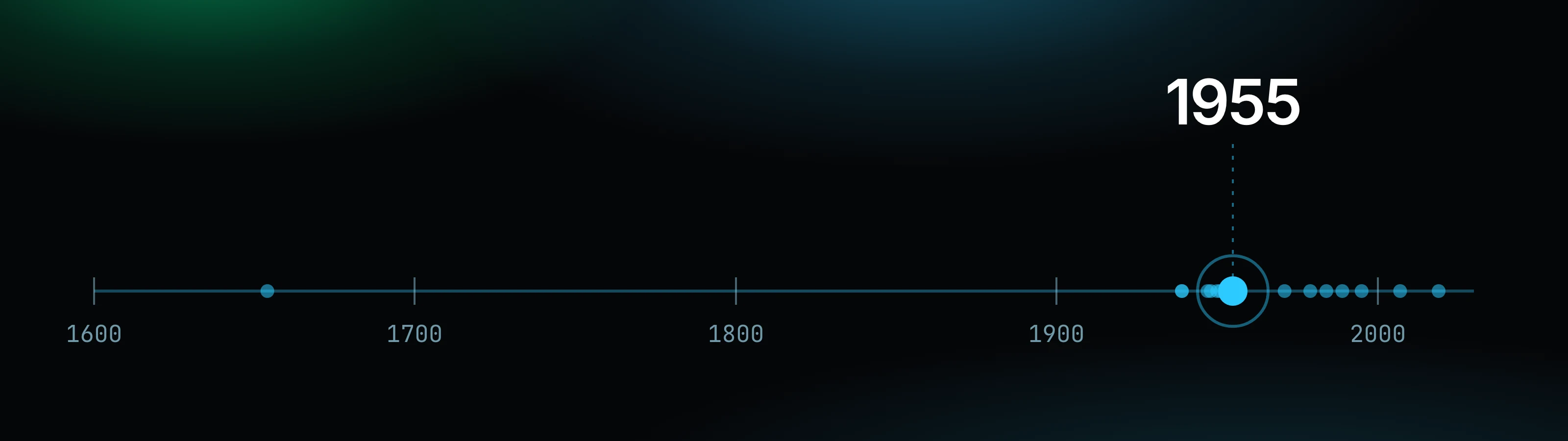
In this history of decision intelligence we’ve followed Dantzig’s simplex method and the Berlin Airlift, Kantorovich’s linear programming, von Neumann’s duality, Koopmans’ activity analysis and Bellman’s dynamic programming. These mathematical frameworks changed how we approach optimisation. Yet one piece was missing: a realistic account of how people actually decide.
Enter Herbert A. Simon, whose theory of bounded rationality challenged the prevailing view and brought the human being to the centre of decision intelligence.
01The Polymath Who Humanized Decision Science
When Herbert Simon began questioning the dominant economic theory of his day in the mid-1950s, he was already a scholar whose work crossed political science, economics, psychology, and later computer science and artificial intelligence. That breadth was what a theory bridging mathematical optimisation and human thinking needed.
Unlike those who worked mainly on the mathematics, Simon was fascinated by how people actually made decisions. His observations led to a deep insight: people don’t behave like the perfectly rational agents of classical economic theory. They work within real limits, and the limits change how decisions get made.
02The Revolutionary Insight: Rationality Has Limits
Simon’s 1955 paper, “A Behavioral Model of Rational Choice”, offered a very different view of decision-making. In plain terms, it says human rationality is bounded by three kinds of limit:
- Limited information: decision-makers rarely know all the possibilities.
- Limited capacity: the human mind can only process so much.
- Limited time: most real decisions must be made before an exhaustive analysis is possible.
So the optimising models of Kantorovich, Dantzig and others, elegant as they were, didn’t describe how people actually decide. Instead of optimising, Simon proposed, people “satisfice”: they look for a solution that is good enough rather than the best.
The idea mattered because it moved attention from finding the theoretically best answer to designing ways of deciding that work within human limits. As Simon put it in Models of Man (1957): “The capacity of the human mind for formulating and solving complex problems is very small compared with the size of the problems whose solution is required for objectively rational behavior in the real world.”
03Satisficing: The Practical Alternative to Optimization
Satisficing (a blend of “satisfy” and “suffice”) is a different way of deciding from the optimisation methods that led operations research. Instead of comparing every possible option, the decision-maker sets an aspiration level, a threshold of what is acceptable, and takes the first option that meets it.
That is how executives, policymakers and individuals actually behave when a decision is complex and time is short. Instead of calculating the theoretically best answer, often impossible in practice, they:
- Simplify the problem until it can be handled
- Look at options one after another
- Stop when they find an acceptable one
When a chief executive needs to fill a key role, for example, they don’t evaluate every possible candidate in the market. They set out what an acceptable candidate looks like, interview a limited set of people, and choose the first who meets the bar. The process may not find the single best person in theory, but it finds one good enough, within the time and information the executive has.
04The Corporate Strategy Application
To see what bounded rationality changes, consider strategic decisions in a large company.
A multinational technology company is choosing between five possible market expansions, each with its own investment, risk and potential return. Textbook optimisation would gather full data on every option, estimate the probability of every outcome, and choose the option with the highest expected value.
Simon’s insight explains why that rarely happens. Executives face:
- Unclear data about each market’s potential
- A limited capacity to compare options on many dimensions at once
- Time pressure, before the opportunity is gone
- Internal politics that shape how options are judged
A company that takes these limits seriously can design its planning around them instead of pretending to optimise. It can:
- Set clear minimums for acceptable return and maximums for acceptable risk
- Look at opportunities in order, starting with those closest to what it already does well
- Take the first option that clears both bars, rather than analysing every possibility to the end
The trade is explicit: a “good enough” choice made in time can be worth more than the theoretically best choice made too late.
05Public Policy Through the Lens of Bounded Rationality
Simon’s work matters just as much for government. Consider how a state government allocates a limited healthcare budget across competing priorities:
- Hospital buildings and equipment
- Preventive care
- Medical research grants
- Rural access to care
- Mental health services
Textbook optimisation would build one model of every factor, limit and outcome and compute the best split. Simon’s work explains why policymakers rarely work that way. They face:
- Incomplete evidence about what each programme achieves
- The limits of understanding complex social systems
- Political calendars that favour visible short-term results
- Departments that don’t share information
A budget process designed with bounded rationality in mind looks different. Rather than attempting one grand optimisation, it:
- Sets minimum targets for a few key health measures
- Finds the “good enough” funding for each area to meet those targets
- Adjusts step by step as results come in, instead of re-planning everything at once
That is close to what Charles Lindblom called “muddling through”: decisions that people can actually make, check and correct.
06From Individual to Organizational Decision-Making
One of Simon’s most important contributions was carrying bounded rationality from the individual to the organisation. In his 1947 book Administrative Behavior, he analysed how structures, rules and culture shape the decisions an organisation makes.
Organisations, Simon observed, cope with bounded rationality through:
- Division of attention: different units attend to different parts of a problem
- Standard procedures: routines that simplify decisions that recur
- Hierarchy: breaking complex problems into parts people can handle
- Organisational memory: written-down knowledge that makes up for what any one person can hold
That view still shapes how good organisations work. Rather than designing processes that assume perfect rationality, they build structures that work with human limits.
Amazon’s “two-pizza teams” (teams small enough to be fed by two pizzas) echo the same insight: by keeping groups small and decisions local, an organisation avoids the coordination costs that make bounded rationality bite harder.
07The Nobel Recognition and Beyond
Simon received the 1978 Nobel Prize in Economic Sciences “for his pioneering research into the decision-making process within economic organizations”. The recognition mattered because his work challenged the model of the perfectly rational actor that dominated economics.
In his Nobel lecture, Simon put the choice plainly: “decision makers can satisfice either by finding optimum solutions for a simplified world, or by finding satisfactory solutions for a more realistic world.” That insight still shapes decision intelligence today.
Simon’s work bridges the optimisation methods of Kantorovich, Dantzig and von Neumann and the messy reality of human decisions. The earlier work gave formal methods for finding the best solution; Simon explained why those methods alone were not enough, and how they had to be adapted to human limits.
08The Computational Dimension: AI and Expert Systems
Simon’s influence reaches into artificial intelligence. A pioneer of the field, he saw that bounded rationality applies not only to people but to any system with limited resources.
His work with Allen Newell on heuristic problem-solving (rules of thumb that usually work, instead of exhaustive search) shaped expert systems and AI methods that prefer practical answers to theoretical perfection. The view still matters: even today’s computers cannot examine every possibility in most real problems.
Chess shows both sides. When IBM’s Deep Blue defeated Garry Kasparov in 1997, it could not examine every possible line of play; it searched as deep as it could and judged the positions at the end with an evaluation function. It searched far more than any person, but it, too, had to settle for “good enough” within its limits.
09Modern Applications: Behavioral Economics and Nudge Theory
Simon’s bounded rationality laid the ground for behavioural economics. Researchers such as Daniel Kahneman, Amos Tversky and Richard Thaler built on his insight to identify specific biases and rules of thumb that shape human decisions.
Those findings are now used across many fields:
- Marketing: how consumers choose when there is too much information
- Finance: investment approaches that allow for common biases
- Healthcare: helping patients make better treatment decisions
- Public policy: “nudges” that steer people towards better choices without removing their freedom
When the UK government set up its Behavioural Insights Team (the “Nudge Unit”) in 2010, it put the same insight to work in public policy. One of its best-known trials changed the wording of tax reminder letters, adding that most people pay on time, and more people paid promptly as a result (Hallsworth and colleagues, 2017).
10The Ethical Dimension: Values in Satisficing
Bounded rationality has ethical consequences. When decision-makers satisfice rather than optimise, the thresholds they set for “good enough” carry value judgements that can stay hidden and unexamined.
When a hospital administrator decides how to allocate scarce resources in a crisis, for example, the bars set for patient survival, staff safety and cost reflect priorities that deserve to be stated openly.
Those value choices are better made in the open than hidden behind what looks like purely technical analysis. That matters all the more in modern decision tools, where algorithms often build values into their goals and limits without saying so.
11Conclusion: The Human Reality Behind Decision Intelligence
Herbert Simon’s bounded rationality connects formal mathematical methods to the reality of human thinking. The earlier pioneers gave us powerful tools for optimisation; Simon explained why, and how, those tools had to be adapted to human limits.
In an age of big data, machine learning and artificial intelligence, his insight is as relevant as ever. Computing power grows, but the limits he named (limited information, limited capacity to process it, and limited time) still shape decisions in businesses, governments and organisations of every kind.
Good decision tools take that reality seriously. Rather than chasing theoretical optimisation at any cost, they work with how people decide: simplifying what is complex, pointing attention to what matters most, and helping find answers that are good enough in the real world.
When you design a decision process for your organisation, remember Simon’s insight: perfect rationality is a mathematical fiction, but good decisions within limits are achievable. The goal is not to remove the limits but to understand them, and to design for them.
12References
- Simon, H. A. (1955). A behavioral model of rational choice. The Quarterly Journal of Economics, 69(1), 99–118.
- Simon, H. A. (1947). Administrative behavior: A study of decision-making processes in administrative organization. Macmillan.
- Simon, H. A. (1957). Models of man: Social and rational. Wiley.
- Simon, H. A. (1978). Rational decision-making in business organizations. Nobel Prize lecture.
- Hallsworth, M., List, J. A., Metcalfe, R. D., & Vlaev, I. (2017). The behavioralist as tax collector. Journal of Public Economics, 148, 14–31.
First published on blog.othor.ai, 1 May 2025; revised 23 Nov 2026.