Few ideas behind today’s decision tools have had as deep an impact as duality. While Kantorovich’s linear programming laid the foundation for optimization and the Berlin Airlift showed what planning under hard limits could do, it was John von Neumann who saw a principle that changed how we understand decision problems with constraints.
01The Hungarian Polymath
John von Neumann was already a legendary mathematician when he made his contribution to what would become decision intelligence. Born in Budapest in 1903, he worked across an astonishing range of fields, from quantum physics to computer science, from economics to nuclear research.
Unlike Kantorovich, who came to linear programming through a practical problem at a plywood trust, von Neumann came to duality from his theory of games: in 1928 he proved the minimax theorem for two-person games, and in 1944, with Oskar Morgenstern, he published Theory of Games and Economic Behavior. His gift for seeing the same structure in different problems would prove crucial.
02The Dual Perspective
At its core, duality is a simple-sounding insight: every linear optimization problem (the “primal”) comes paired with a second problem (the “dual”), built from the same numbers, that looks at it from the other side. The relationship between the two is not merely academic: it tells you how valuable each of your limits is.
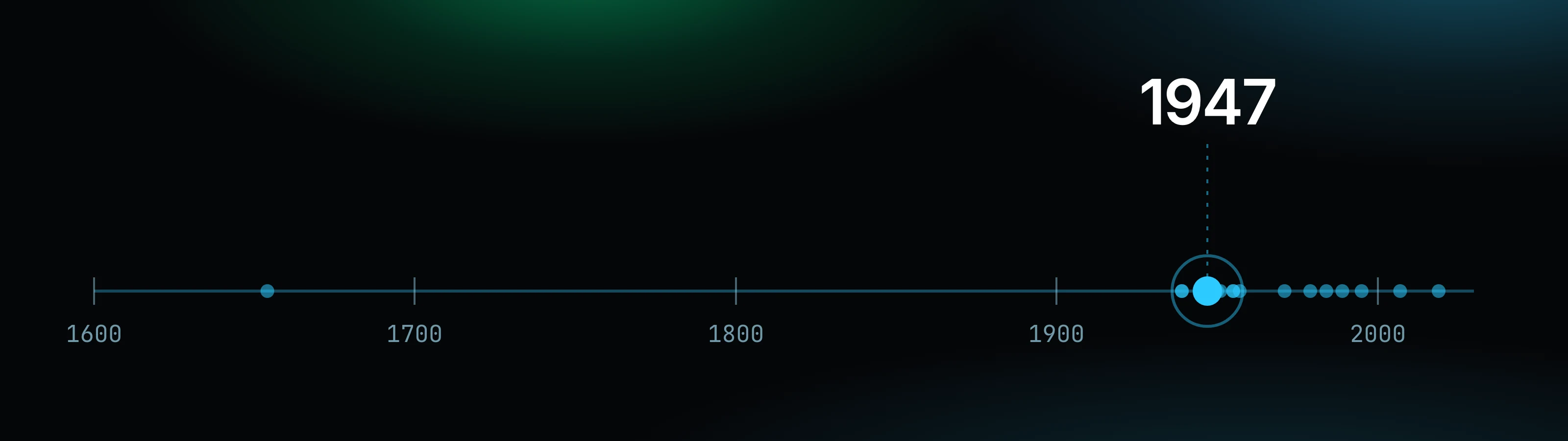
The story of how it was found is well known. In October 1947, George Dantzig visited von Neumann in Princeton to describe the linear programming problem. As Dantzig later told it, von Neumann listened and then, almost at once, sketched the dual problem and its link to his theory of games (Dantzig, 2002). The full proof of the duality theorem was published in 1951 by David Gale, Harold Kuhn and Albert Tucker.
03Mathematical Elegance with Practical Implications
The duality theorem says that:
- If the primal problem has a best solution, so does the dual
- The two best values are equal
- At the best solutions, a limit that is not fully used has a dual value of zero, and a dual value above zero means its limit is fully used (complementary slackness)
What makes this powerful for decisions is that the dual variables mean something concrete: each is the extra value one more unit of a resource would bring, its “shadow price”. That link between abstract mathematics and economic meaning turned duality from a theoretical curiosity into a practical tool.
04Duality in Action: A Corporate Strategy Example
Consider a technology company deciding how to spread a $10 million R&D budget across five product features. Each feature needs different amounts of research, engineering and marketing time, and promises different revenue.
The primal problem asks: “How should we spend the budget to earn the most?”
The dual asks the complementary question: “What is one more unit of each resource worth to us?” If the answer says an extra engineering month is worth far more than an extra marketing month, the company knows where adding capacity pays, before it spends anything. Rather than accepting its limits as fixed, it can see which limit is worth moving.
05The Government Policy Application
Duality also changes how public bodies can think about their choices. Consider a state government choosing among infrastructure projects:
- Highway expansion: $50M, benefits 200,000 citizens
- Bridge repairs: $30M, benefits 120,000 citizens
- Public transit: $40M, benefits 150,000 citizens
- Airport renovation: $60M, benefits 180,000 citizens
With a $100M budget, the best choice of whole projects is the highway and public transit: 350,000 citizens served for $90M. The next best, transit and the airport, serves 330,000 and spends the full $100M.
Whole projects make the arithmetic lumpy, so there is no neat price per extra dollar here. But the dual question still guides the conversation: what would more budget buy? With $120M, the highway, bridge repairs and transit fit together and serve 470,000. Knowing that the next $20M is worth 120,000 more citizens is exactly the kind of answer policymakers need when they argue for, or against, a bigger budget.
06The Game Theory Connection
What truly set von Neumann’s contribution apart was the link between duality and games. A two-person zero-sum game (where one player’s gain is the other’s loss) can be written as a pair of linear programs that are dual to each other: one player’s best mixed strategy solves one, the opponent’s solves the other, and the value of the game is the shared best value.
That gives a precise way to think about strategy against an opponent who is also optimizing: find the plan whose worst case is as good as possible. Most real competition between companies is not zero-sum, and later game theory (Nash, Selten and Harsanyi) was needed for it, but the habit of looking at a decision from the other side starts here.
07From Cold War to Corporate Boardrooms
Duality found early use in military planning during the Cold War. The RAND Corporation, set up in 1948 to connect military planning with research, became a centre for linear programming and game theory.
From the 1950s, linear programming and its shadow prices moved into industry, first in oil refining and production planning, and later into capital budgeting and investment decisions. Today, whenever an executive looks at an analysis of how a result would change if a limit moved, they are using an idea that duality made precise.
09The Modern Evolution: Duality in Machine Learning
Duality has travelled far beyond linear programming. In machine learning, support vector machines are usually solved through their dual form, which turns a hard problem into a more tractable one, and the Lagrangian dual is a standard tool for optimization with constraints.
These ideas sit underneath many of the methods behind image recognition, language processing and recommendation systems.
10The Ethical Dimension
As with all powerful mathematical tools, duality raises ethical questions. The dual can reveal the value of resources that organisations might prefer to keep private.
When a health system uses optimization to allocate scarce medical resources, the dual effectively puts a price on particular health outcomes. That raises hard questions about how we value human life and well-being in our decisions, and those questions are better asked openly than hidden in a model.
Von Neumann knew how far mathematics could reach: he worked on the Manhattan Project and on the design of the first computers. His career is a reminder that mathematical tools carry consequences well beyond the page.
11Conclusion: The Two-Sided Legacy
Von Neumann’s duality is a fundamental insight into optimization and decision-making. By showing that every such problem has a second side, he gave decision-makers a way to understand trade-offs, see opportunities and work within limits.
From corporate strategy to public policy, from portfolios to supply chains, duality still shapes how we approach critical decisions. Seeing both the allocation question and the value question is now part of deciding well.
The next time you face a decision with many limits and goals, remember von Neumann’s insight: every problem has two faces, and wisdom comes from seeing both.
First published on blog.othor.ai, 8 Apr 2025; revised 23 Nov 2026.