
A good customer stops ordering. Within a minute, someone in the room has the explanation: they've gone to a competitor. From then on, the search is for support. A rival's new price list, a remark from a sales rep, a soft month in the region. Each piece seems to fit, and the story hardens into a fact nobody actually checked.
Intelligence analysts know this trap well. Richards Heuer, a CIA veteran, described it in Psychology of Intelligence Analysis, published by the agency's Center for the Study of Intelligence in 1999. His fix is a method with a plain name: the analysis of competing hypotheses.
01The first answer that seems good enough
Heuer describes how most analysts work: pick the answer that seems most likely, then look at the information to see whether it supports that answer. If it does, they stop. He borrows a term from decision analysis, one coined by Herbert Simon: satisficing, "picking the first solution that seems satisfactory, rather than going through all the possibilities to identify the very best solution."
The weakness, he writes, is that analysts "fail to recognize that most of this evidence is also consistent with other explanations". The evidence for the favourite feels strong because nobody asked whether it fits the other explanations just as well.
02Eight steps, one reversal
Heuer's method sets every reasonable explanation against every piece of evidence, in a table, at the same time. The book lays it out in eight steps:
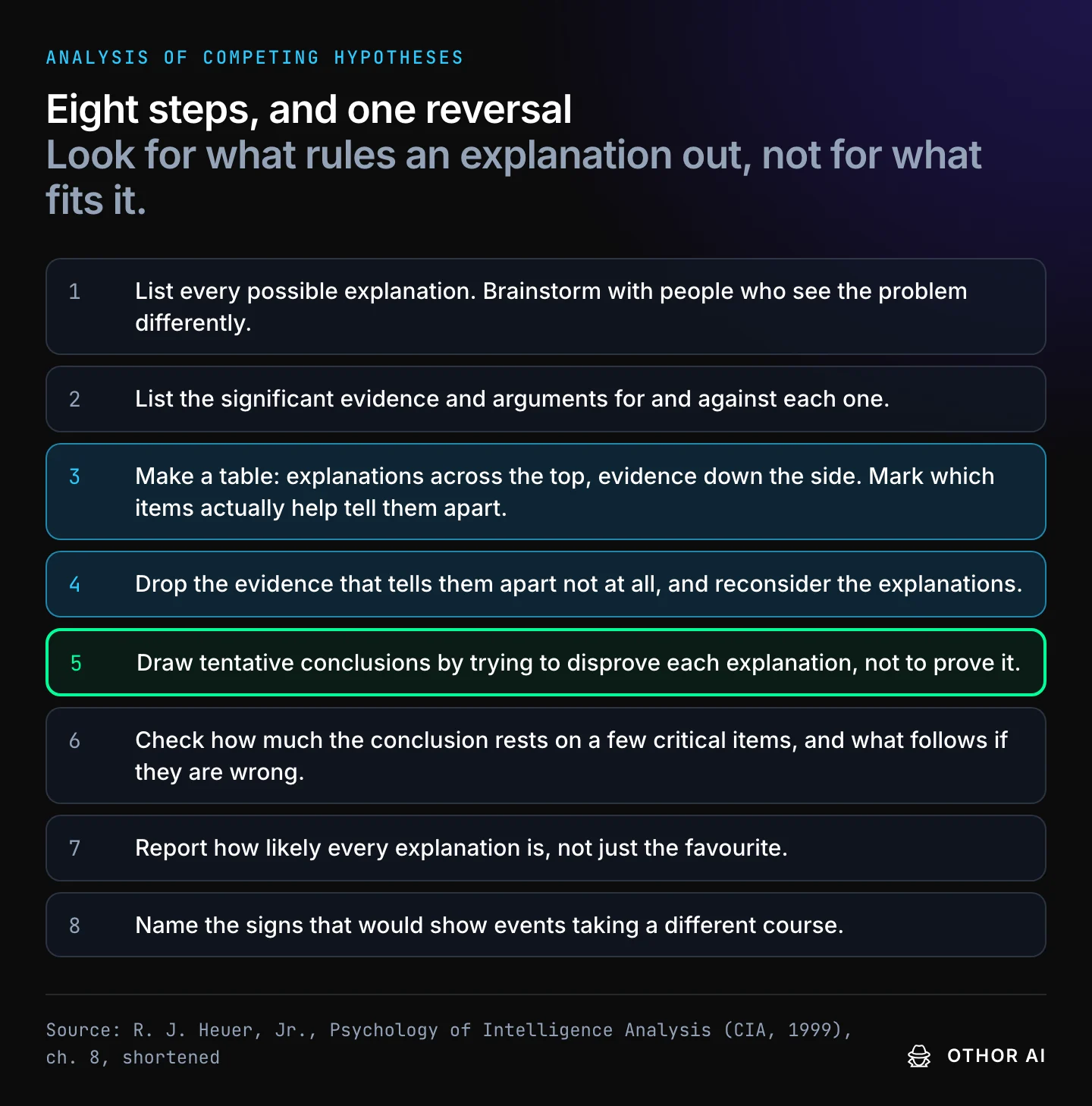
Two ideas carry most of the weight.
Some evidence tells you nothing. Heuer calls the useful kind diagnostic. His example is a doctor: a high temperature tells the doctor that the patient is sick, but very little about which illness, "because a high temperature is consistent with so many possible hypotheses". A piece of evidence that fits every explanation can't help choose between them, however strongly it seems to support yours.
Count what's against, not what's for. "The most probable hypothesis is usually the one with the least evidence against it, not the one with the most evidence for it." One solid fact that doesn't fit can rule an explanation out. A pile of facts that fit can't prove it.
03The same table for a quiet customer
Here is the table for a case from our invented sample company, Indigo Thread Co. On the night of 1 November, its customer Ravira Exports had sent no invoice since 9 October, with ₹0.36 Cr at stake. Othor AI keeps a fixed list of possible reasons for a customer who goes quiet: they moved to a competitor, they are on hold, or their billing moved to another company. Set against the evidence, it looks like this:
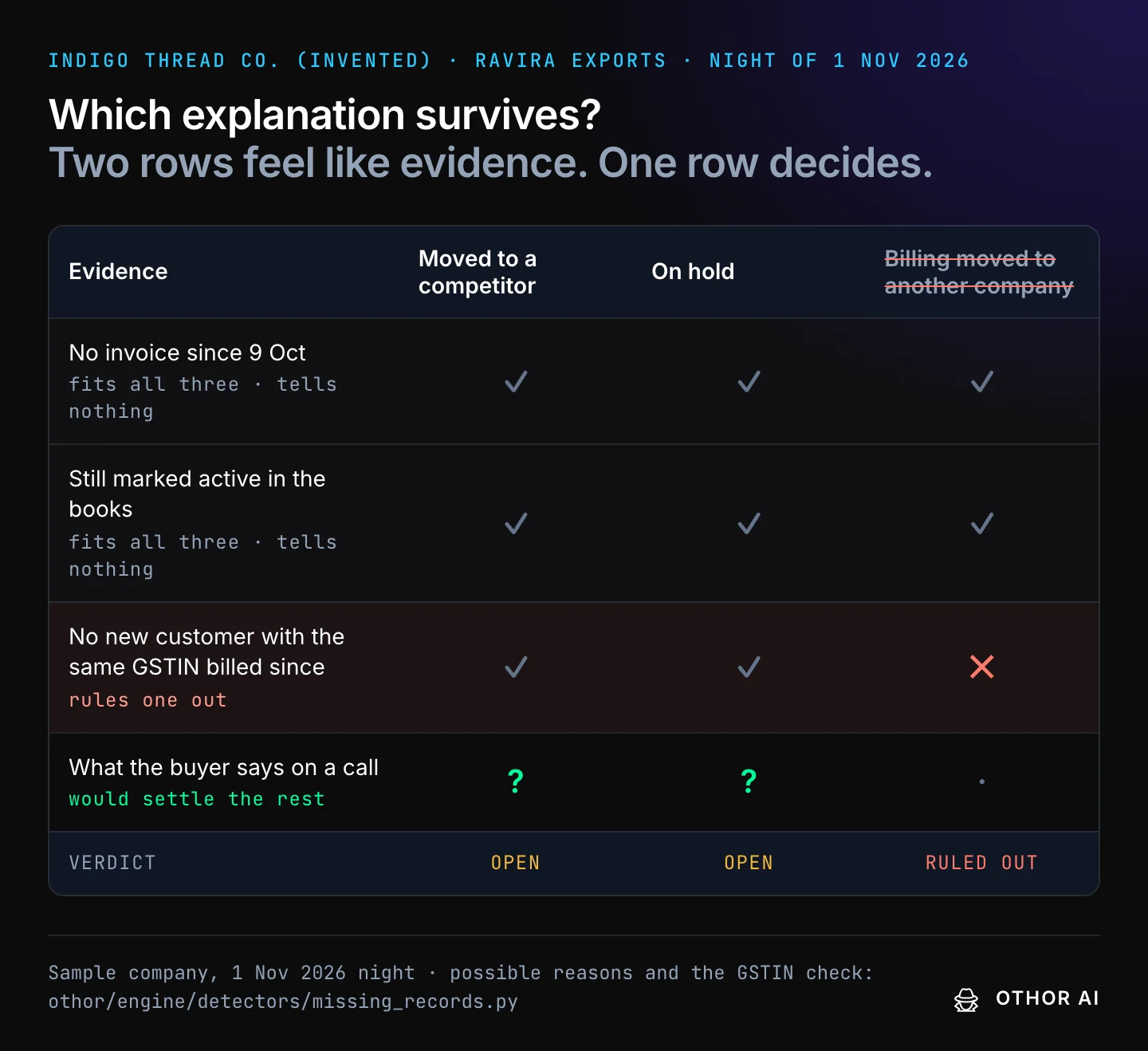
The first two rows are the high temperature. "No invoice since 9 October" is the reason anyone is looking, and "still marked active" is just as true whichever story is right. Neither moves the odds at all.
The third row is the one that counts. If the customer's billing had moved to a new company, that company would usually carry the same tax number. Othor AI looks for a new customer with the same GSTIN billed since the last invoice. For Ravira, it found none, so that explanation is ruled out.
The other two survive, and no figure in the books can separate them. So Othor AI doesn't pick one. The finding is tagged Not determinable, the two that remain are listed, and the brief's question for the day goes to the person who can find out: the head of sales, who can call the buyer.
04Unproven is not disproved
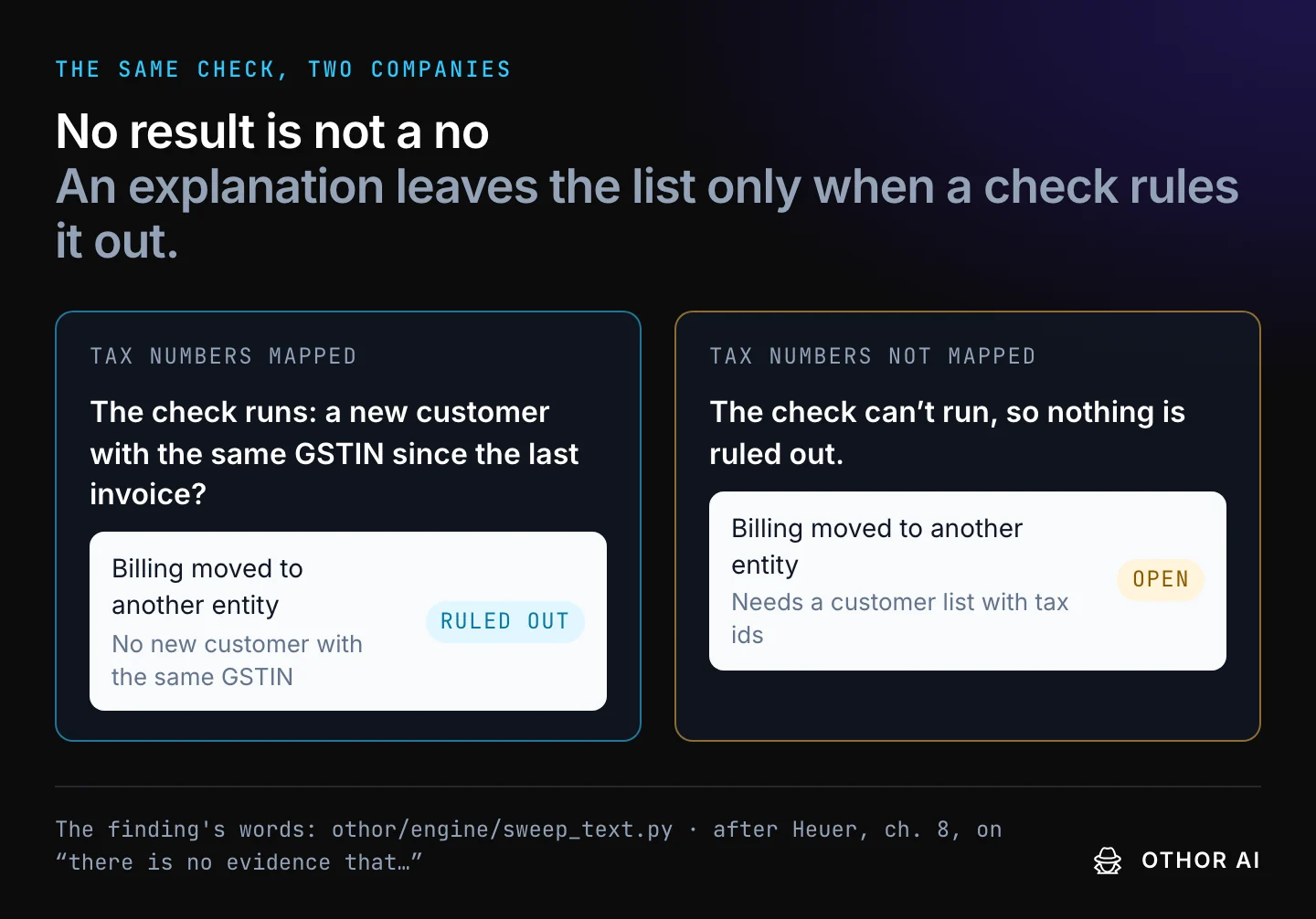
Heuer adds a warning that matters as much as the method. In May 1998, India tested nuclear weapons, and US intelligence had reported, in the words Heuer quotes, that "there was no indication the Indians would test in the near term". An absence of evidence, he notes, doesn't disprove the hypothesis. The question to ask is: if this were true, could I realistically expect to see evidence of it?
The same holds for a customer. Othor AI can only rule out the billing explanation if it can see the tax numbers. When a company hasn't mapped that column, the check can't run. The explanation stays open, and the finding says what would settle it:
05What this changes in a brief
Three habits follow from Heuer's method, and each is set by code rather than by whoever writes the sentence:
- Every explanation on the list stays on it until a check rules it out. Silence in the data is never counted as a no.
- A brief's title doesn't state a cause when the cause explains less than 70% of the change. It says what was measured instead.
- When what remains can't be told apart from the data, the finding says so, and ends with one question for one person.
Heuer's last step is easy to skip: name the signs that would show events taking a different course. For a quiet customer, the sign is simple: an invoice. Othor AI looks for one every night.
The favourite explanation might still be right. The point is to find out by trying to knock it down, not by collecting reasons to keep it.
06Sources
- R. J. Heuer, Jr. Psychology of Intelligence Analysis. Center for the Study of Intelligence, Central Intelligence Agency, 1999. Chapter 4, "Strategies for Analytical Judgment", and chapter 8, "Analysis of Competing Hypotheses".
- U. Koroth. Why Othor AI says what it can’t tell you. Othor AI, 22 November 2026.