
A textile maker's margin can move because cotton got dearer, because the rupee fell against the euro, or because shoppers in Europe stopped buying clothes. None of those numbers is in the company's own books. They sit in public data: central banks, the World Bank, statistics offices, weather records.
External Signals, in Othor AI's Enterprise Edition, tests outside numbers like these against a company's own history, and tells the owner in the morning brief when one that has led their numbers makes an unusual move. Until this week the owner had to know which outside numbers to try. Now Othor AI suggests them.
01What it suggests, and why
Othor AI reads the company's Business Model: what it sells and buys, the names of its numbers, the places in its breakdowns, the currencies it deals in, the countries its customers are in. It matches those words against a catalogue of about 320 public series, each with its source and licence:
- the rupee against 29 currencies, from the European Central Bank's reference rates;
- 67 commodity prices from the World Bank's Pink Sheet: crude oil, gas, metals, fertilisers, cotton, rubber and more;
- demand in export markets: retail sales, factory output and prices in Europe from Eurostat, and in other large markets from the OECD and the World Bank;
- interest rates, from the RBI's repo rate to other countries' overnight and 10-year rates;
- rainfall and temperature in Indian states and large cities, from NASA POWER;
- working days in each month, from India's gazetted holidays.
Each suggestion comes with one plain reason and the numbers it could lead. The ones that touch a headline number or a goal come first, then those with the most money behind the number they could lead over the last 12 months. At most 12 are shown at a time.
Here is what it suggests for our sample company, Indigo Thread Co., an invented textile maker that sells to buyers in Europe and the US:
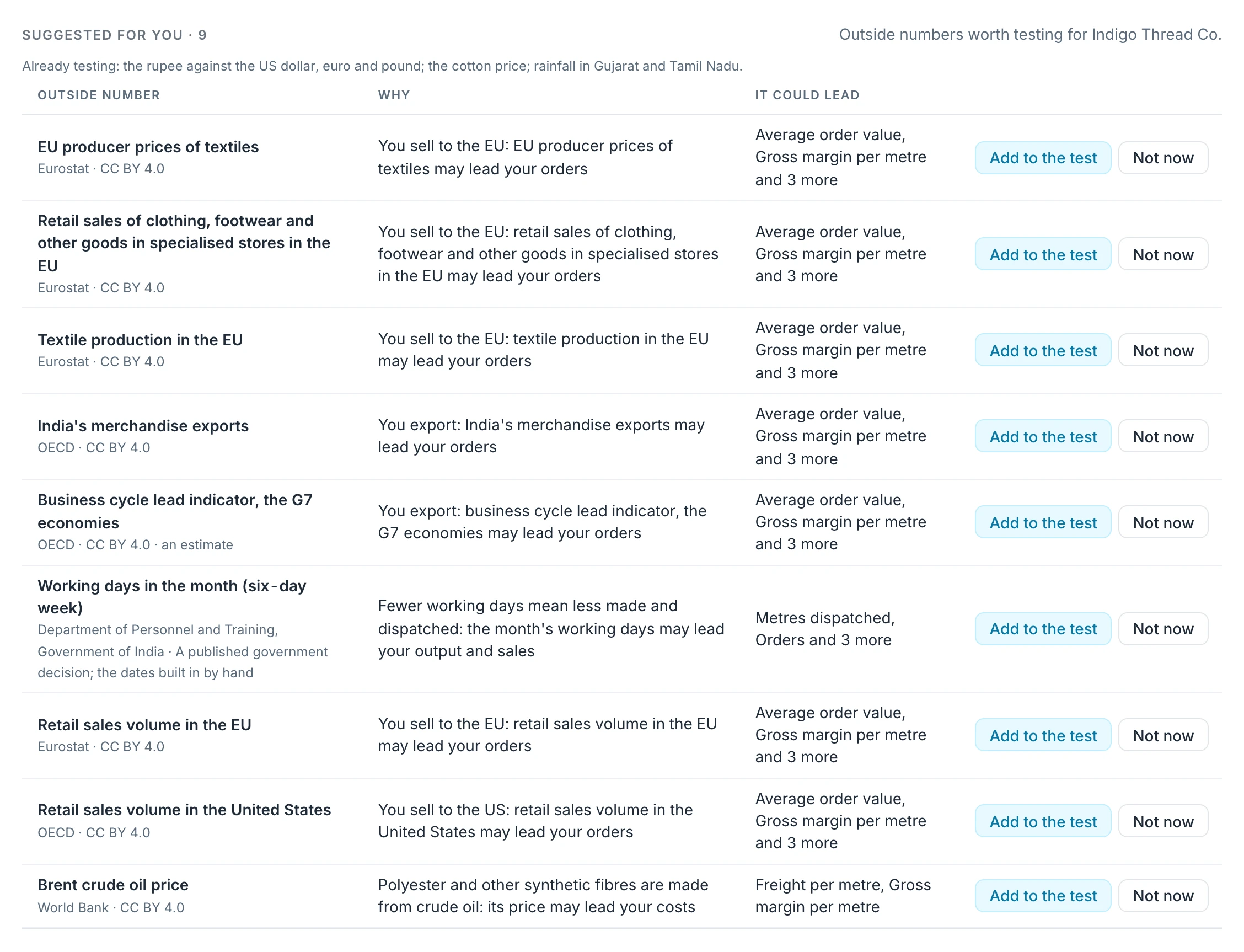
Some of the reasons are obvious once said. "You sell to the EU: retail sales of clothing, footwear and other goods in specialised stores in the EU may lead your orders." Some are less so: "Polyester and other synthetic fibres are made from crude oil: its price may lead your costs", against freight and gross margin per metre. And one comes from the calendar: "Fewer working days mean less made and dispatched", against metres dispatched and orders.
Above the list, a line says what's already in the test, so nothing is suggested twice. For Indigo Thread that's the rupee against the US dollar, euro and pound, the cotton price, and rainfall in Gujarat and Tamil Nadu.
02One click to add, nothing more
Add to the test puts the series into the nightly test. The row moves to Being tested with "First result after tonight's run", and an Undo stays on screen for a moment in case it was the wrong row. Not now hides a suggestion until the Business Model changes enough to suggest it again. There's no form and no page to leave.
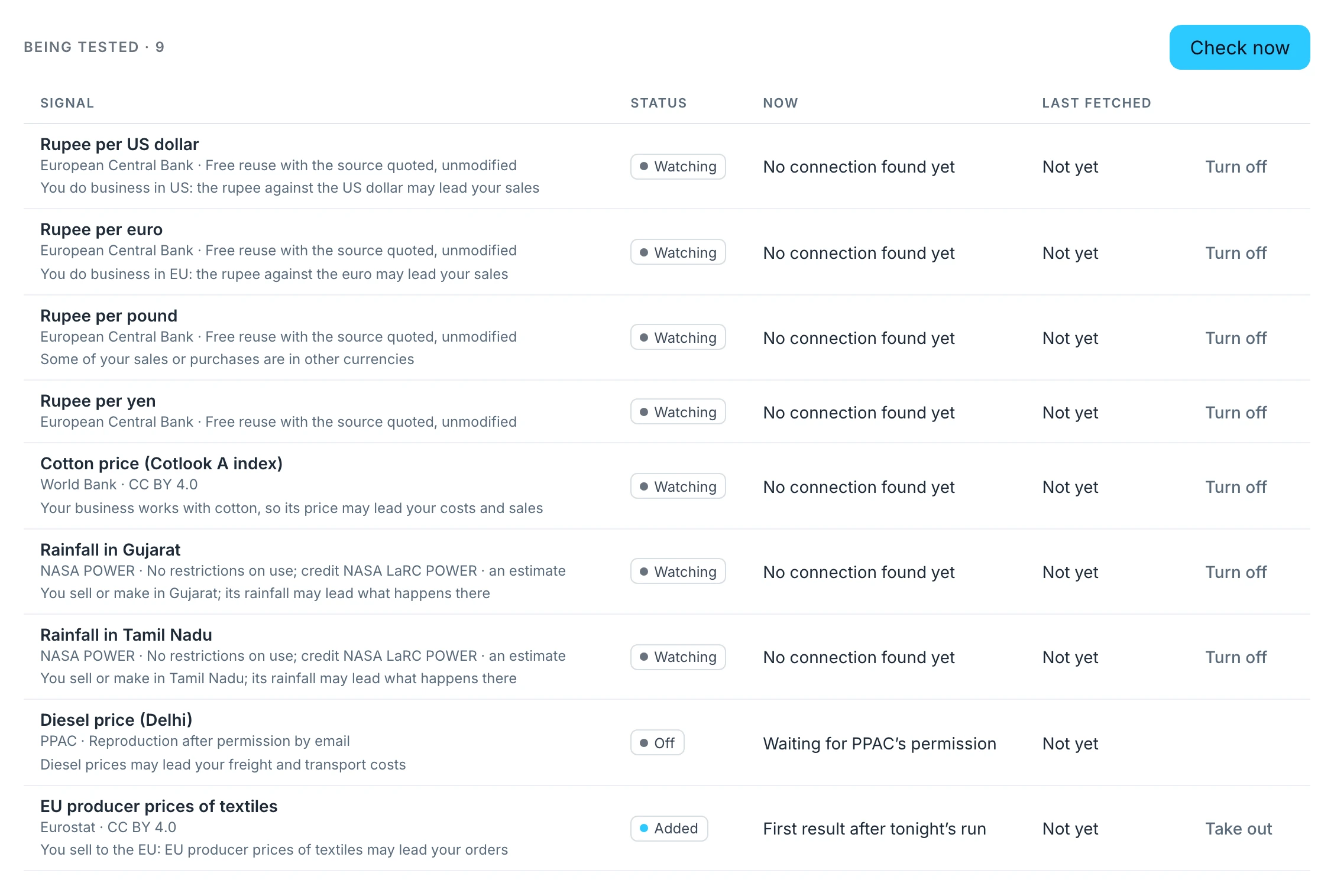
When there are new suggestions, a card on Home says so, with the count, and opens the list:

The same works in the chat. "What outside things affect my business?" lists the suggestions; "add crude oil" finds the series and adds it with one click.
03Only links that hold up are reported
A suggestion is only a reason to look. Plenty of numbers move together by chance, so every night Othor AI tests each outside series against the numbers its reason names:
- it compares month-to-month changes, not levels, because two numbers that both grow over time look linked when they aren't;
- it finds how many months ahead the outside number moves, from one to six, on the first two thirds of the shared history;
- it shuffles that history 9,999 times to see how often chance alone would look as strong;
- the same lead, the same way round, must then hold on the last third, which the first step never saw;
- and the bar rises with the number of pairs tested, so testing more series doesn't produce more false links.
A series needs at least two years of monthly changes beside the company's own before it can pass. Until then the page says "No connection found yet". A link that passes shows on the page with how many months later it shows up in the company's number, and the brief mentions it when that outside number moves more than usual. Everything else stays quiet.
04What it reads, and what it doesn't
The matching is done by code, so the list is the same with or without an AI model. When a model is connected, it may word a reason better or point to catalogue series the matching missed. It sees the names in the Business Model and the catalogue, never the company's figures or rows. A series that isn't in the catalogue is dropped, and so is a reason with a number in it. The reasons in the pictures above are the template's own words, with no model.
The public data is fetched by the install itself, once for all its companies, and each series' source and licence are shown beside it. An install without internet access can load the same values from a file.
The owner doesn't need to know which outside numbers matter. Othor AI suggests them, the owner adds the ones that make sense, and the night finds out which ones really lead.
The pictures are the sample company in the real app. The catalogue's counts are from release 0.38.