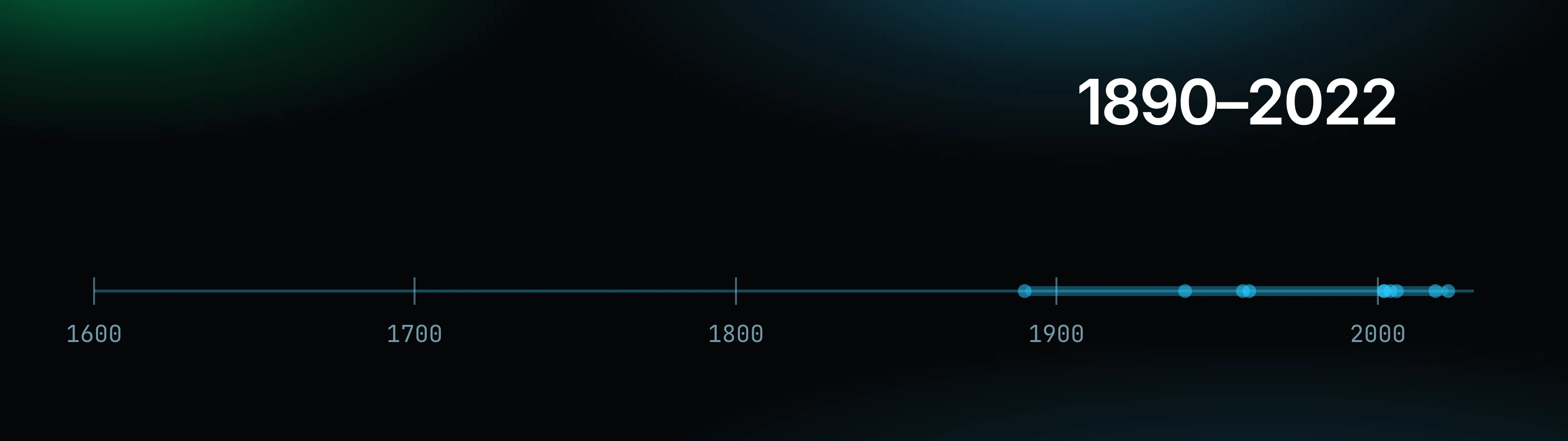
The story of how people learned to make sense of information, from a census in crisis to a chatbot.
01The Greatest Mystery Ever Solved
What if I told you that every time you ask ChatGPT a question, you’re standing on the shoulders of data detectives who spent 132 years on one of the great mysteries: how do we make sense of information?
This isn’t just a story about technology. It’s a story about human curiosity, ingenuity and the long search for patterns in chaos. From a government crisis in 1890 to the AI moment of 2022, this is the tale of how we went from drowning in data to working with it.
Welcome to the world of the Data Detectives.
02Chapter 1: The Crisis That Started It All (1890)
America’s Impossible Task
Picture America in 1890. The country is growing fast: from 38.6 million people in 1870 to almost 63 million twenty years later. Cities are filling with immigrants, the Industrial Revolution is in full swing, and the United States government faces what seems an impossible task.
It needs to count every single person in the country.
The Constitution demands it. Article I, Section 2 requires a census every ten years to share out seats in Congress. It sounds simple enough: just count people. But with a population approaching 63 million, the “simple” task had become a monster.
The 1880 census had taken most of the decade to finish. If the 1890 census took as long by hand, its results might arrive just as the 1900 census began: an administrative spiral that would make fair representation impossible.
Enter the First Data Detective
Herman Hollerith was not yet 30 when he walked into this chaos with an idea that seemed strange: what if machines could read?
A statistician and inventor, Hollerith had worked on the 1880 census and seen the problem first-hand. He understood that it wasn’t just counting; it was processing information efficiently. Clerks, however dedicated, couldn’t keep up with the volume.
His solution was simple and new. He created punched cards where each hole recorded a fact about a person: age, sex, occupation, place of birth. The cards went through a tabulating machine that used electrical circuits to count and sort them automatically.
Hollerith said the idea came from railway tickets, where conductors punched holes to describe the passenger; punched cards had also long steered the patterns of Jacquard looms. If holes in a card could carry information, a machine could count it.
The Miracle of Mechanized Counting
The results were remarkable. A first count of the population was announced about six weeks after the tabulation began, and the whole census was finished faster and more cheaply than the 1880 one. The final figure, 62,947,714 people, was the product of a machine.
Hollerith had done more than solve a government crisis. He had invented the foundation of modern data processing. His Tabulating Machine Company merged in 1911 into the company that was renamed IBM in 1924, and punched cards stayed a standard way to process data into the 1970s. (The full story: The Hollerith Revolution.)
The age of mechanical data processing had begun, and with it our first glimpse of the information revolution.
03Chapter 2: When Data Detectives Became War Heroes (1943)
The Unbreakable Code
Fast forward to the Second World War. Germany’s armed forces send their messages through the Enigma machine, and believe it unbreakable. The army’s version could be set up in 158,962,555,217,826,360,000 ways, and the settings changed daily.
To put that number in perspective: trying one setting a second, you would need about five million million years to try them all. German U-boats in the Atlantic coordinate their attacks through Enigma messages, sinking Allied ships at a terrible rate.
The Battle of the Atlantic is being lost, and the Allies can’t read the messages that direct it.
The Pattern Hunter
At Bletchley Park, a secret site in the English countryside, the mathematician Alan Turing is staring at sheets of letters that look random. Where others see chaos, Turing sees the possibility of hidden patterns.
His insight was that even very sophisticated encryption leaves fingerprints. Operators repeat themselves; messages follow routines; a machine that never encrypts a letter as itself gives something away. If you know how to look, the patterns are there.
Teaching Machines to Think
Turing’s breakthrough came from understanding that Enigma, for all its complexity, was a machine following fixed rules. Build another machine that tests possibilities faster than people can, and the code can be broken.
Building on Polish codebreakers’ pre-war work, and with Gordon Welchman and the engineers who built it, Turing designed the Bombe, an electromechanical device for finding the day’s Enigma settings. It didn’t try settings at random. It started from a crib, a word the codebreakers guessed was in a message, and rejected every setting that led to a logical contradiction, narrowing an impossible search to a few candidates that people could test by hand.
As more Bombes came into service, Bletchley Park read more and more German traffic, often in time to act on it. Convoys could be routed away from U-boat packs. Before D-Day, decrypts helped confirm that the Germans believed the deception plans about where the landings would come.
The Birth of Artificial Intelligence
Turing’s wartime work showed that data, however hidden, could give up its secrets to the right method. His 1936 paper had already described a universal computing machine, and in 1950 he asked in print whether machines could think, proposing the test that now bears his name.
The implications went far beyond cryptography. If machines could break codes, what other patterns could they find? What other problems could be solved by bringing computation to data?
Turing’s work helped win the war, and his ideas sit at the root of computing and of artificial intelligence. (The full story: From Code-Breaking to Business Breaking.)
04Chapter 3: The Real-Time Revolution (1960s)
The Frustration of Analog Business
Picture trying to book a flight in the 1950s. You call the airline, wait, and reach an agent who has to check seat availability on cards and boards, and by telephone with other offices. Booking a single seat could take an hour or more.
This wasn’t incompetence; it was business before computers. Airlines kept their seat inventory on paper, spread across offices.
For American Airlines, growing fast, the system was becoming unsustainable. Customers were frustrated, and the airline sold seats it didn’t have while flying others empty.
The Partnership That Changed Business
In 1953, on a flight from Los Angeles to New York, American Airlines president C. R. Smith sat next to an IBM salesman, R. Blair Smith. They talked about a radical idea: a computer system that could track every seat, as it was sold, across the whole airline.
The idea was audacious. It meant connecting terminals in many cities to central computers, keeping one up-to-date record, and handling many bookings at once. Much of the technology had to be built for it.
The result was SABRE, a system that would change not just the airline industry but the idea of business intelligence.
The First Real-Time Data System
After trials from 1960, SABRE was handling all of American’s reservations by 1964. Agents could check a seat on any American flight, book it and confirm it at once. What had taken an hour or more took seconds.
SABRE’s impact went far beyond airline seats. It proved that processing data in real time wasn’t just possible; it was a competitive necessity.
The Template for Modern Business
SABRE became a template for the real-time systems that followed: card payments, banking networks, hotel and car-rental bookings.
The data detectives had moved beyond counting and analysing. They had built systems that acted on data as it arrived.
More importantly, SABRE showed that data wasn’t only a record of what had happened; it could shape what happened next. (The full story: SABRE.)
05Chapter 4: The Pattern Hunters Discover Human Nature (1990s–2000s)
The Most Unexpected Data Detective Story
One of the most famous stories in retail analytics came out of Walmart. Since 1987, a satellite network had carried every store’s sales back to headquarters, building up one of the largest commercial databases in the world.
In 2004, as Hurricane Frances approached Florida, Walmart’s chief information officer, Linda Dillman, had her team look at what had sold before an earlier storm. As The New York Times reported, strawberry Pop-Tarts sold at about seven times their normal rate ahead of a hurricane, and the top-selling item was beer.
Cracking the Code of Human Behavior
Why Pop-Tarts? Perhaps because they need no fridge and no cooking, keep for a long time, and are a familiar comfort when things are frightening. The data couldn’t say why; it said what, and that was enough to act on.
Walmart had found something important: human behaviour that looks irrational often follows patterns, and patterns can be measured.
From Reactive to Predictive
The discovery changed how Walmart prepared. Instead of waiting for events and reacting, it could stock stores ahead of a storm with what people would need.
But the real change wasn’t disaster preparation; it was the method. Customer behaviour, however random it looked, could be anticipated. (The full story: The Pop-Tarts Phenomenon.)
The Netflix Million-Dollar Question
Netflix took the idea further. In 2006 it launched the Netflix Prize: one million dollars to anyone who could make its film recommendations 10% more accurate.
Thousands of teams from around the world entered, using collaborative filtering, machine learning and statistical models to predict what people would enjoy. In 2009 a team called BellKor’s Pragmatic Chaos won.
The Prize didn’t create recommendation systems (Amazon had been recommending products for years), and Netflix never put the full winning blend into service. But it made the methods famous, and it showed how much a crowd of outsiders could learn from one company’s data. (The full story: The Million-Dollar Algorithm.)
The Dawn of Behavioral Prediction
These data detectives had moved beyond describing what happened to predicting what would happen next. They weren’t just counting transactions; they were forecasting behaviour.
That shift, from describing to predicting, became a foundation of the modern data economy.
06Chapter 5: The Rebels Who Conquered Tradition (2002)
David vs. Goliath with Data
2002: baseball, America’s pastime. A sport with more than a century of tradition, where seasoned scouts could “see” talent in a player’s swing and managers trusted their instincts.
Then came Billy Beane, and a front office that trusted the numbers.
The Oakland Athletics had one of the smallest payrolls in the game, about a third of the New York Yankees’. By every traditional measure, Oakland should have finished near the bottom.
But Beane used the data detective’s best weapon: he set aside what baseball “knew” and followed what the numbers showed.
Questioning Everything
Working with Paul DePodesta, a Harvard economics graduate, Beane looked at baseball statistics in ways that challenged its basic assumptions. Building on Bill James’s work, they found that batting average, runs batted in and stolen bases said little about winning games.
Instead they focused on what drives runs: on-base percentage, slugging percentage, and other numbers scouts dismissed.
The approach was revolutionary because it meant giving up not just old statistics but old beliefs about what a good player looked like. Players who looked unimpressive but had excellent numbers became bargains.
The Moneyball Revolution
In 2002 the Oakland A’s won 103 games and their division on one of the lowest payrolls in baseball. They did it with players other teams overlooked.
Scott Hatteberg, a catcher with a damaged elbow, became a first baseman valued for getting on base. Chad Bradford, a reliever with an unusual underarm delivery, became a key part of the bullpen. David Justice, thought past his best, still got on base.
Data vs. Intuition
Moneyball showed that analysis could compete with tradition, intuition and even money. (The full story: Moneyball.)
If a sport with that much tradition could be changed by questioning conventional wisdom and following the numbers, so could other industries.
The Democratization of Analysis
Perhaps most importantly, Moneyball showed that good analysis didn’t need huge resources. The methods were fairly simple statistics, applied with clear thinking and a willingness to challenge assumptions.
That inspired data-driven approaches far beyond sport. Managers questioned their habits. Investors looked for undervalued companies. Marketers measured what campaigns actually did.
The data detectives had shown that analytical thinking could level the field.
07Chapter 6: When Data Science Lost Its Innocence
The Power to See the Unseen
As analytics grew more powerful, it began to uncover things that raised uncomfortable questions about privacy and responsibility. The tools that predicted hurricane shopping could also look into the most personal parts of people’s lives.
Target’s analysts, according to Charles Duhigg’s 2012 report in The New York Times Magazine, built a model that could predict from ordinary purchases (unscented lotion, certain supplements, cotton balls) that a customer was probably pregnant, and when she was due, so baby offers could reach her early.
The Teenager Who Made Headlines
The article included an account, from one unnamed source, of an angry father in a store near Minneapolis: Target was sending baby coupons to his daughter, still in high school. The manager apologised, and called again days later; by then the father had talked to his daughter. She was due in August.
The story was never confirmed, but Target’s own reaction, disguising its baby offers among unrelated ones, shows what it believed its model could do. (The full story: The Target Pregnancy Prediction.)
From Helpful to Manipulative
The same methods that produced charming discoveries like the Pop-Tarts could find people’s vulnerabilities, and be used against them.
The darkest chapter came with Cambridge Analytica, which used data taken from Facebook, from up to 87 million people by Facebook’s own estimate, to build psychological profiles and target political advertising. How much it actually changed votes is disputed; that it tried, without those people’s consent, is not.
The Reckoning
Cambridge Analytica’s exposure in 2018 changed how many people saw data analytics. Tools that had seemed like harmless progress were shown to matter for privacy, democracy and personal freedom. (The full story: Cambridge Analytica.)
The data detectives learned their most important lesson: intelligence without ethics is just sophisticated manipulation. The power to predict behaviour comes with the responsibility to use it well.
The reckoning forced the whole industry to face questions about consent, transparency and the limits of data-driven decisions. It ended data science’s age of innocence.
08Chapter 7: The Great Awakening (2020)
When Everyone Became a Data Analyst
March 2020. The world shut down. COVID-19 spread across continents, governments imposed lockdowns, and suddenly everyone needed to understand exponential growth, infection rates and models.
Johns Hopkins University put up a simple dashboard of cases and deaths around the world. Within weeks it was one of the most visited sites on the internet.
Data Literacy as Survival Skill
For many people, reading data stopped being optional. Grandparents read infection charts. Parents weighed the numbers before schools reopened.
The pandemic taught more people to read a chart than years of education campaigns had. People who had never cared about statistics compared models and argued about which data to trust.
The Unintended Consequence
The data detectives had accidentally taught the world their language. “Flattening the curve”, “R number” and “excess deaths” entered everyday speech. (The full story: Dashboard Democracy.)
That new familiarity with data reached beyond the pandemic, into how people judged claims about the economy and their own decisions.
The Foundation for What Came Next
The pandemic left many people more comfortable with numbers. It set the scene for what came next: AI systems that anyone could talk to, whatever their technical background.
09Chapter 8: The Ultimate Breakthrough (November 2022)
The Moment Everything Changed
On 30 November 2022, OpenAI released ChatGPT to the public. Its chief executive said it passed one million users within five days, and two months later a UBS estimate reported by Reuters put it at 100 million monthly users, which would make it the fastest-growing consumer application to that date.
ChatGPT wasn’t just another product. It answered a question the data detectives had been asking for 132 years: how do you make information accessible to everyone?
From Punch Cards to Plain English
The journey had come full circle. Hollerith’s cards needed specialist operators. SABRE needed trained agents. Walmart’s analysis needed teams of analysts. Even a spreadsheet needed skills that put many people off.
ChatGPT changed that. Anyone could ask a question about economics, science or almost anything in plain English and get a fluent answer. No code. No statistics course. No intimidating screens. (The full story: The ChatGPT Moment.)
The Democratization of Intelligence
The goal so many data detectives had worked towards, insight for everyone, came much closer. A small business owner could ask about a market. A student could talk through a hard idea. Someone could ask for help reading a medical statistic.
One caution belongs here: a language model writes fluent words, and it can state a wrong number with the same confidence as a right one. For figures that decisions rest on, the numbers still have to be computed and checked.
Standing on Giants’ Shoulders
Every chapter of this story contributed to that moment:
- Hollerith’s punched cards laid the foundation of automated data processing
- Turing’s work at Bletchley Park and after shaped computing and machine intelligence
- SABRE’s real-time processing made instant answers normal
- Walmart’s pattern-finding showed what behaviour data could reveal
- The Netflix Prize made recommendation methods famous
- Moneyball’s thinking spread evidence-based decisions
- The lessons of Target and Cambridge Analytica showed where the limits must be
- The pandemic made a generation more at home with data
Each step built towards one result: tools that put information and analysis within reach of almost anyone.
10Epilogue: The Case is Closed, The Future is Open
What the Data Detectives Achieved
From Hollerith’s mechanical counters to ChatGPT’s neural networks, the data detectives spent 132 years on one of humanity’s great information problems. They didn’t just build better tools; they changed the relationship between people and knowledge.
The mystery they worked on wasn’t only technical; it was human. How do you help people make sense of a complicated world? How do you put data-driven insight in the hands of people without a technical background?
The Deeper Victory
Their greatest achievement wasn’t sophistication; it was access. They took abilities that once needed teams of specialists, room-sized computers and years of training, and brought them within reach of anyone with a question.
That is one of the significant achievements of our time. The gap between having a question and finding an answer has never been smaller, even if the answer still needs checking.
The Story Continues
Making data accessible has come a long way, but the story continues. As AI grows more powerful and more woven into daily life, new mysteries appear:
How do we keep AI useful and aligned with human values? How do we keep privacy and freedom in an age of predictive systems? How do we use these tools on the hardest problems: climate change, disease, poverty and inequality?
The next generation of data detectives will take on these questions, building on 132 years of invention, discovery and curiosity.
The Human Element
Perhaps the most remarkable thing about this journey is that it was never really about the technology. It was about people trying to understand their world, decide better and help each other through complexity.
From Hollerith’s wish to count people accurately to Turing’s mission to save lives, from SABRE’s aim to serve customers better to Walmart’s effort to be ready, from Netflix’s recommendations to Beane’s underdog team, every breakthrough had a human motive.
The data detectives made progress by never forgetting that behind every data point is a person, and behind every algorithm a purpose.
The Final Clue
The next time you ask ChatGPT a question and get a helpful answer, remember: you’re not just using a language model. You’re standing on the shoulders of data detectives who spent more than a century on the great mystery of the information age.
They brought people and computers together. They put intelligence within reach. They turned data from an intimidating subject into something you can talk to.
The case is closed. The future is open. And the story of human curiosity continues.
First published on blog.othor.ai, 21 Jul 2025; revised 23 Nov 2026.