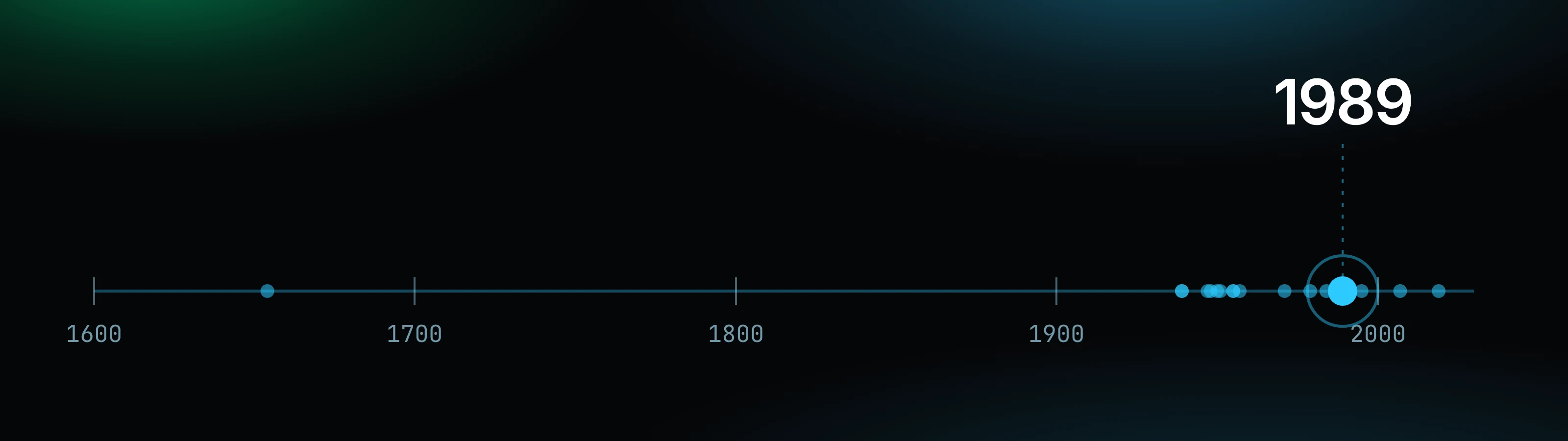
In this history of decision intelligence we’ve seen remarkable single breakthroughs: the Berlin Airlift and Dantzig’s simplex method, von Neumann’s duality, Nash’s game theory, Khachiyan’s polynomial-time proof and Karmarkar’s projective scaling algorithm, which finally brought practical speed. Each was one insight that changed the field. Yet one of the deepest changes in optimization came not from a single breakthrough but from a wave of work by many researchers, from the mid-1980s through the 1990s.
Karmarkar’s 1984 algorithm had opened a door to a new approach: interior-point methods, which move through the inside of the region of possible answers rather than along its edges. What followed was one of the most intense periods of research in the history of optimization, as researchers around the world set out to extend, refine and perfect the idea. It produced the methods inside today’s large-scale optimization software.
01The Research Gold Rush
Karmarkar’s paper set off something like a gold rush. His work pointed to a wide landscape of unexplored possibilities, and researchers in universities, companies and government laboratories saw that a new branch of optimization was being born.
Groups at Bell Labs, IBM, Stanford and many universities across the United States, Europe and Japan took up the work. It was not only academic curiosity: the practical value of faster optimization was obvious to anyone working on large decision problems.
What made the period unusual was the mix of depth and immediate relevance. Researchers could pursue fundamental mathematical questions knowing that the answers would be used in business, engineering and public policy.
The work was also strikingly collective. Results built on each other quickly, across institutions and countries, and much of the progress came from many hands rather than one.
02The Primal-Dual Revolution
One of the most important advances came from recognising that Karmarkar’s approach could be strengthened by using duality theory, the framework von Neumann had pointed to decades earlier.
Nimrod Megiddo at IBM described a path through the interior that leads to the solutions of a problem and its dual together, and Masakazu Kojima, Shinji Mizuno and Akiko Yoshise in Japan turned it into a primal-dual algorithm with a polynomial-time guarantee; both were published in 1989. Instead of working only on the original problem (the primal), these methods work on it and its dual at the same time, using the relationship between them to move faster and more reliably.
It was a synthesis of ideas spanning four decades: von Neumann’s duality from the 1940s, Karmarkar’s interior-point approach from the 1980s, and from the two something stronger than either.
The practical consequences were large. Primal-dual methods became the basis of the fastest interior-point codes; Sanjay Mehrotra’s predictor-corrector version (1992) is the one most solvers still build on. And the primal-dual framework extended naturally beyond linear programming to quadratic programming, semidefinite programming and general convex optimization.
03The Corporate Strategy Application
To see why this mattered to companies, consider a large consumer goods manufacturer planning its supply chain: many factories, thousands of products and a great many places where customers buy.
With older methods, such a company could optimize pieces of the problem (one region, one product line) but not the whole system at once. Faster methods for large linear programs make it practical to plan manufacturing, distribution, stock and transport together, and to add more of the real detail: uncertain demand, capacity limits, transport and storage costs, and service levels.
Companies that learned to do this well gained real advantages, and the practice spread through whole industries. Supply chain optimization became standard work, with interior-point methods as one of the tools inside it.
04The Public Sector Applications
Public planning gained too. A city transit agency has to plan routes, timetables, vehicles and crews across an entire network. Older approaches could handle a route or a small part of the system; larger, faster solvers make it possible to plan more of the network together, with passenger flows, transfers, vehicle capacity, maintenance and fairness to underserved neighbourhoods included.
Perhaps as important, the analysis can show the expected effect of a proposed change before it is made. That transparency helps the public see why a decision was taken, and helps agencies make the case for funding.
05The Path-Following Algorithms
As interior-point methods matured in the late 1980s, researchers found better ways to steer towards the answer. One of the most important was “path-following”.
The idea is to follow a particular path through the interior, the “central path”, which leads to the best answer. Path-following methods, developed by researchers including James Renegar, Pravin Vaidya and Clóvis Gonzaga, combined the polynomial-time guarantee that Khachiyan’s work had shown possible with practical speed that often beat Karmarkar’s original algorithm.
They also proved robust across many kinds and sizes of problem, which mattered for commercial software, and they extended naturally to new classes of problems. In 1994 Yurii Nesterov and Arkadi Nemirovski published a general theory of interior-point methods for convex optimization, showing how far the idea could reach.
06The Software Revolution
From the mid-1980s to the mid-1990s optimization software changed alongside the algorithms. Interior-point codes such as OB1, built by Irvin Lustig, Roy Marsten and David Shanno, showed how fast the new methods could be on large problems, and commercial solvers such as CPLEX added interior-point (“barrier”) options.
This was not simply translating research into code: it took new thinking about data structures and numerical methods, above all about solving the large, sparse systems of equations at the heart of each step.
By the mid-1990s, commercial packages routinely offered a choice: the simplex method where it was still better, interior-point methods for large problems, and ways to combine the two. Practitioners could pick the right method for each problem, and could focus on modelling their problem rather than on the algorithm.
07Beyond Linear Programming: The Extensibility Revolution
Perhaps the most important long-term effect of interior-point methods was how far they reached beyond linear programming.
Quadratic programming, with goals or limits that curve, had been much harder than linear programming. Interior-point methods made it nearly as tractable, which helped applications such as portfolio optimization and engineering design.
Semidefinite programming, which generalises linear programming to matrices, became practical through interior-point methods. It opened applications in control theory, combinatorial optimization and robust optimization that are still growing.
Convex optimization in general, used in signal processing, statistics, control and parts of machine learning, gained reliable solvers from the same ideas.
08The Numerical Computing Revolution
Interior-point methods grew up alongside broader advances in numerical computing. Each step of an interior-point method solves a large system of linear equations, so the methods gained enormously from better numerical linear algebra, better techniques for sparse matrices and better ways to keep calculations stable.
The two advanced together: better numerical methods made better interior-point algorithms possible, and demanding interior-point applications pushed numerical computing forward. The same pattern continues as solvers adapt to parallel processors and new hardware.
09The Academic Transformation
The interior-point revolution changed how optimization is taught and researched. Before Karmarkar, courses centred on the simplex method; afterwards, interior-point methods took their place beside it, and students learned to choose a method by the problem.
Research changed too. The success of interior-point methods drew in people from convex geometry, numerical analysis, complexity theory and algorithm design, and connected optimization more closely with those fields.
10The International Collaboration
The interior-point revolution was strikingly international. Key contributions came from researchers in the United States, Japan, the Netherlands, Hungary, Russia and many other countries.
That was natural for advances of this kind: mathematical insights travel freely, and optimization problems exist in every economy. The networks formed in those years continued into later work on optimization for machine learning and large-scale decisions.
11The Modern Legacy: From Research to Infrastructure
Today’s optimization software bears the clear mark of the interior-point revolution. Methods developed in the 1980s and 1990s run inside the solvers used for supply chains, portfolio management, energy systems and network design, on problems with millions of variables.
Their reliability and predictability also made it possible to build optimization into everyday operational systems, confident that the solver will behave consistently as problems change.
12Conclusion: Collaborative Innovation and Cumulative Progress
The evolution of interior-point methods, from Karmarkar’s breakthrough through a decade of refinement, is a remarkable example of mathematics advancing through the work of many. Unlike the single breakthroughs earlier in this history, it showed the power of researchers building steadily on each other’s results.
It also showed that a theoretical advance becomes practical value only with sustained development. Karmarkar provided the idea; it took about a decade of research and engineering to create the tools organisations rely on today.
As decision intelligence moves on through artificial intelligence and machine learning, the interior-point story is a reminder that the most lasting advances often come from patient, shared work rather than a single flash of inspiration.
13References
- Megiddo, N. (1989). Pathways to the optimal set in linear programming. In N. Megiddo (Ed.), Progress in mathematical programming. Springer.
- Kojima, M., Mizuno, S., & Yoshise, A. (1989). A primal-dual interior point algorithm for linear programming. In N. Megiddo (Ed.), Progress in mathematical programming (pp. 29–47). Springer.
- Mehrotra, S. (1992). On the implementation of a primal-dual interior point method. SIAM Journal on Optimization, 2(4), 575–601.
- Nesterov, Y., & Nemirovskii, A. (1994). Interior-point polynomial algorithms in convex programming. SIAM.
- Lustig, I. J., Marsten, R. E., & Shanno, D. F. (1994). Interior point methods for linear programming: Computational state of the art. ORSA Journal on Computing, 6(1), 1–14.
- Wright, S. J. (1997). Primal-dual interior-point methods. SIAM.
- Vanderbei, R. J. (2020). Linear programming: Foundations and extensions. Springer.
First published on blog.othor.ai, 12 Jun 2025; revised 23 Nov 2026.