In this history of decision intelligence we’ve travelled through the Berlin Airlift and Dantzig’s simplex method, Kantorovich’s linear programming, von Neumann’s duality, Koopmans’ equilibrium theory, Bellman’s dynamic programming, Simon’s bounded rationality, stochastic programming, the first decision support systems and Nash’s game theory. Each widened the decisions we could solve.
Yet under all these practical advances lay a deep theoretical question: could linear programming problems be solved efficiently in the worst case? Dantzig’s simplex method worked brilliantly in practice, but in 1972 Victor Klee and George Minty had built problems on which it takes an exponential number of steps. If linear programming could not be proven efficient, what did that mean for the promise of mathematical optimization?
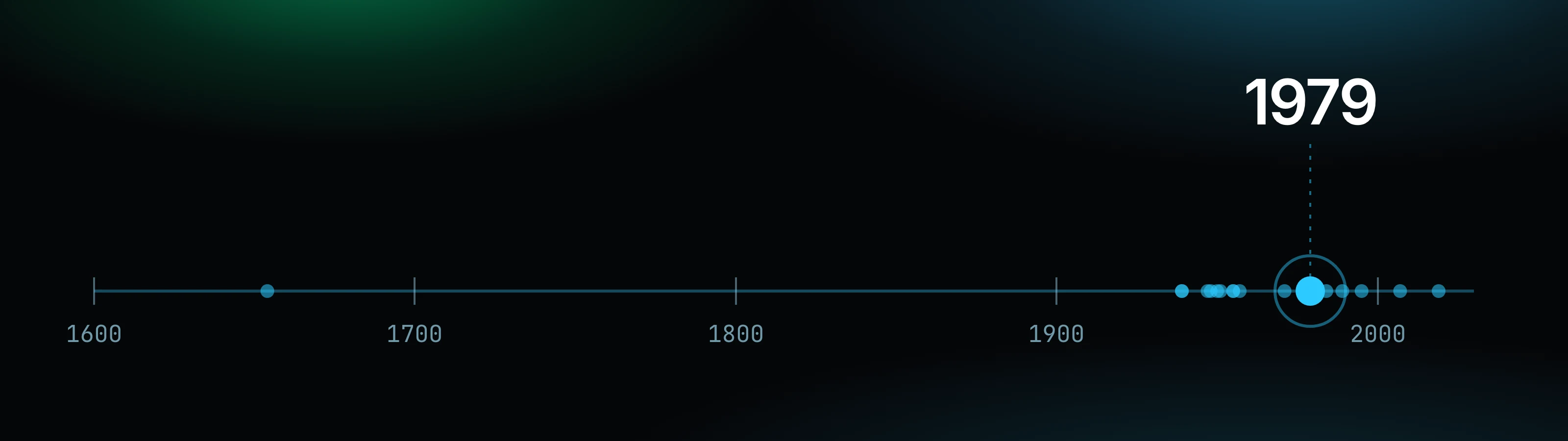
In 1979, a young Soviet mathematician, Leonid Khachiyan, gave the answer. His ellipsoid algorithm proved, for the first time, that linear programming can be solved in polynomial time: a foundation under decades of practical success, and the start of new lines of research.
01The Computational Complexity Crisis
To see why this mattered, consider the question that had been building in the 1970s. Linear programming had worked in practice since the late 1940s, but theorists were increasingly uneasy about its foundations.
The issue was computational complexity: how the time to solve a problem grows as the problem gets bigger. The simplex method, so effective in practice, had a troubling property: on specially built problems, the number of steps it needs grows exponentially with the size of the problem. In principle, a large enough or awkward enough problem could make it hopelessly slow.
By the late 1970s, linear programming was being used on ever larger problems in logistics, manufacturing, finance and telecommunications. Real problems rarely behaved like the worst case, but nobody could promise they never would.
So the question was pressing: was there an algorithm that solves every linear programming problem in polynomial time, where the work grows at a manageable, predictable rate rather than explosively?
02Khachiyan’s Revolutionary Insight
Leonid Genrikhovich Khachiyan was working in Moscow when he made his breakthrough. Building on earlier work by Soviet mathematicians, Naum Shor and David Yudin with Arkadi Nemirovski, who had developed the “ellipsoid method” for convex optimization, Khachiyan showed how to use it to solve linear programming in polynomial time.
The method rests on a simple geometric idea. Instead of walking along the edges of the region of possible answers, as the simplex method does, it surrounds the answer with an ellipsoid (a stretched sphere in many dimensions). At each step it checks the ellipsoid’s centre, keeps only the half of the ellipsoid that can still hold the answer, and wraps that half in a new, smaller ellipsoid. The ellipsoids shrink step by step around the answer.
They shrink slowly, though. In two dimensions each new ellipse has at most about 77% of the area of the one before; in a hundred dimensions, at most about 99.5% of the volume, so it takes about 139 steps just to halve it. Khachiyan’s achievement was to prove that, even so, the number of steps needed is bounded by a polynomial in the size of the problem. His algorithm was itself the proof that linear programming is efficiently solvable.
His paper appeared in the Soviet journal Doklady Akademii Nauk SSSR in 1979, and the news spread quickly. In November 1979 The New York Times carried it on its front page, and in its enthusiasm overstated what the method could do: it was a breakthrough for theory, not a faster way to solve the problems companies had.
03The Corporate Strategy Application
What did a theoretical result mean for companies that used linear programming, for example to plan supply chains?
Before 1979, a company planning its supply chain with linear programming lived with a quiet uncertainty. The models worked for today’s problem sizes, but there was no proof that a larger, more complex supply chain wouldn’t hit a computational wall.
Khachiyan’s proof removed that doubt in principle: linear programming problems, however large, are solvable in polynomial time. It did not make anyone’s model faster on the day; the simplex method stayed the tool in daily use. What it changed was the ground under the field: optimization at large scale was not, in theory, doomed to become impossible.
04The Public Sector Applications
The same holds for public planning. Transit networks, with thousands of routes, stops and timing rules, make very large optimization problems, and planners need confidence that the methods will keep up as their systems grow.
Khachiyan’s result gave that confidence in theory. The practical speed to use it on very large networks came a few years later, from the algorithms his proof helped inspire.
05Beyond Theory: The Practical Paradox
Khachiyan’s ellipsoid algorithm settled the theoretical question but created a paradox in practice: despite its guarantee, it was usually far slower than the simplex method on real problems.
The paradox showed a real distinction in computer science between efficiency in theory and efficiency in practice. A polynomial bound says the work can’t explode; it does not say the work is small.
The value of the breakthrough was not in replacing the simplex method but in proving that linear programming is fundamentally tractable. That encouraged researchers to look for better algorithms with the same guarantee.
In its wake, in 1984, came Karmarkar’s algorithm and the interior-point methods that followed it, which combined the polynomial-time guarantee with speed that matched and often beat the simplex method on large problems.
06The Complexity Class Revolution
Khachiyan’s result reached beyond linear programming. It placed linear programming in the class P, the problems solvable in polynomial time, settling a question that complexity theory had left open while it was sorting problems into those that are efficiently solvable and those that seem not to be.
The ellipsoid method also became a powerful tool of theory. Martin Grötschel, László Lovász and Alexander Schrijver showed that it can solve optimization problems even when the limits are too many to write down, as long as one can check whether a point breaks any of them; with it they proved that many problems in combinatorial optimization can be solved in polynomial time.
When people ask today whether an optimization approach will still work as a problem grows, they draw on the theory of computational complexity, of which Khachiyan’s result is a landmark.
07The International Impact: Cold War Mathematics
The political context adds another dimension. At the height of the Cold War, a Soviet mathematician’s theoretical advance became front-page news in the West.
It showed how mathematical research crosses political boundaries. Khachiyan’s work built on research from many countries, and it was taken up at once by researchers everywhere.
08From Soviet Academy to Silicon Valley
The path from Khachiyan’s proof to practice was indirect. He worked in the Soviet academic system with limited computers, and his own algorithm was rarely used to solve real problems.
Its effect on practice came through the research it set off. The search for a polynomial-time method that was also fast led, within five years, to Karmarkar’s work at Bell Labs and then to the interior-point solvers built into commercial optimization software.
09The Modern Legacy: Interior-Point Methods
Khachiyan’s ellipsoid algorithm proved that linear programming can be solved in polynomial time; its largest practical legacy is the research it inspired. Narendra Karmarkar’s 1984 interior-point algorithm gave both the polynomial-time guarantee and real speed on large problems.
Interior-point methods are now standard in commercial optimization software, and they power large-scale optimization in supply chains, energy and finance.
Today’s solvers handle problems with millions of variables and limits, and the confidence that such problems are tractable in principle rests on the theory Khachiyan settled.
10The Continuing Evolution
Khachiyan’s influence reaches beyond linear programming, into how we think about computation in decision intelligence. His result is a reminder that understanding a problem’s complexity should guide how much we invest in solving it by computation.
Knowing which problems can be solved efficiently, and which probably can’t, helps organisations choose sensibly between exact optimization, approximations and rules of thumb.
11The Ethical Dimension: Democratizing Optimization
By proving that linear programming can always be solved efficiently in principle, Khachiyan’s work strengthened the case for investing in optimization methods and software.
The investment that followed, together with faster computers, made optimization available to smaller businesses and public agencies that once could not afford it. Today it is available through cloud platforms and ordinary business software, at scales that once needed the largest computers.
12Conclusion: The Theoretical Foundation of Practical Success
Leonid Khachiyan’s ellipsoid algorithm is a turning point in the history of decision intelligence, where understanding in theory gave confidence in practice. His algorithm was not the practical tool, but his proof that linear programming can be solved in polynomial time put decades of practical work on firm ground.
His contribution reminds us that theory and practice feed each other. A proof that seemed abstract set off the research that produced the fast methods in daily use today.
The next time you use a tool that plans or optimizes, remember that its reliability at scale rests on foundations laid by mathematicians like Khachiyan.
13References
- Khachiyan, L. G. (1979). A polynomial algorithm in linear programming. Doklady Akademii Nauk SSSR, 244(5), 1093–1096.
- Klee, V., & Minty, G. J. (1972). How good is the simplex algorithm? In O. Shisha (Ed.), Inequalities III (pp. 159–175). Academic Press.
- Karp, R. M. (1972). Reducibility among combinatorial problems. In Complexity of computer computations (pp. 85–103). Springer.
- Karmarkar, N. (1984). A new polynomial-time algorithm for linear programming. Combinatorica, 4(4), 373–395.
- Schrijver, A. (1986). Theory of linear and integer programming. John Wiley & Sons.
- Grötschel, M., Lovász, L., & Schrijver, A. (1988). Geometric algorithms and combinatorial optimization. Springer-Verlag.
First published on blog.othor.ai, 27 May 2025; revised 23 Nov 2026.