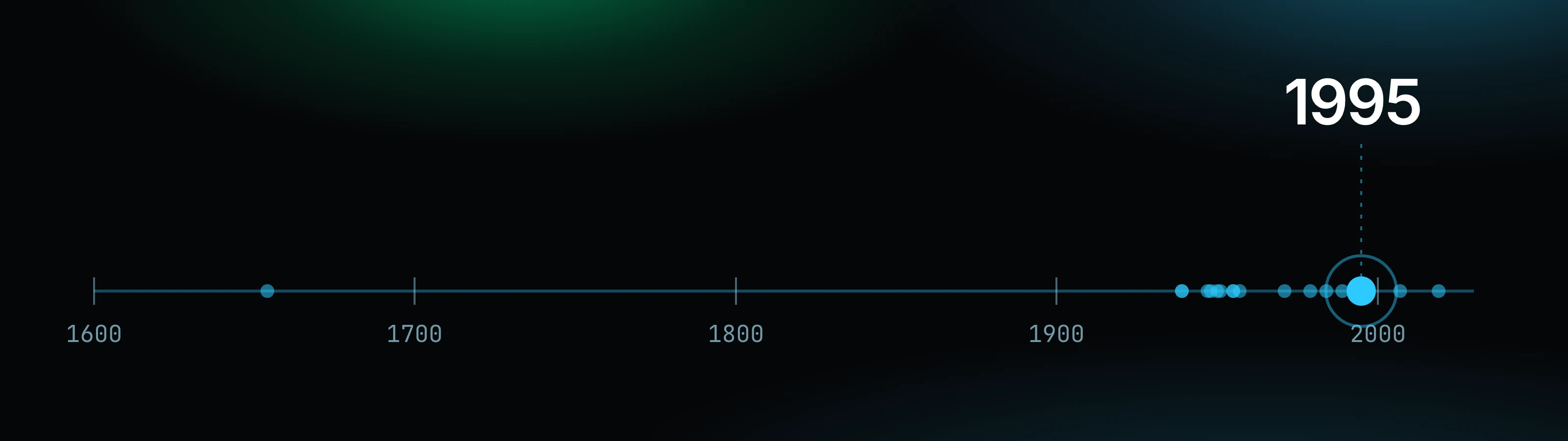
In this history of decision intelligence we’ve seen a remarkable progression: from Kantorovich’s linear programming and Dantzig’s simplex method, through von Neumann’s duality, Nash’s game theory, Khachiyan’s polynomial-time proof and Karmarkar’s practical breakthrough, to the interior-point methods that grew out of it. Each advance widened the range of problems that could be solved exactly. Yet by the 1990s, decision-makers faced challenges that optimization alone couldn’t address: how do you optimize when you don’t know the parameters? How do you decide when the environment itself keeps changing? How do you handle patterns in data too complex to write down by hand?
The answer came through one of the most important convergences in computing: the marriage of optimization with machine learning. It didn’t simply add machine learning to existing decision methods. It changed how decision intelligence works, producing systems that learn from data, adapt to changing conditions and choose actions in ways earlier decision theorists could only imagine.
01The Recognition of Fundamental Limitations
By the early 1990s, practitioners of optimization kept meeting the same limit. Interior-point methods had made optimization fast and scalable, but they still needed someone to write down the exact goal, the limits and the numbers. That works for problems with a known, stable structure, and much less well when the situation is changing or poorly understood.
Consider a retail chain deciding how to spread its stock across hundreds of stores. Optimization can solve the allocation efficiently, given demand forecasts, costs and capacities. But what if customers’ tastes are shifting? What if new competitors are opening? What if the economy is changing buying habits in ways no one has modelled?
The problem wasn’t computing power. It was knowledge: how do you optimize a system you don’t fully understand? That question led researchers to combine machine learning, which is good at finding patterns in data, with optimization, which is good at choosing the best action, to build decision systems that adapt.
The convergence wasn’t immediate or obvious. Machine learning and optimization had grown up largely apart, with different mathematics, research communities and uses. Machine learning was about recognising patterns, predicting and drawing conclusions from data; optimization was about finding the best answer to a well-defined problem. Bringing them together changed how both fields saw their purpose.
02The Emergence of Learning-Based Optimization
The first big step was seeing that the two fields were already tied together: many optimization problems could be recast as learning problems, and every learning problem has an optimization problem at its core.
Training a model, whether a neural network, a support vector machine or a decision tree, means solving an optimization problem: finding the settings that make the fewest prediction errors on the training data while still working on new examples. Modern models have millions or billions of such settings, and they are trained mostly with simple gradient steps, an idea that goes back to Robbins and Monro’s stochastic approximation of 1951, scaled up with new tricks.
In the other direction, many classic optimization problems gained from learning. Instead of asking people to supply every number in a problem, learning algorithms could estimate those numbers from data and update them as new information arrived.
That two-way relationship made far more capable decision systems possible. Rather than solving a fixed problem once, organisations could build systems that learned from experience, adapted to change and improved over time.
The mathematical foundations came from researchers working where optimization, statistics and computer science meet. A landmark was the support vector machine of Cortes and Vapnik (1995), which used convex optimization to find the best boundary between classes; others came from the gradient-based training of neural networks, and from statisticians using optimization to improve inference.
03The Corporate Strategy Application: Dynamic Pricing Revolution
To see the power of combining the two, consider dynamic pricing, one of the best-known commercial uses of the convergence.
A large online retailer has to set prices for millions of products while the market moves. Classic price optimization needs demand curves, competitors’ likely responses and customers’ sensitivity to price. In reality those numbers change constantly, with the season, promotions, stock levels and what competitors do.
Combining learning with optimization changes the approach. Instead of writing down every pricing number by hand, a system can:
- Learn demand patterns from past sales, using machine learning
- Predict how competitors respond from what they have done before
- Set prices with optimization that uses those predictions
- Adapt continuously as new data arrives
Online retailers came to change prices far more often than shops ever had, using patterns a person would struggle to spot: how the weather moves demand for some products, how price sensitivity shifts with the time of day, how a promotion in one category changes buying in another. The approach showed how learning and optimization together could solve problems neither could solve alone.
04The Public Sector Applications: Smart City Optimization
The convergence matters just as much for public decisions. Take traffic management, where the complexity of human behaviour meets the need for systematic planning.
Traffic flow can be modelled mathematically, but real traffic depends on countless things that are hard to specify: how drivers behave, accidents, weather, special events, roadworks, and the routes navigation apps send people on.
A city that combines learning with optimization can:
- Learn how traffic actually flows from road sensors, GPS traces and incident reports
- Predict conditions by time of day, weather, events and history
- Set signal timings and suggested routes with optimization
- Keep adjusting as conditions change
The value of such systems is that they adapt: when navigation apps change their routing, when roadworks block a junction, or when an event brings unusual crowds, the learning part notices and the optimization part finds a new plan.
05The Reinforcement Learning Revolution
Perhaps the deepest development came through reinforcement learning: an approach that joins machine learning to the sequential decision-making of Bellman’s dynamic programming.
Reinforcement learning tackles a basic problem: how do you make good decisions when you don’t know the rules of the world you’re acting in? Classic optimization assumes you know how actions lead to outcomes. Reinforcement learning lets an agent learn that relationship from experience while improving its decisions at the same time (Sutton and Barto’s textbook is the standard account).
Its mathematics builds directly on Bellman. The Bellman equation, which describes the best sequence of decisions, becomes a target the learning algorithm tries to approximate by trial and error. Decades of optimization research could be applied to learning, and learning made dynamic programming practical in worlds too complex to solve on paper.
Reinforcement learning has been applied, with mixed success, wherever decisions follow one another under uncertainty: trading, supply chains, the order in which customers are served.
DeepMind’s AlphaGo, which beat the world champion Lee Sedol at Go in March 2016, showed what combining deep learning’s pattern recognition with search descended from dynamic programming could do (Silver et al., 2016). The immediate use was a game, but the techniques carry over to other problems of decisions in sequence under uncertainty.
06The Deep Learning Integration
The rise of deep learning in the 2010s created new ground for the convergence. Deep neural networks turned out to be remarkably good at finding complex patterns in data with many dimensions, but training them meant solving optimization problems with millions or billions of unknowns.
That pressure drove new work on optimization itself: fast variants of stochastic gradient descent that work on huge, noisy, streaming data. The same methods proved useful for business optimization problems with large or noisy data.
The integration ran both ways. Machine learning helped optimization by finding a problem’s structure, predicting its numbers and adapting to change. Optimization made machine learning faster, more reliable and more scalable.
Modern systems routinely combine the two. Supply chain systems use machine learning to forecast demand and spot disruptions, then optimization to choose the response. Portfolio systems use machine learning to estimate how assets behave, then optimization to balance risk and return.
07The Data Revolution: From Model-Driven to Data-Driven
The convergence shifted how organisations approach decisions. Classic optimization was model-driven: analysts built a mathematical model from their understanding of the problem, then optimized within it.
Learning-based decision systems can be data-driven: they learn a problem’s structure from data, find patterns people might miss, and update the model as conditions change. That doesn’t remove the need for human judgment, but it widens what judgment can work with.
In supply chains, for example, the classic approach needed experts to specify how suppliers, demand, capacity and costs relate. Learning-based systems can estimate many of those relationships from transactions, shipping records, stock levels and outside signals such as weather and economic indicators.
The result is planning that adjusts as conditions change, notices emerging patterns sooner and handles more detail than hand-built models could.
08The Personalization Revolution
One of the most visible uses of the convergence is personalization, which reshaped digital shops, media and services.
Classic marketing optimization might choose the best advertisement for a broad group of customers. Learning-based approaches can tailor each person’s experience as it happens, weighing their history, their situation, their likely preferences and the business’s goals at once.
Netflix’s recommendations are a well-known example: machine learning predicts what each viewer might enjoy from what they have watched and rated, and the choice of what to show is itself an optimization, among many titles and limited space on the screen.
With millions of users and thousands of titles, the number of possible ways to personalise is astronomical. Machine learning makes the problem manageable by learning preferences and the character of each item from data; optimization then picks the best suggestions given what has been learned. Personalization has since become something customers expect.
09The Real-Time Decision Revolution
Combining learning and optimization also made real-time decision systems possible: systems that take in large amounts of data and act within moments.
High-frequency trading is an extreme case. Trading programs read market data and news and decide to buy or sell in fractions of a second; learning spots patterns, optimization chooses positions.
Real-time decisions now appear in many fields. Pricing systems adjust to demand, stock and competitors. Advertising platforms place ads as people browse, within each campaign’s budget. Delivery systems reroute vans around traffic and weather.
None of this works without both halves: learning to interpret the flood of data, optimization to choose what to do with it.
10The Autonomous Systems Frontier
The most advanced uses are autonomous systems that make complex decisions with little human oversight. Self-driving vehicles are the most visible example; similar ideas are at work in factories, warehouses and finance.
A self-driving vehicle combines several decision techniques: machine learning to see (recognising objects, predicting what they will do), optimization to plan a path, game-like reasoning about other road users, and learning to cope with new situations.
The difficulties are large. Such a system must decide in ways that are efficient, safe, reliable in all conditions, and explainable enough for someone to be held accountable.
It balances many goals at once: getting there, keeping safe margins, saving energy, a comfortable ride, the rules of the road, and the unexpected. Without learning, that balancing act could not be done.
11The Ethical Dimension: Algorithmic Decision-Making
The convergence has produced powerful decision systems, and it has raised serious ethical questions. When systems decide things that affect people’s lives, such as hiring, lending, criminal justice and healthcare, learned patterns combined with optimized choices can carry forward, or amplify, the biases in the data they learned from.
Classic optimization usually made its values explicit, in its goal and its limits. A learning system can pick up a biased pattern from history without anyone noticing it is there. Put the two together and a system can pursue its goal well while treating some groups unfairly.
Answering that takes both technical and ethical work: methods that weigh fairness alongside accuracy, systems that can explain how a decision was reached, and independent audits for bias and side effects.
That is a turn in decision intelligence towards systems that are not just efficient and effective, but fair, transparent and accountable. Organisations are still learning what that responsibility asks of them.
12The Future Convergence: Quantum and Neuromorphic Computing
Looking ahead, new kinds of computers may extend the convergence. Quantum computers might speed up some optimization and learning problems, though for most practical problems no such speedup has yet been shown. Neuromorphic chips, built to work more like a brain, aim to make learning cheaper in energy.
Both build on the foundations laid by the joining of learning and optimization: quantum optimization algorithms adapt classical ideas to quantum hardware, and neuromorphic systems apply optimization principles to brain-inspired designs.
Both are still largely in research. The last post in this history, on quantum decision theory, looks at what has been shown so far and what has not.
13Conclusion: The Transformation Continues
The convergence of machine learning and optimization that began in the 1990s has changed decision intelligence. What started as two separate fields, optimization for solving well-defined problems and machine learning for finding patterns in data, became one way of building systems that learn and adapt.
Today many systems combine the two: recommendations learn preferences and choose what to show; autonomous vehicles learn to see and plan their routes; financial systems learn from markets and build portfolios.
The change reaches beyond technology into how organisations decide. Instead of relying only on experience and intuition, they can use systems that learn from data, adapt as conditions change and work at scales no person could.
That capability brings responsibility. As decision systems grow more powerful and more autonomous, making sure they serve human values matters more. The future of decision intelligence lies not only in what these systems can do, but in the judgment to use them well.
The road from Kantorovich and Dantzig through von Neumann, Nash and the optimization breakthroughs of the 1980s leads to today’s learning systems. Each step built on the last and opened new possibilities. The convergence of learning and optimization is not an end point, but a foundation for what comes next.
14References
- Cortes, C., & Vapnik, V. (1995). Support-vector networks. Machine Learning, 20, 273–297.
- Vapnik, V. N. (1995). The nature of statistical learning theory. Springer.
- Silver, D., et al. (2016). Mastering the game of Go with deep neural networks and tree search. Nature, 529, 484–489.
- Sutton, R. S., & Barto, A. G. (2018). Reinforcement learning: An introduction (2nd ed.). MIT Press.
- Goodfellow, I., Bengio, Y., & Courville, A. (2016). Deep learning. MIT Press.
- Boyd, S., & Vandenberghe, L. (2004). Convex optimization. Cambridge University Press.
- Russell, S., & Norvig, P. (2020). Artificial intelligence: A modern approach. Pearson.
- Hastie, T., Tibshirani, R., & Friedman, J. (2009). The elements of statistical learning. Springer.
First published on blog.othor.ai, 19 Jun 2025; revised 23 Nov 2026.